Equinor plans tieback of Grimsnes discovery to Oseberg platform in North Sea
Key Highlights
- Equinor's Grimsnes prospect confirmed hydrocarbons near Osberg field.
- The estimated size of the discovery is 19-50 MMboe.
- The discovery could be developed as a tieback to the Oseberg Sør platform.
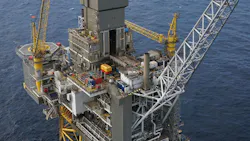
Equinor Energy AS made an oil and gas discovery in the Grimsnes prospect near Oseberg field in the North Sea about 15 km southwest of the Oseberg Sør (South) platform and 145 km west of Bergen in 96 m of water.
Well 30/8-7 S, the fifth exploration well in production license (PL) 190, was drilled by the Deepsea Bergen semi-submersible drilling rig to a vertical depth of 3,752 m subsea. It was terminated in the Drake formation in the Lower Jurassic, the Norwegian Offshore Directorate reported.
The primary exploration target was to prove petroleum in Middle Jurassic reservoir rocks in the Tarbert formation. The secondary target was to prove petroleum in Middle Jurassic rocks in the Ness and Etive formations.
The well encountered a combined oil and gas column totaling 54 m (39-m gas column, 15-m oil column) in the Tarbert formation. The total thickness of the Tarbert formation was 264 m, 111 m of which were sandstone with moderate to good reservoir properties.
In the secondary exploration target in the Ness formation, the well encountered a sandstone layer totaling 289 m with variable reservoir quality from poor to very good. The reservoir was aquiferous with a few potential hydrocarbon-filled zones. In the Etive formation, the well encountered aquiferous sandstones totaling 10 m, with moderate reservoir quality.
The preliminary volume estimate of the discovery is 19-50 MMboe (3-8 million std cu m). Data has been collected and samples have been taken.
The well has been permanently plugged, and the Deepsea Bergen rig will now proceed to Visund Sør field to drill a development well.
Equinor plans to quickly tie the discovery back to existing subsea infrastructure and produce the volumes through the Oseberg Sør platform. Grimsnes will most likely be developed with 2-3 wells in a standard 4-slot template.
The discovery will now be matured rapidly towards an investment decision, and procurement of subsea production equipment is planned early next year, the operator said. As the equipment is standardized, it could be redeployed elsewhere if the project is not sanctioned by the partnership or approved by authorities, Equinor continued.
The potential development is part of Equinor's broader aim to maintain production of 1.3 MMboe/d on the Norwegian continental shelf in 2035. About 70% will come from new wells and developments, the company said.
Equinor is operator at PL 190 (50%) with partners Petoro AS (40%) and TotalEnergies EP Norge AS (10%).