Tamboran flow tests Beetaloo horizontal well
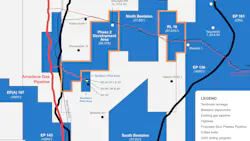
Tamboran (B2) Pty Ltd. flow tested Shenandoah SS2-1H in the Amungee Member B-Shale in the Beetaloo subbasin, Northern Territory, Australia, said partner Falcon Oil & Gas Ltd. in a Apr. 2 release.
The well achieved an average 20-day initial production (IP20) flow rate of 10.3 MMcfd over 2,632-m (8,635-ft) across a 57-stage stimulated length.
The normalized 11.9 MMcfd flow rate over an extrapolated 10,000-ft horizontal section compares favorably to the average performance of more than 11,000 producing wells in the Marcellus Shale dry gas fairway with over 12 months of production history, Falcon Oil & Gas said.
The exit rate trajectory continues a steady, low-declining curve at 8.8 MMcfd (normalized at 10.2 MMcfd/10,000 ft) with a flowing wellhead pressure of about 580 psi. The steady state decline curve on SS2-1H is consistent with that achieved from the Shenandoah SS2-2H ST1.
Testing has been curtailed to avoid unnecessary flaring and carbon emissions and preserve reservoir energy ahead of tie‑into the Sturt Plateau Compression Facility (SPCF) and the beginning of gas sales in third-quarter 2026.
The 2026 stimulation campaign for the Shenandoah South 3H, 4H, and 5H wells is planned to start in this year's second quarter, with all three wells expected to be tied into the SPCF and brought into production during third-quarter 2026.
Beetaloo subbasin is an onshore Proterozoic and Cambrian tight oil and gas basin covering about 8.7 million acres (35,260 sq km) 600 km south of Darwin. It is close to infrastructure including a highway, a pipeline, and a railway and offers transport options to the Australian market and beyond via the existing and developing LNG capacity in Darwin.
About the Author

Alex Procyk
Upstream Editor
Alex Procyk is Upstream Editor at Oil & Gas Journal. He has also served as a principal technical professional at Halliburton and as a completion engineer at ConocoPhillips. He holds a BS in chemistry (1987) from Kent State University and a PhD in chemistry (1992) from Carnegie Mellon University. He is a member of the Society of Petroleum Engineers (SPE).