Cut Waste. Boost Throughput with Intelligent Thermal Control for Gas Compression
Key Highlights
- Prevent over-cooling to reduce freeze-ups, scrubber dumps, and maintenance costs
- Reclaim up to 10% engine power for increased gas compression throughput
- Maintain optimal temperatures across engine, oil, and process gas systems
- Stabilize performance year-round despite changing ambient temperature conditions
- Simple retrofit installation with automated fan speed control and temperature mapping
- Increase throughput up to 20% by keeping valuable gas in-stream


Cut Waste. Boost Throughput with Intelligent Thermal Control for Gas Compression
In oil and gas compression, direct-drive cooling fans have long been a standard feature of gas compression packages. Simple and reliable, they seem like a sensible solution. But their inability to modulate speed based on actual thermal demand creates a cascade of operational headaches: over-cooled process gas, scrubber dumps, hydrate formation, wasted horsepower, and costly downtime. Horton's Gas Thermal Control Clutch is designed to eliminate all of it.
The Problem with Always-On Cooling
Direct-drive fans don't discriminate. Whether it's a blazing July afternoon or a sub-zero night in January, they run at the same speed, moving the same volume of air across the cooling package. That consistency sounds appealing until you consider what it means for the gas you're trying to compress.
Over-cooling is a genuine and costly problem. When process gas temperatures drop too low, hydrate formation becomes a real risk — triggering scrubber dumps and forcing expensive maintenance and downtime. Freeze-ups can take a compressor unit offline entirely, costing operators time and money.
There's also a horsepower argument to be made. Cooling fans are mechanical loads, and on a gas compression package, that load has a direct cost. Fans can consume up to approximately 10% of total engine power — power that could otherwise be redirected to the compressor to move and process more gas efficiently. Horsepower consumed by the fan is horsepower unavailable for compression.
What the Gas Thermal Control Clutch Does
Horton's Gas Thermal Control Clutch is a variable-speed fan clutch engineered specifically for the thermal demands of gas compression. Rather than running the cooling fan at a fixed speed regardless of conditions, the clutch modulates fan speed automatically based on real-time temperature data from three key points: engine jacket water, compressor oil, and process gas.
The result is a cooling system that responds dynamically to what the equipment actually needs. The system maintains engine jacket water and compressor oil within their proper temperature ranges to support reliable performance and long equipment life. It also keeps process gas temperatures in the optimal range by decoupling them from ambient temperature swings, ensuring consistent operation while saving valuable horsepower for compression, even during the hottest months of the year.
Installation and Integration
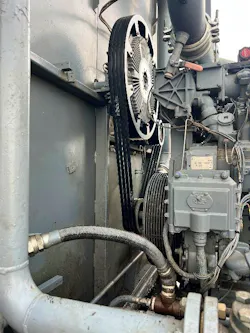
One of the practical strengths of the Gas Thermal Control Clutch is how cleanly it integrates into existing compression packages. The clutch is mounted directly to the engine's fan drive hub, positioned between the engine and the cooling fan. Because it fits the same space claim as the existing driven fan sheave or pulley, field installation is straightforward.
The Gas Thermal Control Clutch controller installs in the unit's control panel and connects to temperature sensors monitoring engine jacket water, compressor oil, and process gas. From there, operators program temperature setpoints and a fan speed map tailored to the unit's operating parameters. Once commissioned, the system operates autonomously — modulating fan speed in response to live thermal data without requiring manual intervention.
Measurable Outcomes in the Field
The operational benefits of the Gas Thermal Control Clutch are tangible. Operators who have made the switch report several consistent improvements:
Fewer freeze-ups and scrubber dumps. By preventing the over-cooling that drives hydrate formation, the clutch eliminates one of the most common causes of unplanned maintenance events and unscheduled shutdowns.
Higher throughput. When heavy gases stay in the stream, BTU content stays elevated. Operators have reported throughput improvements of up to 20% — a substantial gain that flows directly to production.
Improved efficiency. With fan speed matched to actual demand, the horsepower that once powered an oversized fan is redirected to the compressor. This either increases compression capacity or reduces fuel consumption — either way, the unit does more with the same engine.
Year-round operational stability. Automated temperature maps maintain consistent process conditions regardless of seasonal changes in ambient temperature. Operators don't need to intervene when weather shifts as the system adjusts on its own.
The Bigger Picture
Gas compression is a demanding application. Equipment runs continuously in conditions ranging from extreme cold to intense summer heat. Every inefficiency carries a cost, and every unplanned shutdown carries a bigger one.
Replacing a fixed-speed fan drive with Horton's precision-controlled variable-speed clutch isn't a major capital project — it's a targeted upgrade that pays for itself through reduced downtime, better throughput, and recovered horsepower. For operators looking to squeeze more performance and reliability out of existing compression assets, that's a compelling value proposition.