Fluor, Axens secure contracts for US grassroots refinery project
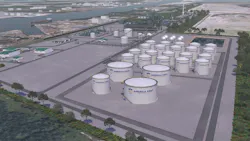
Fluor Corp. and Axens Group have been awarded key contracts for America First Refining’s (AFR) proposed grassroots refinery at the Port of Brownsville, Tex., advancing development of what would be the first new US refinery to be built in more than 50 years.
Fluor will execute front-end engineering and design (FEED) for the project, while Axens will serve as technology licensor of core refining process technologies to be used at the site, the service providers said in separate Apr. 7 releases.
The AFR refinery is designed to process more than 60 million bbl/year—or about 164,400 b/d—of US light shale crude into transportation fuels, including gasoline, diesel, and jet fuel.
Contract details
Without disclosing a specific value of its contract, Fluor said the scope of its FEED study will cover early-stage engineering and design required to define project execution, cost, and schedule based on a complex that will incorporate commercially proven technologies to improve efficiency and emissions performance while processing domestic shale crude.
As technology licensor, Axens said it will deliver process technologies for key refining units at the site, including those for:
- Naphtha, diesel hydrotreating.
- Continuous catalytic reforming.
- Isomerization.
Alongside supporting improved fuel-quality specifications, the unspecified technologies to be supplied for the refinery will also help to reduce overall energy consumption at the site.
Axens—which confirmed its involvement since 2017 in working with AFR on early-stage development of the project—said this latest licensing agreement will also cover engineering support, equipment, catalysts, and services across the refinery’s process configuration.
Project background, commercial framework
Upon first announcing the project in March 2026, AFR said the proposed development came alongside an already signed 20-year offtake agreement with a global integrated oil company covering 1.2 billion bbl of US light shale crude, as well as capital investment to support construction.
As part of the agreement, AFR—which described the transaction as representing about $125 billion in crude supply and $175 billion in refined product value—has committed to producing an estimated 50 billion gal of refined products over the contract period.
The operator also reported receiving a nine-figure equity investment at a 10-figure valuation from the same counterparty, which US President Donald Trump separately identified as Reliance Industries Ltd., India’s largest privately held energy company.
AFR plans to begin construction on the project during second-quarter 2026, the company said.
Refinery design, feedstock
Designed to process 100% US light shale oil with gravity of about 47° API, AFR’s proposed refinery configuration reflects ongoing shifts in US crude supply, which has increased availability of light tight oil relative to heavier imported grades.
In addition to bolstering US domestic crude processing capacity aligned with current production profiles, the refinery’s proposed location at the Port of Brownsville will provide access to deepwater export infrastructure and domestic distribution networks.
According to AFR, the planned refinery aims to:
- Supply refined products to both US domestic and global export markets.
- Improve utilization of US crude production.
- Reduce US reliance on imported feedstocks.
The company also said the grassroots refinery will be supported by modern process design and technology integration to enable production of fuels with lower emissions intensity compared with existing US refining sites.
If completed as planned, the project would mark the first addition of a new US refinery in decades for a sector that has historically experienced limited new-build activity due to high capital costs, regulatory complexity, and evolving market dynamics.
About the Author
 Robert Brelsford
Robert Brelsford
Downstream Editor
Robert Brelsford joined Oil & Gas Journal in October 2013 as downstream technology editor after 8 years as a crude oil price and news reporter on spot crude transactions at the US Gulf Coast, West Coast, Canadian, and Latin American markets. He holds a BA (2000) in English from Rice University and an MS (2003) in education and social policy from Northwestern University.