MOL wraps repairs on major unit at Hungarian refinery
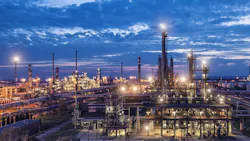
Hungary’s MOL Group has completed repairs to a main crude processing unit that suffered major damage resulting from a late-2025 fire at its 8.1-million tonnes/year (163,000-b/cd) refinery along the Danube River in Százhalombatta, near Budapest.
Repair-related construction works amounting to 18 billion forints (Hun.; US$57.1 million) were completed as of Sept. 22 on the refinery’s atmospheric-vacuum distillation (AV-3) unit, paving the way for the unit’s gradual restart once construction equipment is removed, MOL said in a release.
Completed according to schedule, the year-long comprehensive repair project entailed the demolition and rebuilding of the unit’s reinforced concrete structure, as well as restoration works on all unit equipment impacted by the fire, including related control and electrical systems, the operator said.
Alongside mechanical repairs, the project also included:
- Installation of 27 new, high-capacity pumps.
- Replacement of 8 km of piping.
- Installation of 100 km of electrical cables.
With construction activities now wrapped, MOL said the refinery is preparing for the unit’s gradual restart following a series of next steps that will include:
- Flushing of unidentified unit systems.
- Executing pressure tests.
- Performing functional tests of the process control and safety equipment.
- Connecting of all associated auxiliary power supplies.
- Coordinating operation of the repaired AV-3 unit with associated plants of the refinery.
Once all preliminary restart activities and complementary operational safety inspections and tests have been completed, crude throughputs will be reintroduced into the unit for phased restart of production activities beginning in October, MOL said.
Requisite repairs to AV-3 follow a fire that broke out in the unit on Oct. 20, 2025, which led to a temporary shutdown of the refinery and a 50% drop in crude distillation capacity at the site following the incident, according to the operator’s 2025 annual report to investors.
While plants not affected by the fire were quickly restarted to ensure maximum production of fuel and secondary products, MOL continued to ensure ongoing supplies in the region via synergies with subsidiary Slovnaft AS’ 6.1-million tpy (122,500-b/cd) integrated refining and petrochemical complex in Bratislava, Slovakia, and majority owned INA Industrija Nafte DD’s 4.5-million tpy (90,000-b/cd) Rijeka refinery in Urinj, Kostrena Municipality, near Rijeka, Croatia, as well as product imports from abroad, the company said.
Upon announcing completion of repairs to AV-3, Krisztián Pulay—MOL’s senior vice-president of downstream production and development—stressed the importance of the unit’s upcoming return to service.
“The effects of the war in Iran and the global energy crisis have already spread to our region; everyone is competing for alternative sources, which increases the value of every reliable supply route and European refining capacity,” Pulay said.
“Recent months have also shown that we can put our fuel supply on a solid footing through our own production, diversified procurement, and import options. With the return of AV3, we are regaining an important capacity: the Danube refinery will become stronger and more flexible, giving MOL greater leeway in meeting domestic and regional demand,” Pulay said.
About the Author
 Robert Brelsford
Robert Brelsford
Downstream Editor
Robert Brelsford joined Oil & Gas Journal in October 2013 as downstream technology editor after 8 years as a crude oil price and news reporter on spot crude transactions at the US Gulf Coast, West Coast, Canadian, and Latin American markets. He holds a BA (2000) in English from Rice University and an MS (2003) in education and social policy from Northwestern University.