XCF starts Reno renewable fuels production, advances Australian project
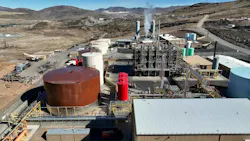
XCF Global Inc. has moved from the commissioning phase to official production of renewable fuels at its New Rise Reno renewable fuels plant in McCarran, Nev., while also advancing its broader international renewable fuels roadmap via a recently signed separate agreement to advance the New Rise ANZ renewable fuels platform in Australia.
In early August, the operator said its New Rise Renewables Reno plant resumed renewable diesel operations following a series of planned upgrades to improve operational performance and enable steady production of renewable fuels in the wake of the refinery’s initial commissioning in July.
Upgrades included updating process conditions and lowering the temperature of operating parameters to improve operational performance and potentially help establish a foundation for further plant optimization as the plant ramps up production, according to the operator.
The Reno renewable fuels plant—XCF’s flagship production asset—is designed with a nameplate production capacity of 38 million gal/year. The operator said the plant’s renewable fuels configuration is intended to support a longer-term transition to sustainable aviation fuel (SAF) production as part of its planned operating strategy.
With renewable fuels production now under way, XCF said New Rise Reno is positioned to begin contributing revenue from renewable fuel sales, marking a shift from commissioning activity to expected revenue generation.
Reno plant overview
Built across a 10-acre parcel, New Rise Reno’s newly constructed infrastructure includes a 16-car heated rail spur, more than 5 million gallons of tankage, as well as installations for power co-generation, off-gas energy recovery, and water recovery, according to the operator.
The plant consists of the following major installations:
- A feedstock pretreatment unit equipped with licensed technology from Alfa Laval Corp. AB.
- A hydrotreater licensed by Axens North America LLC.
- A steam methane reformer licensed by Hydro-chem—a division of Linde PLC—that produces hydrogen for the plant’s hydrotreating operations.
- An amine gas treater licensed by Kinder Morgan Inc. for removal of contaminant gases—including hydrogen sulfide (H2S) and carbon dioxide (CO2)—from the plant’s hydrotreater process stream.
- A anaerobic wastewater treating unit from Evoqua Water Technologies, now a part of Xylem Inc.
Also equipped to produce 3,000 b/d of synthetic blending component for future production of SAF, the Reno plant currently produces fuels from renewable triglyceride feedstocks, including corn oil, soybean oil, and other qualifying biogenic oils meeting the federal US Renewable Fuels Standard (RFS), XCF said.
Proposed Australian renewable fuels plant
In a separate update dated July 23, XCF said it entered into a joint commercialization and development (JCD) agreement with Continual Renewable Ventures Pty. Ltd. (CRV) to advance New Rise Australia Pty. Ltd.’s planned New Rise ANZ renewable fuels platform (RFP) in Australia.
Under the agreement, the parties plan to move the New Rise ANZ initiative from early-stage development toward a more structured commercialization framework, encompassing co-development, financing, construction, and operation of a hydroprocessed esters and fatty acids (HEFA)-based renewable fuels refinery at a yet-to-be-determined location.
XCF said the proposed plant will have production capacity of about 175 million l./year of SAF and renewable diesel, subject to definitive project agreements, financing, regulatory approvals, final investment decision, and customary conditions.
The operator said the platform is designed to be an integrated renewable fuels ecosystem extending beyond the refinery itself, the scope of which would include feedstock development, logistics, storage, distribution, and modular-blending infrastructure intended to support phased market entry while reducing the capital required for conventional fuel storage and blending systems.
XCF said the New Rise ANZ platform could also enable potential future expansion across Australia, New Zealand, and other select markets in the Asia Pacific.
Under terms of the JCD agreement, XCF said it may receive up to a 10% equity interest in New Rise Australia through milestone-based technical, development, and project support, with CRV to retain majority ownership and control of the project entity.
The platform’s modular-based design includes use of CRV’s modular blending unit (MBU) technology, which XCF said is intended to reduce capex associated with conventional blending infrastructure.
A timeframe for final investment decision on the Australian project has yet to be revealed.
About the Author
 Robert Brelsford
Robert Brelsford
Downstream Editor
Robert Brelsford joined Oil & Gas Journal in October 2013 as downstream technology editor after 8 years as a crude oil price and news reporter on spot crude transactions at the US Gulf Coast, West Coast, Canadian, and Latin American markets. He holds a BA (2000) in English from Rice University and an MS (2003) in education and social policy from Northwestern University.