Orlen launches transshipment hub at Gdańsk refinery
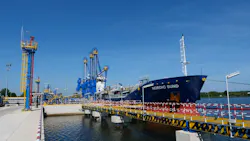
Orlen SA has opened a marine transshipment terminal aimed at streamlining direct transfer of blendstocks and finished products between tankers and the 10.5-million tpy refining complex in Gdańsk, Poland, operated by Rafineria Gdańska sp. z o.o., a joint venture of Orlen (70%) and Saudi Aramco (30%).
Located on the Martwa Wisła River that runs along the refinery’s northern border, the new petroleum products-handling terminal supports transshipment of refinery streams without the need for intermediate transportation routes, specifically reducing reliance on road and rail haulage, as well as external port infrastructure in Gdańsk and Gdynia, Orlen said.
Designed to receive and store more than 1.8 million tpy of product, the terminal had already received its first vessels as of early August, which included deliveries of fatty acid methyl esters (FAME) offloaded to the refinery for its the biofuel production, alongside loadings of marine gas oil (MGO) delivered to the terminal from the Gdańsk complex.
Started for construction in 2022, Orlen said the terminal also strengthens fuel-logistics security and efficiency in Poland by shortening the supply chain and improving the Gdańsk complex’s operational flexibility.
During the terminal’s first year of operation, Orlen said it anticipates the new marine hub will handle 100 vessels and product throughputs averaging about 500,000 tpy, with throughput volumes ramping up to hub’s design capacity of 1.8-2.0 million tpy thereafter.
Terminal configuration, capabilities
The terminal features a 380-m quay with two identical berths capable of simultaneously handling two tankers up to 10,000 dwt each, with maximum vessel dimensions of 130 m in length, 17.6 m in beam, and 5.8 m of draught, according to Orlen.
For transfer operations, each berth is equipped with four automated, bidirectional marine-loading arms rated at 10 bara at a transfer capacity of up to 500 cu m/hr.
Orlen said the terminal’s export capabilities support handling the refinery’s output of Group I and Group II base oils, low-sulfur marine gas oil, and xylene.
On the import side, the terminal is designed to receive various feedstocks and blendstocks for the refinery, including FAME and used cooking oil methyl ester (UCOME) for biofuel production; ethanol as a gasoline-blending component; and methyl tertiary butyl ether (MTBE) and ethyl tertiary butyl ether (ETBE) as gasoline octane additives.
Built largely by Poland-based contractors, the new marine transshipment terminal was completed at an overall cost of about 500 million zloty ($134.2 million), Orlen said.