INEOS plans 2027 startup of Antwerp grassroots ethane cracker
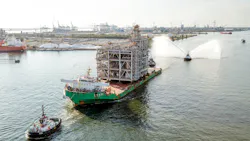
INEOS AG has received the first of two final and long-delayed shipments of major modular equipment required to advance mechanical completion of subsidiary INEOS Olefins Belgium NV’s grassroots €5-billion Project ONE ethane cracker project in Lillo, at the Port of Antwerp, Belgium.
Built in and shipping from Abu Dhabi to the project site, the critical modules for the cracker were on separate ships to Antwerp when blockades caused by the war in Iran disrupted marine transport routes, leaving both shipments trapped at the Strait of Hormuz for months, INEOS said.
While INEOS did not reveal details regarding a specific length of the delay, the operator confirmed the two ships carrying the cracker modules were able to safely pass through Hormuz during a 1-week ceasefire in mid-June before completing their 6-week-long journey via the Suez Canal to reach Antwerp’s port in late July.
Weighing 6,920 tonnes and standing 55-m high, INEOS said the first of the two steel modular structures arriving at Antwerp on July 28 was to be followed by the second 7,200-tonne module within “the coming days.”
Following removal of steel structures in place to protect the cracker modules during the overseas trip, the modules will be transported to the project site for positioning at the heart of the cracker complex, the company said.
Marking the final major construction milestone for Project ONE, arrival of the cracker modules at Antwerp follows completed delivery and installation between January-December 2025 of the complex’s cracking furnaces, which are equipped with ultralow nitrogen oxide (NOx) burners and combustion air preheaters to ensure maximum reduction of NOx emissions, as well as maximum energy efficiency.
Equipped to consume fuel with a high-hydrogen content and outfitted with technology to enable switching to 100% hydrogen upon establishment of a reliable and affordable regional hydrogen economy, INEOS said the furnaces will allow the ethane cracker, from its first day of operation, to meet 60% of its heat demand with low-carbon hydrogen instead of natural gas.
Alongside use of low-NOx burners and implementation of selective catalytic reduction (SCR) technology for reducing NOx emissions, using the two Best Available Techniques (BAT) into design of the complex’s six furnaces and two steam generators will ensure a 71% NOx emissions-reduction rate of 71% from these eight combined furnace-steam generator emissions points, according to the company.
Project capacities, startup
Following a July 2023 revocation of its original permitting for Project ONE by the Council for Permit Disputes in Flanders, INEOS in August 2024 submitted a new environmental permit application for Project ONE, include a fully updated environmental impact assessment (EIA) in accordance with European and Flemish regulatory requirements.
According to the revised EIA, Project ONE’s ethane cracker—which will be configured to produce 1.45 million tonnes/year (tpy) of ethylene from 1.91 million tpy of ethane feedstock—will also be able to supply:
- Polymer-grade (99.5% purity) propylene; 230,500 tpy.
- C4 hydrocarbons; 162,000 tpy.
- C5 hydrocarbons; 66,750 tpy.
- Pyrolysis oil; 12,000 tpy.
With the entirety of works at the Project ONE site scheduled for mechanical completion by summer 2027, INEOS said it expects to formally enter the new ethane cracker into operation sometime during second-half 2027.
About the Author
 Robert Brelsford
Robert Brelsford
Downstream Editor
Robert Brelsford joined Oil & Gas Journal in October 2013 as downstream technology editor after 8 years as a crude oil price and news reporter on spot crude transactions at the US Gulf Coast, West Coast, Canadian, and Latin American markets. He holds a BA (2000) in English from Rice University and an MS (2003) in education and social policy from Northwestern University.