Digitalization paying off for Rompetrol’s Petromidia refinery
Key Highlights
- Implementation of Emerson’s DeltaV AgileOps system reduced alarm volumes from more than 2 million/month to less than 50,000/month, improving safety and operational focus.
- Digital process control systems increased refinery capacity utilization in 2025 to 98.1% and reduced technological losses to 0.78%, boosting profitability.
- Ongoing digital initiatives aim to enhance safety, efficiency, and operator skills, ensuring Petromidia remains a leading, technologically advanced refinery.
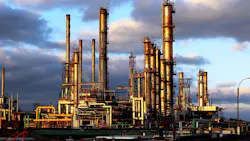
Rompetrol Rafinare SA—jointly owned by Kazakhstan’s state-owned JSC NC KazMunayGas (KMG) subsidiary KMG International NV (54.63%) and Romania’s Ministry of Economy, Energy & Business Environment (44.7%)—is using proprietary operations management software from Emerson Electric Co. to improve alarm performance its more than 5-million tonne/year Petromidia refinery in Năvodari, Romania, on the Black Sea.
To date, implementation of Emerson’s DeltaV AgileOps operations management software has helped reduce distributed control system (DCS) alarm volumes at the Petromidia refinery by more than 95%, the service provider said on July 14.
Emerson said the project improved alarm performance, increased operator effectiveness, and brought alarm rates within the Engineering Equipment and Materials Users Association (EEMUA) 191 guideline recommendations.
Before implementation of DeltaV AgileOps, alarm behavior at the refinery—Romania’s largest—expanded beyond recommended best practices, including high alarm volumes during plant disturbances, nuisance-chattering alarms, and alarms that remained active during normal operation.
To address those issues, Rompetrol Rafinare worked with KMG International’s engineering and maintenance services provider SC Rominserv SRL to improve alarm quality and reduce nuisance alarms across the refinery.
Use of DeltaV AgileOps—which pulls alarm and event data directly from the DeltaV DCS running the plant—provided continuous visibility into alarm performance, including average and peak alarm rates, recurring alarm sequences, and time spent outside recommended operating thresholds, Emerson said.
Following implementation, engineering teams at the refinery used performance dashboards and historical trending to identify high-frequency alarms, stale alarms, and nuisance “bad actor” alarms responsible for disproportionate alarm activity. The teams evaluated alarm behavior during steady-state operation, startup conditions, and process disturbances, then assessed proposed changes to alarm limits, priorities, and suppression strategies against plant data.
Emerson said the project reduced alarm generation to fewer than 50,000 alarms/month from more than 2 million alarms/month during normal operation.
Emerson—which linked the outcome to EEMUA 191 guidance that operators should receive no more than one alarm every 10 min. during steady-state operation—said its deployment of DeltaV AgileOps at Petromidia has improved the refinery’s long-term visibility into control system performance through automated alarm and event reporting, with alarm and event retention expanded to nearly 2 months from a previous 4-5 days, supporting analysis of recurring issues, as well as maintenance and optimization decisions.
“Alarm management plays a critical role in maintaining safe, efficient refinery operations,” said Nilca George, process engineering director at Rompetrol Rafinare. “The continuous alarm performance monitoring and analytics provided by DeltaV AgileOps has significantly reduced operator alarm burden while improving overall operational awareness.”
While modern control systems generate extensive operational information, operators need context and visibility to act. Installation of DeltaV AgileOps at Petromidia enables the refinery’s continuous monitoring and improvement of alarm system performance so the operator can focus on events that matter for safe, efficient operation of the site, according to Guido Wink, Emerson’s vice-president of control systems and software business in Europe.
Additional site digitalization works
In a separate release on July 2, parent company KMG International confirmed works to digitize Petromidia’s operational processes have notably benefited the refinery’s production and financial performance.
During 2025, the site’s advanced process control (APC) digital process control system resulted in operational benefits and substantial cost reductions of more than $2.5 million combined.
Specifically, the APC system has eliminated the need for operators to manually adjust unit parameters (e.g., temperatures, pressures, flows), allowing them now to instead set targeted product qualities for which the APC software automatically calculates optimal unit settings every minute.
As a result, each unit at the refinery operates based on a digital autopilot providing real-time adjustments to key technological parameters that, since implementation, has consistently led to improved yields of high‑value products and enabled units to run at maximum capacity under stable and predictable conditions, KMG International said.
Adjustments made through the predictive control of processes and operational flows alongside routinely scheduled maintenance works at the site help the refinery achieve new operational records in 2025, including maximum production levels for gasoline, diesel, and jet fuel.
Implemented in 2020 across all site installations to identify, in real time, optimal operating points to increase capacities, improve product quality, reduce energy consumption, and limit losses, the APC system contributed to keeping Petromidia’s technological losses in 2025 at just 0.78%, as well as achieving a record-low score of 92.5 on the Solomon Energy Intensity Index (EII).
“The digital component helps us streamline processes, adapt production recipes, and meet our objectives. Alongside the crude oil volumes received, which reached historic levels [in 2025], and the alignment with market demand, the [APC] system was a central element of last year’s performance,” said Sorin Graure, Rompetrol Rafinare’s general manager.
Supported by solid operational reliability and favorable market conditions, the refinery’s utilization rate in 2025 increased to 98.1%, with an average feedstock throughput of over 16,000 tonnes/day.
KMG International said Rompetrol Rafinare continues to implement advanced digital solutions at Petromidia in the operational area and in operator skills development with the objective of ensuring the highest standards of safety, efficiency, and technological performance at the site.
About the Author
 Robert Brelsford
Robert Brelsford
Downstream Editor
Robert Brelsford joined Oil & Gas Journal in October 2013 as downstream technology editor after 8 years as a crude oil price and news reporter on spot crude transactions at the US Gulf Coast, West Coast, Canadian, and Latin American markets. He holds a BA (2000) in English from Rice University and an MS (2003) in education and social policy from Northwestern University.