Repsol’s Puertollano refinery starts up renewable fuels plant
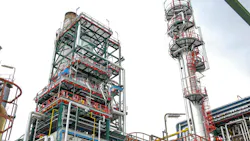
Repsol SA has commissioned the Iberian Peninsula’s second plant dedicated exclusively to 100% commercial-scale production of renewable fuels at the operator’s 150,000-b/d Puertollano refining and petrochemicals industrial complex in Spain’s province of Ciudad Real, Castile-La Mancha.
Now in service, the newly commissioned plant—the operator’s second in Spain—is equipped to produce 200,000 tonnes/year (tpy) of renewable diesel as part of the company’s broader commitment to advancing transformation of its business to generating essential products with a smaller carbon footprint in line with the circular economy, Repsol said on May 26.
Completed at an overall investment of €130 million ($151.2 million), the renewable fuels plant project—which involved the Iberian Peninsula’s first-ever conversion of a conventional refining unit to processing used cooking oil and other agri-food waste for bio-based fuels production—entailed installation of new reactors designed for renewables service, as well as adaptation and integration of existing auxiliary equipment and logistics infrastructure, the operator said.
In addition to supporting domestic employment and strengthening of Spain’s energy independence, startup of renewable diesel production at Puertollano aligns with Repsol’s goal of competitively meeting the needs of society in a lower-carbon future, according to Antonio Lorenzo, director of the Puertollano complex.
“The start of production at this plant represents another step in Repsol's commitment to liquid fuels of renewable origin, as well as in the transformation of our complex, with the aim of consolidating itself as a leading industrial center in the circular economy and renewable fuels,” Lorenzo said.
Repsol previously began producing 250,000 tpy of renewable diesel and sustainable aviation fuel (SAF) in 2024 from a new plant commissioned in 2024 at its 220,000-b/d Cartagena refining complex in the Spain’s southeastern province of Murcia, along the Mediterranean Sea.
Puertollano’s production of renewable diesel—available for immediate use in cars, trucks, and ships without requiring any modifications to existing refueling infrastructure—is slated to prevent about 700,000 tpy of carbon dioxide (CO2) emissions across the product’s entire lifecycle compared to the conventional fossil-based fuels, according to Repsol.
The Puertollano complex already produces biojet fuel, or SAF, for distribution to major airlines as part of Repsol’s goal of contributing to decarbonization of key sectors such as air transportation, the operator confirmed.
Future phase
As part of an additional €16-million investment in a future leg of the project, Puertollano’s renewable fuels plant also will begin using renewable hydrogen to further reduce the CO2 footprint of its renewable diesel production by up to 98% compared to traditional-based fuels, the company said.
Repsol said it will produce renewable hydrogen on site at the industrial complex by replacing its current use of natural gas-derived conventional hydrogen with a biogas produced from waste.
A timeframe for the renewable-hydrogen leg of the project was not immediately revealed.
Puertollano petrochemical project
As part of its overall investment of nearly €800 million during the past 5 years to increase Puertollano’s competitiveness and open new markets for complex, Repsol said it is nearing completion of a new petrochemical production plant at the site.
Scheduled to become operational in the coming weeks, the new plant is designed to produce ultrahigh molecular-weight polyethylene (UHMWPE)—a so-called superpolymer due to its high-strength properties which are comparable to those of steel—used in production of medical prostheses and defense textiles.
Startup of the new renewable fuels and UHMWPE plants follow Repsol’s previous commissioning of plants at Puertollano geared at the circular economy, including installations for recycling of plastic materials and production of recycled polyol from mattress foams, the company said.
About the Author
 Robert Brelsford
Robert Brelsford
Downstream Editor
Robert Brelsford joined Oil & Gas Journal in October 2013 as downstream technology editor after 8 years as a crude oil price and news reporter on spot crude transactions at the US Gulf Coast, West Coast, Canadian, and Latin American markets. He holds a BA (2000) in English from Rice University and an MS (2003) in education and social policy from Northwestern University.