Phillips 66 steps up Permian gas-processing capabilities
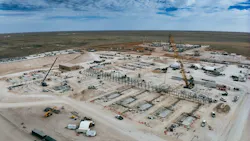
Phillips 66 Co. is executing a coordinated expansion of its Permian midstream platform with start of construction on a grassroots cryogenic natural gas processing plant at the operator’s existing complex in West Texas’ Midland basin.
Included as part of the company’s 2026 $1.1-billion midstream capital budget that allots $700 million for growth projects and $400 million for sustaining projects, the proposed gas plant comes as part of Phillips 66’s broader plan to organically advance its integrated NGL wellhead-to-market strategy by increasing gas processing, pipeline, and fractionation capacity in key basins.
Combined with ongoing integration of the operator’s recently acquired Coastal Bend NGL assets into a long‑haul pipeline and fractionation network, the gas plant is part of the operator’s overall objective to increase NGL recovery from rich Permian gas, provide producers multiple routing options, and link wellhead volumes to US Gulf Coast fractionation, petrochemical demand, and export pathways.
Iron Mesa under way
Approved for final investment decision (FID) in 2025 and now under construction adjacent to Phillips 66’s existing 160-MMcfd gas plant in Goldsmith, Ector County, Tex.—about 15 miles northwest of Odessa—the new Iron Mesa plant is designed with a nameplate cryogenic gas processing capacity of 300 MMcfd (Fig. 1).
Operationally, Iron Mesa is designed to process rich Permian gas—streams with elevated ethane and heavier NGL content—to enable Phillips 66 to increase its capture rates. Products will be routed via its existing pipeline and fractionation platforms.
The plant’s proximity to the existing Goldsmith complex and tie-ins to Phillip 66’s gathering footprint in the region also will support feedstock aggregation from both Midland and Delaware basins and improve flow assurance by allowing multiple delivery options for processed gas and NGLs.
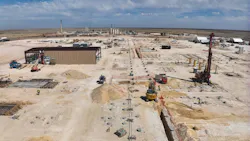
According to corporate disclosures, structural steel and foundation work on the new plant accelerated through early April 2026, with the project logging more than 77,000 safe work hours and the team preparing for a major equipment lift involving installation of a processing tower for component separation (Fig. 2).
The company confirmed in April 2026 the project remains on schedule and on budget, with commissioning slated for first‑quarter 2027.
Consolidated Permian footprint
A composite of acquired assets, fresh capacity additions, and existing downstream links, Phillips 66 said its Permian plan supports the company’s larger ambition of shaping a wellhead-to-market NGL value chain.
In addition to the Iron Mesa plant, key components relevant to the operator’s Permian buildout include:
- Dos Picos complex (Midland County, Tex.): Two 220-MMcfd gas processing plants with combined capacity of 440 MMcfd following startup of Dos Picos II—which added advanced ethane‑extraction capability to the site—in 2025.
- Goldsmith complex (Ector County): Existing 160-MMcfd plant with planned upgrades tied to Iron Mesa construction; portions of the older plant are slated for retirement as the new Iron Mesa plant and upgrades optimize performance.
- Coastal Bend (formerly EPIC NGL): Integrated pipeline and fractionation assets including roughly 885 miles of NGL pipeline with an initial capacity of about 175,000 b/d. The Coastal Bend integration specifically involves two fractionators near Corpus Christi, Tex., totaling 170,000 b/d, and about 350 miles of purity product distribution pipeline. Alongside a previous segment expansion increasing throughput on this distribution network to 225,000 b/d, a sanctioned second expansion to 350,000 b/d is targeted for completion in fourth‑quarter 2026. Also under consideration for FID is an additional 100,000‑b/d fractionator in Corpus Christi that, if approved in 2026, would reach startup sometime in 2028.
Capturing optionality, margin stack
Phillips 66 said its Permian investment program intends to provide the operator a way to capture richer molecules at source for flexible placement into downstream markets where NGLs and separated purities can command differentiated pricing.
According to the operator, the value proposition rests on three interlinking mechanics:
- Increased NGL recovery: Additional cryogenic capacity raises total ethane and heavier NGL capture, which is material when ethane pricing and petrochemical demand provide favorable spreads relative to NGLs left in residue gas.
- Molecule optionality: Long‑haul pipelines and fractionation scale allow the company to route Y‑grade and separated purities—ethane, propane, butanes—toward US Gulf Coast fractionators, the Sweeny Hub, domestic petrochemical plants, or export corridors. Multiple delivery routes reduce exposure to localized bottlenecks.
- Margin capture across the chain: Owning processing, long‑haul transport, and fractionation capacity increases the potential to capture value both at the wellhead (processing fees, retained NGL volumes) and downstream (fractionation margins, market placement). The integrated model turns commodity flows into optional decision points that can be optimized for netbacks.
While system optionality can reduce takeaway risk and improve netbacks for producers by offering alternate sales points when local constraints tighten, for Phillips 66, the ability to move molecules to higher‑value end markets influences returns on midstream capital and the timing of incremental capacity additions. Execution, capital discipline, and relative NGL spreads will ultimately determine near‑term cash flow outcomes, the company said.
Investment justification
Centered on adding incremental cryogenic processing capacity, enlarging long-haul pipeline throughput, and expanding fractionation scale, Phillips 66’s strategy of shaping a wellhead-to-NGL value chain complements the operator’s ongoing investment in Permian operations as the region remains the largest US oil and associated-gas growth engine.
With continued production of substantial associated Permian gas volumes as regional oil‑directed drilling continues, pressure remains on regional takeaway infrastructure, sustaining demand for additional processing, and midstream capacity.
Several market realities have underpinned Phillips 66’s investment case:
- Permian crude-production growth increases associated gas availability, and cryogenic plants that extract ethane at the wellhead improve recoveries, in turn creating product flows for coastal fractionators and export markets.
- Fractionation capacity and pipeline throughput on the US Gulf Coast remain pivotal for price realization. When downstream capacity is constrained, ethane yields can be curtailed; conversely, expanded fractionation and export options raise the marginal value of captured ethane and propane.
- The return on midstream growth capital is a function of project execution, term contract coverage (take‑or‑pay or fee structures), and the spread between NGL-purity prices and residue gas. Ownership of both processing and fractionation can mitigate basis risk and enhance margin realization if markets align.
Lessons from Coastal Bend
A pivotal part of the operator’s larger Permian program, Phillips 66 has emphasized the integration of the former EPIC NGL business, rebranded Coastal Bend.
In early February, the company said its strategy allowed alignment of people, systems, assets, and digital systems to be completed ahead of schedule with measurable efficiency gains in process and field‑to‑office workflows.
Cross‑functional integration of human resources, IT, operations, and field services also has been critical to maintaining business continuity during the transition, according to the company.
The Coastal Bend integration also underscores a common midstream execution challenge: converting acquired physical infrastructure into a cohesive operational platform. Aligning supervisory control and data acquisition (SCADA) systems, scheduling and commercial nomination systems, and maintenance and operations practices reduces friction and can lower operating costs and outage risk, the company said.
In a series of regulatory filings and public disclosures, Phillips 66 identified digital alignment and operational discipline front and center as value drivers post‑acquisition.
About the Author
 Robert Brelsford
Robert Brelsford
Downstream Editor
Robert Brelsford joined Oil & Gas Journal in October 2013 as downstream technology editor after 8 years as a crude oil price and news reporter on spot crude transactions at the US Gulf Coast, West Coast, Canadian, and Latin American markets. He holds a BA (2000) in English from Rice University and an MS (2003) in education and social policy from Northwestern University.