Cheniere, Bechtel let equipment and services contracts for Sabine Pass LNG expansion
Why it matters
- The orders to supply liquefaction equipment and fleet-wide gas turbine technology upgrades are aimed at increasing LNG production to help support growing global demand for natural gas in energy and industrial applications.
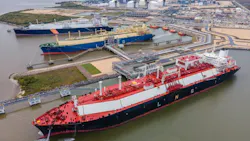
Cheniere Energy Inc. and Bechtel Energy Inc. have let contracts to Baker Hughes Inc. for work to expand the 30-million tonnes/year (tpy) Sabine Pass LNG plant in Cameron Parish, La.
The awards, booked in the second quarter, comprise orders to supply liquefaction equipment for Train 7 and for a boil-off gas re-liquefaction unit, as well as an award for fleet-wide gas turbine technology upgrades, Baker Hughes said.
The work is part of the pre-final investment decision Sabine Pass LNG Expansion project (SPL Expansion) and follows a lump sum, turnkey, engineering, procurement, and construction contract Cheniere subsidiary Sabine Pass Liquefaction Stage V LLC entered into with Bechtel in May. At the time, Cheniere issued a limited notice to proceed early engineering and procurement work for Phase 1 of the expansion. Full construction is expected to begin in early 2027.
The equipment orders for Phase 1 of the Sabine Pass expansion project include seven PGT25+ G4 gas turbines driving 15 centrifugal compressors, enabling about 6 million tpy of additional LNG production capacity.
Baker Hughes also will deliver upgrades across the entire fleet of installed aeroderivative PGT25+ G4 gas turbines at the Sabine Pass plant over a 4-year period.
The upgrades are aimed at increasing the power output of the turbines to enhance LNG production capabilities to help support growing global demand for natural gas in energy and industrial applications.
Sabine Pass LNG
Sabine Pass currently includes six liquefaction trains, LNG storage tanks, three marine berths and supporting infrastructure.
Train 7 will feature an approximate 5-million tpy optimized cascade process (OCP) configuration, along with about 1 million tpy of boil-off gas re-liquefaction, Bechtel detailed on its website, noting the project will incorporate streamlined flare systems with minimal outside battery limits (OSBL) infrastructure and a BASF heater/hot catalyst (HHC) system.