eLNG liquefaction gaining momentum as next-gen development option
Global LNG supply has grown faster than overall natural gas demand in recent years, and it is expected to enter a major expansion phase from now to 2030.1 The International Energy Agency (IEA) estimates global LNG production will increase by more than 7% in 2026, its fastest pace since 2019.2 Other industry forecasts suggest global demand will rise around 60% by 2040, driven by economic growth in Asia, emissions reductions in heavy industry and transport, and the rise of artificial intelligence.3
The difficulty in meeting this scale of LNG infrastructure growth should not be underestimated. India, for example, where demand is expected to increase 60% by 2030,4 requires significant development across the entire value chain, from overseas liquefaction to transportation and domestic regasification and distribution.
eLNG’s role
Electric liquefied natural gas (eLNG) is a process whereby LNG plants use electric motor-driven technology instead of gas turbines to liquefy natural gas, supporting efforts to reduce emissions. Electric power drives the compressors, pumps and refrigeration units that would traditionally be powered by gas turbines.
The IEA estimates emissions from the LNG supply chain at around 350 million tonnes/year (tpy) of carbon dioxide equivalent (Mt CO2e).1 The principal source of these emissions is the energy required to compress and liquefy natural gas at plants. Electrifying existing LNG liquefaction plants could reduce emissions by around 60 Mt CO2e/year, the IEA estimates.
Beyond the carbon savings, eLNG offers considerable efficiency gains. Gas turbines achieve roughly 35% energy efficiency.5 By comparison, large synchronous electric motors can achieve efficiencies of 98.2-98.5%.6 They also require less frequent maintenance. Gas turbines must be serviced roughly once a year, requiring the plant to shut down for an average of 1 week. Electric motors, by contrast, need maintenance every 3-5 years, which can typically be completed within a matter of days, significantly increasing plant availability.
The next phase of capacity additions should be electric-driven and industry adoption is gaining momentum. Equinor ASA’s 4.6-million tpy Hammerfest plant in Norway, completed in 2006, was Europe's first LNG export site and the world's first all-electric LNG plant.7
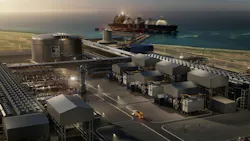
Abu Dhabi National Oil Co.’s (ADNOC) 9.6-million tpy all-electric Ruwais LNG project will be the region's first all-electric LNG plant, deploying electric motors in place of gas turbines across its liquefaction trains (Fig. 1).8
When, where eLNG works
Despite its benefits, electrification of LNG production is not yet suitable for every region or location. There are important factors to evaluate when considering eLNG. Chief among them is where the electricity powering the plant comes from, and if the grid is stable enough to support continuous operations.
If the grid electricity powering the compressor originates from a gas-fired power plant, efficiency losses will occur that would not be as significant as with low-carbon energy sources, such as hydropower, nuclear, solar, or wind.
Less than full grid reliability creates the possibility of voltage interruptions. Fluctuations of as little as 50–150 ms are sufficient to disrupt an LNG train, and once interrupted, operations can take 6-24 hrs to reset, cool down, and return to normal production. This is why operators in some African regions are keen to adopt electrically driven compressors but find it difficult to do so.
To reduce such issues, operators can build their own low-carbon energy infrastructure to support grid stabilization. Newly developed advanced electrical and automation solutions, incorporating undervoltage management and model predictive torque control (MPTC) technology, designed to detect and mitigate voltage drops, can help eLNG plants maintain the same levels of reliability as conventional gas turbine-driven plants. Gassco AS and Equinor have deployed such integrated drive and automation systems at their 156-million cu m/day (5.5-bcfd) Kollsnes gas processing plant in Norway, which handles roughly 45% of Norway’s gas exports.
Digitalization
Electrification of LNG liquefaction is just one element of what is possible when it comes to improving the efficiency, reliability, and operational effectiveness of the next phase of LNG expansion. Automation and digitalization are equally important differentiators and, when combined with electrification, can be viewed as genuine force multipliers.
By integrating electrification with advanced process control, real-time data and machine learning, operators can use data-driven insights to predict faults, optimize operations and reduce energy waste across a range of operational processes. Ideally, this begins at the design phase, during which plans, designs, and simulations can be used to create a digital twin that can inform operations from day one.
Digital twins can provide a bridge between design and operations, ensuring engineering intent is preserved throughout the asset lifecycle. They support better decision-making by enabling teams to test scenarios, predict outcomes and reduce operational risk before changes are implemented in the field. They have also demonstrated proven, tangible benefits for plant reliability through equipment-fault detection and predictive maintenance. Critically, even where a digital twin is not developed from the outset, one can be built effectively once a plant is operational.
Integrating fault detection
When considering electrical distribution systems for LNG trains, fault detection using digital plant models and data-driven insights plays a vital role. If an electrical failure occurs, the entire system will stall. Every hour a train is offline can cost upwards of $100,000 in lost production.
Predictive insights derived from a scalable digital platform that integrates process, electrical, and asset data into a single operational view allows operators to intervene earlier, plan maintenance more effectively and extend asset lifecycles. This is the essence of digital optimization: using digital plant models and data-driven insights to continuously improve production and operations, reduce fault occurrence, and avoid unplanned shutdowns by identifying when equipment requires maintenance before it fails.
The return on investment for operators is well-documented. After introducing its AI-enabled process optimization technology, which autonomously monitors performance of critical equipment, ADNOC reported pilot-phase results indicated the technology could reduce unplanned shutdowns by 50%.9
A growing body of real-world examples further demonstrates the impact of this approach. Shell Australia’s 8.5-million tpy Queensland Curtis LNG plant in Australia uses the IEC 61850 communications protocol as a standard for integrating intelligent electrical devices, enabling substation equipment and process instrumentation to be monitored and controlled remotely. As a result, the plant has substantially reduced the need for human-based maintenance: the system delivers diagnostic data directly to alarm and asset management networks, eliminating the need for engineers to travel across the site to inspect devices or retrieve diagnostic information.
ADNOC has also invested in a microcontroller-based electrical control and monitoring system. Integrated with the company’s AI-driven analytics platform, the solution will provide real-time insights, rapid fault detection and predictive maintenance capabilities, maximizing both operational efficiency and safety.8
Operational optimization
Digital-twin models running continuously in parallel with live operations can be used not only for fault detection and condition monitoring, but also to intelligently and continuously advise operators on how to optimize their plants. This provides augmented operations in which personnel receive real-time guidance to improve efficiency and stability.
The benefits of digitally optimized operations are harder to quantify in straightforward data terms. They tend to be cumulative across the entire plant and do not always fit neatly into conventional return on investment models. Nevertheless, the operational advances are considerable and are rapidly being recognized across the industry.
By integrating intelligent, increasingly AI-powered digital platforms and tools, it becomes possible to detect subtle variations in plant behavior that may indicate equipment is underperforming, depreciating, or operating outside its intended parameters. Such findings require plant managers to adapt their operations to maximize efficiency. A range of optimization tools—from classical methods to AI-based approaches—can continuously support operators in identifying the optimum working point for their facility.
By deploying a cloud-based feedback control solution for monitoring and managing production assets, AS Norske Shell’s Ormen Lange remote subsea natural gas production site offshore Norway has achieved more than 99 percent uptime in most months since its startup in 2007. The company has recorded a 60% annual reduction in days on site, improving safety and reducing operational costs by about $1 million/year.
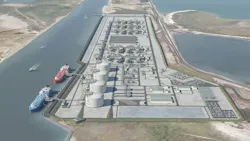
NextDecade Corp.’s Rio Grande LNG project in Brownsville, Tex., is deploying an automation platform designed to support safe, efficient, and reliable operations as it scales towards its full 30-million tpy production capacity (Fig. 2).8
Automation on the horizon
As digital maturity increases, digital twins will increasingly serve as the foundation for AI-driven optimization and the gradual transition from semi-autonomous to fully autonomous operations at LNG plants and terminals.
Across the value chain, automation and AI can improve production planning, inventory visibility and logistics coordination, supporting more resilient and efficient networks. In LNG plants and terminals, where the safety of people, the environment, and assets is paramount, human oversight and clear operational guardrails will remain essential across many processes for the foreseeable future.
The journey towards AI-powered, data-driven operations will be progressive, as systems evolve from an advisory to a supervisory role. As trust is established through consistent and reliable performance over a sustained period, the industry will have the ability to move towards fully autonomous operation. But operators will need to see dependable results before they are comfortable closing the loop and ceding greater control to automated systems.
Every organization and every site is at a different point on this journey, so the question of when to advance towards greater autonomy must be considered in the context of where an operator currently stands. Key factors include the maturity of existing systems, cyber security risk exposure, and the readiness of both people and processes to support a more automated operating environment.
Scaling LNG
Alongside electrification and digitalization, two further factors are critical to scaling LNG infrastructure efficiently: standardization and modularization. It is not necessary to design LNG plants from scratch each time. Instead, by modularizing and standardizing infrastructure, they can be built more quickly and cost-effectively. ABB is working with engineering, procurement, and construction contractors to develop standard packages for electrical systems and electrically driven machinery, reducing both cost and delivery times for projects and thereby improving returns on investment.
As LNG projects become larger and more capital-intensive, modularization is increasingly being adopted to mitigate cost overruns and schedule-delays. The approach involves individual sections being fabricated in a controlled factory environment and assembled on site. It is particularly well-suited to the integration of automation, electrification, and digitalization solutions, as this equipment can be more readily incorporated into prefabricated modules that are transported to site and integrated into the overall project. It also reduces the complexity of on-site construction, which can be a factor in determining terminal and plant locations.
Modularization is no longer a niche option, but a critical enabler of fast, safe, and scalable LNG infrastructure delivery. Rio Grande LNG is an example of this. Its Phase 2 project scope includes prefabricated equipment buildings—two for Train 4 and one for Train 5—housing critical control and electrical systems in modular units to streamline on site installation and commissioning. The solutions being delivered to Bechtel Corp. use a capital project methodology developed by ABB Ltd. that optimizes engineering workflows and reduces delivery timelines. For Rio Grande LNG, this encompasses standardized servers and cabinets, cloud infrastructure, engineering tools and network equipment.
Electrification, digitalization
Where viable, eLNG is emerging as a major focus for LNG operators, driven by the benefits it can deliver in terms of energy efficiency and plant availability. Increasingly, this investment is paired with digitalization and advanced automation. Digital technologies are rapidly becoming a defining feature of the next generation of LNG operations. AI-enabled optimization and predictive maintenance tools are giving operators unprecedented ability to monitor their assets, helping improve reliability, reduce downtime, and optimize production in real time.
The impact extends well beyond fault prediction. Advanced digital systems can continuously analyze data to identify efficiency gains, improve energy performance, and support more stable, resilient operations.
As efforts continue to improve competitiveness while reducing emissions and operational risk, digitalization is increasingly being viewed not as an optional enhancement, but as a strategic lever.
References
- International Energy Agency (IEA), “Assessing emissions from LNG supply and abatement options,” June 19, 2025.
- IEA, Gas Market Report Q1-2026, Executive Summary, Jan. 23, 2026.
- Shell PLC, “Asian economic growth expected to drive 60% rise in LNG demand to 2040,” Feb. 25, 2025.
- IEA, India Gas Market Report: Outlook to 2030, Feb. 12, 2025.
- US Department of Energy, “How Gas Turbine Power Plants Work,” https://www.energy.gov/hgeo/how-gas-turbine-power-plants-work.
- ABB, “ABB motor sets new world record by achieving 99.13% energy efficiency,” May 28, 2025.
- ABB, “The future of LNG: electrification, innovation, and efficiency,” Apr. 14, 2025.
- ABB, “ABB integrated solutions to support ADNOC’s all-electric Ruwais LNG facility,” Nov. 5, 2025.
- ADNOC, “ADNOC Deploys Pioneering AI-Enabled Process Optimization Technology,” Aug. 27, 2024.
The author
Bjarte Pedersen is senior vice president of the Hub India, Middle East, and Africa (IMEA) at ABB Energy Industries. With a career at ABB spanning three decades, Bjarte has been instrumental in driving the company's growth and innovation. He joined ABB in 1992 and has since held various key positions, including local division management, regional business area management, and global product group management. In his current role, Bjarte is responsible for overseeing the IMEA region for ABB Energy Industries. He holds a master’s degree in control systems from the Norwegian University of Science and Technology.