4 FSRUs in 3 months
Key Highlights
- 4 FSRUs in 3 months – Energos delivers the fastest FSRU capacity deployment in global LNG history
- 90% of all LNG cargoes delivered into Egypt so far this year originated from the United States
- 35% of Egypt’s natural gas demand is now supplied via Energos-operated regasification units
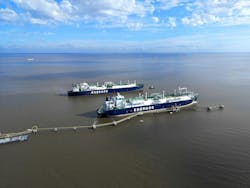
Building Energy Security at Scale: How Egypt and Energos Delivered One of the Fastest FSRU Deployments in Global LNG History
Egypt’s LNG sector has entered a new phase of acceleration—one defined by rapid offshore infrastructure deployment, strengthened international partnerships, and a renewed commitment to energy security. That momentum was the focus of a high-level reception held at the newly opened Grand Egyptian Museum in Cairo, hosted by Energos Infrastructure and the Egyptian Natural Gas Holding Company (EGAS) under the patronage of H.E. Karim Badawi, Minister of Petroleum and Mineral Resources.
More than 100 senior leaders from across the global LNG and offshore industries attended the event, one of the first major energy gatherings at the iconic museum since its public opening.
A National Vision for Energy Resilience
In his keynote remarks, Minister Badawi reaffirmed Egypt’s determination to reinforce its role as a regional energy hub. He emphasized the country’s strategy of building resilient infrastructure and forming strategic partnerships that can support both domestic gas needs and longer-term industrial development.
He highlighted the importance of Egypt’s newly deployed floating storage and regasification units (FSRUs), noting that these assets not only help meet immediate consumption demands but also support Egypt’s broader ambitions in regional energy trade.

U.S.–Egypt LNG Collaboration Reaches New Heights
A central theme of the evening was the exceptional contribution of U.S. LNG to Egypt’s supply balance in 2025. According to data from commodity analytics firm Kpler, 90% of all LNG cargoes delivered into Egypt so far this year—93 out of 103 shipments—originated from the United States.
Energos Infrastructure’s FSRUs have played a pivotal role in regasifying these volumes. Since July alone, the company’s vessels have received 48 cargoes, 44 of which were U.S.-sourced—a continuous inflow that has strengthened national grid stability during periods of peak demand.
H.E. Ambassador Herro Mustafa Garg, United States Ambassador to Egypt, underscored the significance of this cooperation. She praised the public-private partnership between Energos, EGAS, and the Ministry of Petroleum, calling it a model of innovation, reliability, and shared benefit.
Delivering Four FSRUs in Three Months
Energos Infrastructure CEO Arthur Regan highlighted the technical and operational scale of the joint achievements with EGAS. Deploying four FSRUs in a three-month window required precise coordination across global shipping partners, U.S. export terminals, offshore marine operations, Egyptian port authorities, and national grid operators.
The result: approximately 35% of Egypt’s natural gas demand is now supplied via Energos-operated regasification units—a level of offshore LNG capacity rarely achieved so quickly on a national scale.
Regan noted that this outcome demonstrates what can be delivered when partners are aligned: “This is what partnership looks like. This is what delivery looks like for Energos.”
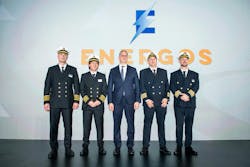
EGAS: Strengthening the Backbone of Egypt’s Gas System
Eng. Mahmoud Abdel Hamid, Executive Managing Director of EGAS, reflected on the years of infrastructure development, network expansion, and operational discipline that enabled this accelerated deployment. He emphasized the value of long-standing cooperation between EGAS and international partners, particularly Energos, in supporting energy security and enhancing regional supply capabilities.
A Case Study in Fast-Track Offshore LNG Deployment
The Egypt–Energos–EGAS collaboration represents a powerful example of what can be achieved through coordinated offshore regasification strategy. As global markets continue to experience supply volatility, the ability to deploy flexible infrastructure—quickly and safely—has become a defining advantage for countries seeking to safeguard energy stability.
For Egypt, this partnership has delivered immediate impact. For the offshore LNG sector, it underscores the essential role of FSRUs in today’s energy landscape.
For more information visit Energos Infrastructure
This content is sponsored by:
