GAO recommends USCG adopt risk-based vessel exam approach
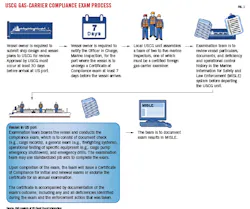
Adapted from United States Government Accountability Office Report to Congressional Committees, “Coast Guard: Assessment of Risk-Based Approach for Conducting Gas Carrier Exams is Needed,” GAO-22-105432, January 2022.
US exports of liquefied gases are expected to continue to increase, which can pose safety and environmental risks in US ports because these commodities are highly combustible. The US Government Accountability Office (GAO) earlier this year recommended the Coast Guard (USCG) assess adopting a risk-based approach to conducting gas carrier compliance exams and take actions as appropriate and feasible. The Department of Homeland Security (DHS) concurred with this recommendation.
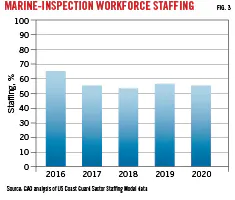
The USCG has a shortage of about 400 marine inspectors, according to its workforce modeling, affecting its ability to conduct gas carrier compliance exams. GAO analysis of the data shows that from 2016 through 2020 the Coast Guard staffed key operational field units that conduct gas carrier exams at less than 70% of estimated need. USCG officials stated that all required exams are completed, but representatives from six of nine industry participants told GAO they had sometimes experienced costly delays because marine inspectors were not available. The Coast Guard has ongoing initiatives to address its marine inspection workforce problems. GAO also made a number of recommendations to strengthen USCG’s workforce planning efforts.
The Coast Guard regularly updates gas carrier exam policies and procedures to reflect industry changes. For example, according to USCG officials, every 4 years it updates the key guidance document for conducting exams. Representatives from all nine gas carrier companies stated marine inspectors are well trained and the exams are thorough.
The Coast Guard has not considered potential gas carrier exam efficiencies in the context of potential risks when assessing its policies and procedures. For example, it has not assessed the benefits and risks of adopting a risk-based inspections approach. GAO analysis of USCG data shows marine inspectors identified a low frequency of instances (250 out of 2,075; 12%) in which more serious deficiencies posed a risk to the cargo, vessel, or crew during gas carrier compliance exams from 2016 through 2020. Coast Guard officials also stated that gas carriers are generally well run. Given the nature of their cargo, however, gas carriers present safety concerns.
USCG previously considered developing legislative changes to reduce the annual exam requirement. It did not, however, conduct a risk assessment for the potential legislative change. Conducting such an assessment and taking actions, as appropriate and feasible, would help ensure that the Coast Guard is efficiently and effectively using its marine inspection resources.
Background
Gas-carrier vessel traffic in US ports has increased from about 1,200 in 2011 to more than 3,200 in 2020. USCG is the principal federal agency responsible for marine safety and is required by statute to conduct gas carrier compliance exams annually.
The National Defense Authorization Act for Fiscal Year 2021 included a provision for GAO to report on gas carrier compliance exam issues. This report addresses:
- Coast Guard marine inspector staffing levels and its ability to meet gas-carrier compliance mission needs.
- The extent to which USCG updates its gas-carrier compliance exam policies and procedures.
- The extent to which the Coast Guard has assessed the efficiency of its policies and procedures in the context of risk.
To address these objectives, GAO reviewed relevant laws and regulations; reviewed Coast Guard workforce planning documents, policies, and procedures; analyzed USCG workforce and exam data from 2016 through 2020; and interviewed agency officials and a nongeneralizable sample of nine industry participants.
Safety incidents involving gas carriers are uncommon but can have dire consequences. In January 2019, two gas carriers caught fire while transferring propane from one vessel to another in waters near the Black Sea. The resulting explosion killed at least 10 crew members, and the fire on one vessel burned for 45 days, according to news reports. In December 2015, a fire started on a gas carrier at the Port of Houston. Emergency response teams quickly doused the flames preventing a catastrophic explosion and potential losses of life, but the incident caused the closure of about 2 miles of the Houston Ship Channel.
A key element of the Coast Guard’s mission is conducting vessel inspections and examinations through the marine inspection program. Federal law requires each gas carrier to undergo a verification exam—called a certificate of compliance exam (compliance exam)—to ensure vessels are in compliance with the appropriate statutory, regulatory, and international requirements. USCG marine inspectors are to conduct these compliance exams at the first US port a gas carrier enters and at least annually thereafter. Industry expects such traffic to continue to grow. There are no US-flagged gas carriers.
Methodology
To address the report’s first objective, GAO analyzed Coast Guard Sector Staffing Model data from 2016 through 2020—the most recent years available—to determine the number of required and actual marine inspectors in the marine inspection program. It also reviewed the tool USCG uses to assess gas carrier examiner training needs.
To assess the reliability of the data, GAO conducted manual data testing for missing data, outliers, and obvious errors; reviewed agency documents, such as a user manual and an accreditation memorandum; and interviewed agency officials responsible for maintaining the data tools. GAO determined the data were sufficiently reliable to:
- Describe the marine inspection workforce needs and staffing levels overall and at locations that conduct the most gas-carrier compliance exams in the aggregate.
- Report the number of certified gas-carrier examiners.
GAO also reviewed Coast Guard strategic plans and various workforce planning documents to understand the plans and activities USCG employed to address its workforce needs and interviewed Coast Guard headquarters and field officials to learn about marine inspection resources dedicated to gas carrier compliance exams. For example, GAO met with both the Liquefied Gas Carrier National Center of Expertise and a nongeneralizable sample of five out of 37 sectors: Corpus Christi, Tex., Delaware Bay, Houston-Galveston, New Orleans, and St. Petersburg, Fla. These sectors had at least 20 marine inspectors and a range of marine inspector staffing levels, are training ports, represent different parts of the country, and conducted a range of gas carrier exams during 2020.
GAO also interviewed representatives from nine industry participants—one international association, six gas-carrier operators, and two site operators—to discuss their perspectives on the Coast Guard’s gas-carrier compliance exam policies and procedures.
To address its second objective, GAO reviewed relevant laws and regulations and USCG policies and procedures relevant to gas-carrier compliance exams. For example, it reviewed the Coast Guard’s Marine Safety Manual and the gas carrier tactics, techniques, and procedures document. GAO interviewed USCG officials and industry representatives to understand how the Coast Guard implements and updates gas carrier compliance exam policies and procedures, including its training material to help inform compliance exam responsibilities. GAO also reviewed the NDAA for fiscal year 2021 to understand the nature of the required study on the efficiency of gas-carrier compliance exam policies and procedures to be conducted by the National Academies in coordination with USCG, which could affect changes to policies and procedures.
To address its third objective, GAO reviewed Coast Guard assessments and plans regarding risk-based marine inspections to understand how USCG considers risk in the marine inspection program. GAO also analyzed Coast Guard Marine Information for Safety and Law Enforcement (MISLE) data for 2016 through 2020—the 5 most recent years available at the time of its review—to determine the number of gas carrier compliance exams completed, where these exams occurred, and deficiencies identified during the compliance exams.
To assess the reliability of these data, GAO conducted electronic testing for missing data, and obvious errors; reviewed related documentation such as the MISLE user guide; and interviewed knowledgeable officials. GAO determined that the data were sufficiently reliable to provide counts of:
- The number of gas carrier compliance exams completed.
- The location of the compliance exams.
- The extent to which USCG marine inspectors identified more serious deficiencies during these exams.
GAO also analyzed the Coast Guard’s November 2020 list of quality ship program (Qualship 21) participants to determine the number and percentage of gas carriers USCG inspected 2016-20 that participate in the program. GAO interviewed Coast Guard officials about their efforts to assess the efficiency of gas carrier compliance exam policies and procedures.
Finally, GAO compared USCG’s efforts to assess its gas carrier compliance exam policies and procedures with the Coast Guard Strategic Plan 2018-22. It conducted this performance audit from October 2020 to January 2022 in accordance with generally accepted government auditing standards.
Compliance exam process
The USCG’s gas carrier compliance exam process includes assembling a team of marine inspectors who:
- Review documentation about the vessel before its arrival, including its history and results of previous Coast Guard inspections.
- Board the vessel to review additional documentation and observe and test such things as ship systems and crew knowledge (e.g., using fire-fighting equipment) to identify any deficiencies.
- Document the results of the exam in the MISLE system.
Fig. 1 provides more detail on the gas-carrier compliance exam process.
Gas carrier compliance exams generally take 4-6 hrs, according to USCG officials. Upon completion of the exam, the Coast Guard issues a certificate of compliance to the vessel. The certificate is valid for 24 months, provided that an annual exam is completed within 90 days of the 1-year anniversary of the certificate’s issue date.
Although gas carrier exams represent < 2% of all Coast Guard vessel inspections, gas carrier compliance exams have increased from about 300 in 2016 to 550 in 2020. Three sectors—Houston-Galveston, Delaware Bay, Corpus Christi, and their respective subunits—conducted 82% of these exams (Fig. 2).
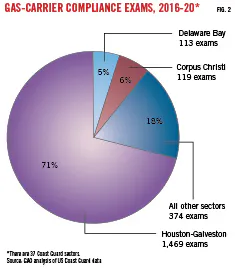
Gas-carrier numbers for Houston-Galveston include Marine Safety Units Port Arthur, Tex., Lake Charles, La., and Texas City, Tex. Additionally, 26% of the compliance exams during this period involved LNG carriers, 72% involved vessels that carry other liquefied hydrocarbon gasses such as propane, and the remainder of the vessels transported ammonia.
The Coast Guard has an overall shortage of about 400 marine inspectors, according to its workforce modeling, affecting the availability of marine inspectors to conduct gas carrier compliance exams and leading to potential delays. Since 2012, USCG has used an analytical tool, called the sector staffing model, to align the number and type of marine inspectors and other personnel needed at specific sectors and subordinate field units with mission activity requirements.
GAO analysis of sector staffing model data shows that the Coast Guard staffed Sectors Houston-Galveston, Delaware Bay, and Corpus Christi— which conduct the majority of gas carrier compliance exams—below 70% of estimated full capacity from 2016 through 2020 (Fig. 3).
Changing context
The USCG has not assessed whether its gas carrier compliance exam policies and procedures reflect the most efficient use of its workforce resources in the context of potential risks. But it previously identified potential efficiencies of adopting a risk-based approach for gas carrier compliance exams and recognized the need to consider potential benefits in the context of potential risks.
For example, in 1991, GAO reported that Coast Guard officials believed they were wasting limited resources because procedures required them to conduct equally detailed examinations of all tankships (which include gas carriers), including those operated by companies with a strong commitment to safety and with programs in place to ensure safe operation.1 Officials said that they would like to devote more resources to “problem” vessels and described an initiative to establish specific criteria that might allow for examination flexibilities.
USCG’s 2017 mission analysis of marine safety found that examination interval requirements are mostly based on fixed schedules and not on updated risk assessments, which hampers the ability to prioritize workloads, reduce maritime risk, and allocate resources efficiently and effectively. According to the 2017 analysis and Coast Guard officials, the USCG could better incorporate vessel risk into inspection decisions.
In 2019, the Coast Guard developed plans to expand use of risk-based inspections to focus marine inspections on higher-risk systems and vessels. For example, USCG has already implemented risk-based inspection programs for certain vessel types, such as foreign and small passenger vessels.
While conducting risk-based gas carrier compliance exams could generate efficiencies, the Coast Guard has also recognized potential consequences of such an approach. Specifically, according to the 2014 Maritime Prevention Performance Plan, conducting risk-based inspections could have negative effects, such as reduced detection of safety and security discrepancies and an uptick in incidents and accidents.
Because of the combustible nature of their contents, gas carriers pose safety and environmental risks, and a safety incident or accident could have dire consequences. Following multiple tanker accidents in the 1970s, Congress enacted measures designed to strengthen vessel safety.
USCG officials who met with GAO described gas carriers as generally well run. They noted that there have been no serious accidents involving gas carriers at US ports, and that lowering the frequency of gas carrier compliance exams would free up resources to focus inspections on riskier vessels.
GAO analysis of Coast Guard data from fiscal years 2016 through 2020 shows that marine inspectors identified low instances of more serious deficiencies that pose a risk to the cargo, vessel, or crew during gas carrier compliance exams: about 12% (250 out of 2,075). These more serious deficiencies included problems identified with firefighting water spray systems, testing and calibration of gas detectors, and electrical systems, according to USCG data.
Further, 29% (238 of 831) of gas carrier vessels the Coast Guard examined during this period participated in its quality ship (Qualship 21) program as of November 2020. This program requires participating ships to be lower risk, having successfully met specified safety, regulatory, and quality requirements. Moreover, cargo ships that participate in the Qualship 21 program are inspected less frequently, while gas carriers, even if considered lower risk through the Qualship 21 program, are still statutorily required to receive an annual compliance exam.
USCG has identified the importance of risk-based planning and mission execution. For example, the Coast Guard Strategic Plan 2018-22 states that innovation requires smart risk taking and that USCG must establish clear risk tolerance levels across the full spectrum of operational and support missions. In the case of gas-carrier compliance exams, establishing risk tolerance could involve assessing the potential workforce efficiencies of reducing the frequency of gas-carrier compliance exams against potential consequences associated with conducting less -frequent gas-carrier compliance exams. The plan also states that the workforce structure must be needs driven and based on operational and support requirements that are objectively determined and continually assessed.
According to the 2014-19 Maritime Prevention Performance Plan, to successfully perform missions in a declining budget environment requires the Coast Guard to identify areas in which it can add efficiencies to current activities. One way this can be accomplished, according to the plan, is through the submission of a legislative change proposal to lower the required inspection frequency, as any changes to frequency would require a change in current law.
Coast Guard headquarters officials stated that one alternative would be to continue to conduct the compliance exam every 2 years but selectively conduct the interim renewal exam based on risk, including the age of the vessel, prior exam history, and participation in the Coast Guard’s Qualship 21 program. But these officials also said USCG has prioritized completion of other legislative change proposals and has not completed an assessment of the benefits and risks of adopting a risk-based approach for conducting gas-carrier compliance exams.
Until the Coast Guard conducts an assessment, it will not have the information it needs to determine whether adopting a risk-based approach or maintaining the current approach to conducting gas carrier compliance exams is appropriate. Conducting such an assessment of the benefits and risks, and taking actions, as appropriate and feasible, would help ensure that the USCG is efficiently and effectively using its marine inspection resources.
References
- GAO, “Coast Guard: Inspection Program Improvements Are Under Way to Help Detect Unsafe Tankers,” GAO/RCED-92-23, Washington, DC, Oct. 8, 1991.