Repeated major incidents at oil and gas plants, refineries, and offshore platforms since 1989 show the petroleum industry still struggles to control process safety. Despite professional, in-depth investigations and accompanying recommendations to prevent similar occurrences, these incidents continue to demonstrate recurring root causes resulting in mounting human and economic costs.
In most cases when an accident occurs, the operator reacts to the emergency, cares for the wounded, pays respect to the fallen, secures the site, begins cleanup and recovery, and initiates an investigation into the incident. For a time, the top priority of the impacted site becomes process and personal safety. But time passes, and when an investigation report into the incident finally emerges (with luck) a year later, operations have already returned to normal and with little to no regard for lessons learned, as attention to production value and profit to please investors has already crept back in to become the priority. This is the cycle the global oil and gas industry collectively must discontinue.
As demand and production pressures rise, operators and regulators must prioritize a consistent, governance‑based approach to process safety management (PSM) on a global level so operations can meet energy needs with reduced risk of recreating past tragedies.
This article examines a selection of both historic and recent high‑fatality incidents at oil and gas operations, synthesizes common causal themes from investigation reports, and proposes a focused set of governance, organizational, and operational actions designed to reduce the likelihood of recurrence as market and production values rebound.
Defining the problem
Simply defined, PSM is managing the safety systems and processes that handle hazardous materials. It involves identifying and assessing potential hazards and ensuring proper safeguards are in place to reduce or eliminate the risk of an accident. In other words, as one long-time refinery worker once explained to the author, PSM means “keeping the oil in the pipe, and making sure everyone gets back home safely.”
While a multitude of serious accidents at oil and gas operations have occurred in recent years, the accompanying table presents a selection of incidents that resulted in higher numbers of injuries and deaths alongside officially reported causes of those events. As the table suggests, these accidents continue to share remarkably similar—and preventable—root causes.
Incident patterns
Analysis of investigation reports and post‑event reviews reveals persistent commonalities:
- Unexpected breaches in hydrocarbon containment.
- Weak or inconsistently applied work‑management and control‑of‑work practices.
- Insufficient process‑safety culture and leadership engagement, particularly during nonroutine operations (startups, shutdowns, unit isolations).
- A cost-cutting-minded approach to plant upkeep, including frequent deferral or scaling back of maintenance alongside less-than-rigorous attention to aging equipment.
- Training and staffing shortfalls, especially loss of experienced personnel.
These factors present consistently across geographic regions and ownership models, indicating system‑level shortcomings rather than isolated operational failures.
A possible economic linkage
A review of historical accident timing against industry value cycles indicates many major, fatal incidents clustered around periods of economic contraction followed by rapid demand recovery.
Fig. 1 illustrates this alarming trend. Many fatal and high-injury accidents in the energy industry have occurred when periods of economic and production downturn are followed by sharp uptakes in refining margins, when the call for increased production output is highest.
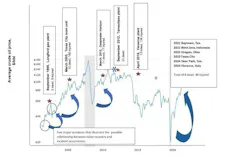
During downturns, companies often reduce staff, defer preventative and predictive maintenance, and scale back training and oversight to cut costs. When prices rebound and production ramps up quickly, the residual effects—gaps in workforce experience, delayed or incomplete maintenance, and rushed or unplanned project execution—create elevated risk, especially during any potentially higher-risk operating modes.
This sequence—drawdown, deferred work, rapid ramp-up to operation—creates a predictable vulnerability. Operators chasing short windows of higher margin may amplify pressure to resume or increase throughput before safety-critical systems and staffing are fully restored.
Behavioral, organizational drivers
Two organizational behaviors repeatedly surface as accelerants of process safety failures: cost-driven normalization and fragmented leadership presence.
Cost‑driven normalization involves treating safety expenditures as discretionary during lean times and as an impediment to profitability during upturns.
Fragmented leadership presence is characterized by reduced senior oversight during night shifts and off‑peak periods, the precise operating windows in which many major incidents occur.
At plants where unions operate, misalignment between management, as well as labor overstaffing and procedures, can further weaken adherence to PSM practices, particularly for cases in which management-union joint expectations and assignments are not clearly established.
12‑point plan to reduce catastrophic risks
As industry continues to encounter swings in profitability, global oil and gas operators must move forward with safety rather than profits as the priority. Both can be achieved..
To break the cycle and fortify operations against the effects of market volatility, industry leaders should adopt a disciplined, governance‑led approach to global PMS. The following 12 actions synthesize lessons from incident reports and established process‑safety practice:
- Implement and measure PSM adoption globally. Adopt an overarching global governance framework characterized by consistent PSM expectations; standardized metrics for implementation and compliance; mandatory, transparent incident reporting; and timely dissemination of lessons learned.
- Strengthen leadership presence and accountability. Ensure senior and technically capable leaders are present and accountable during high‑risk periods (startups, shutdowns, isolations). Leadership must enforce absolute adherence to approved procedures, authorize deviations only with strict controls, and ensure adequate staffing and technical support.
- Protect and rebuild organizational capability. Recognize the operational risk when experienced personnel depart. This requires maintaining staffing levels aligned with safety needs, hiring deliberately, and requiring competency validation before assigning critical roles.
- Eliminate unplanned activity. Treat any deviations from planned work—particularly during nonroutine operations such as startups, shutdowns, or production ramp-ups —as a primary hazard. Pre‑plan, schedule, and execute critical operations with certified procedures, checklists, and sign‑offs. Apply Management of Change (MOC) reviews for any procedure modifications.
- Verify critical safety equipment and instrumentation. Institute routine, documented checks, functional testing, and calibration for all safety‑critical devices, including fire and gas detection, suppression systems, and process alarms. Keep inspection programs current and verified.
- Enforce robust control‑of‑work processes. Standardize and enforce work permits, isolation practices and handover protocols. One operator’s procedural lapse must be prevented from creating multi-organizational catastrophes or permanently altering the lives of plant personnel and their families.
- Hire, train, and supervise to-the-task. Before startups, shutdowns, or production ramp‑ups, confirm personnel competence and place experienced supervision in line positions. Remove or reassign staff who cannot or will not meet safety standards, which requires immediately dismissing personnel that exhibit the inability to adhere to the strictest of those standards.
- Ensure cost-management and profit goals support—not undermine—prioritizing process safety. Embed safety as an enabler of sustained operations rather than a discretionary cost. Both capital and operation and maintenance (O&M) decisions must explicitly account for process‑safety risk and long‑term resilience. This requires fostering a mindset in which process-safety discipline becomes second nature, not just during stable periods but also in times of rapid production shifts. Organizations must genuinely consider how they integrate safety into their profit-driven goals. While economic pressures may tempt decision-makers to cut corners, it is imperative to understand that short-term gains achieved at the expense of safety open the door to potentially catastrophic long-term consequences.
- Align union and management goals around safety. This is a crucial aspect of PMS often ignored or short-changed by industry. Where unions operate, establish joint expectations that place the most capable people in safety‑critical roles, and present a unified message that approved safety procedures are mandatory. Union and plant management must jointly establish the use of approved process safety procedure as a way of life, not a choice. Conflicts between union and corporate leadership are easily detected by personnel and can lead to workers questioning the importance of process safety. Staying on the same page, with common goals and direction, is vital.
- Maintain a strong, grounded PSM system. Sustain rigorous inspection and audit capabilities, sound operating and maintenance procedures, robust maintenance practices, and clearly defined safe-operating limits.
- Accelerate appropriate technology adoption. Invest selectively in automation, advanced monitoring, and AI‑enabled decisionmaking support that reduce human error, improve anomaly detection, and strengthen adherence to safe operating envelopes, all while preserving necessary human oversight for critical interventions.
- Normalize safety‑first decision cycles. Establish, reinforce, and consistently make clear that protecting human life is the operational priority. Institutionalize value cycles that make process safety the default-decision criterion, decoupling everyday operating choices from more-volatile commodity price signals.
Fig. 2 provides a visual representation of the recommended pathway for fostering a resilient PSM system.

Process safety is a cultural outcome driven by ownership and executed by frontline leaders, operators, and maintenance personnel. Culture that privileges safety over short‑term production or profit is self‑reinforcing. Operating sites with high-PSM maturity report fewer upsets and more stable operations. Achieving that state requires continuous top-down accountability, disciplined operational practices, and enforcement of consequences when personnel do not comply with safety standards.
Policy, governance, and industry‑wide measures
Governance and standardization can help close PSM-related gaps and shortfalls across global oil and gas operations.
International industry-led and government-based regulators should work with operators to define minimum PSM expectations, measurement methods, and transparent reporting protocols.
Consistent incident investigation, timely public reporting of findings, and a mandatory mechanism for sharing corrective actions would raise baseline performance and reduce the chance that lessons learned from past incidents remain merely localized and thus unimplemented where they apply or could enhance PSM at similar operations across the globe.
Ensuring responsible PSM
Oil and gas operators face an operational paradox encountered by all industries: market cycles incentivize short‑term cost moves that create long‑term process‑safety vulnerabilities.
A distinct difference, however, is that the very materials involved in petroleum-based operations could at any moment result in catastrophic outcomes to both company personnel and the surrounding community.
Historical incident reviews indicate these vulnerabilities are real and recurring. Addressing them requires disciplined governance, visible leadership during high‑risk operations, regularly improved technical capabilities, and organizational incentives that make safety the default choice regardless of the market environment.
When safety is truly prioritized and integrated into planning, maintenance, and staffing decisions, production and profitability follow with far-lower systemic risk and the preservation of human lives.
The author
Joe Barnes ([email protected]) is the principal at Barnes’ Engineering Consultants, where he specializes in advising oil and gas companies and engineering design groups in plant safety, design, maintenance, and reliability practices. Barnes is a former oil and gas operations and maintenance leader with more than 30 years’ experience, having served in as plant superintendent and manufacturing delivery leader in the refining sector, as well as director of maintenance and reliability in an exploration and production company.