Mideast supply shock further supports Dow’s Path2Zero construction restart
The Mideast war is supporting chemicals producer Dow Inc.’s strategy to focus investments in the Americas, including its January 2026 decision to restart construction of its $7.5 billion (C$10.1 billion) Path2Zero polyethylene and ethylene derivatives expansion and retrofit project in Fort Saskatchewan, Alta., following a 9-month hiatus, company executives said in a first-quarter earnings call Apr. 23.
“Our consistent focus on investing in the Americas gives us reliability, feedstock security, and cost stability at a time when global supply chains are strained,” said Karen Carter, Dow’s chief operating officer and soon-to-be chief executive officer (CEO). Carter is set to become CEO on July 1, 2026.
“We’re making progress on our Alberta project [Path2Zero], where the overarching merits of this investment in the cost-advantaged Americas are further reinforced by the current global dynamics,” said current CEO Jim Fitterling.
Dow’s Path2Zero project lies in Alberta’s Industrial Heartland (AIH), Canada’s only pre-zoned industrial region, in parts of three counties (Lamont, Strathcona, and Sturgeon) and two cities (Fort Saskatchewan and Edmonton).
Dow is targeting late 2029 for startup of Phase 1 of Path2Zero and late 2030 for the second phase, a 2- and 1-year delay compared with the original timeline for the project.
In a recent update, Australian project management firm Worley noted it will provide front-end engineering design (FEED) services under an engineering, procurement, and construction management (EPCM) contract for the cogeneration component of the project’s second phase.
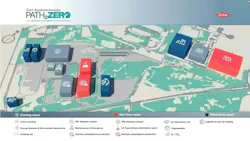
Upon completion of the two phases, Dow’s Fort Saskatchewan petrochemical complex will have capacity to produce about 3.2 million tonnes/year (tpy) of polyethylene and ethylene derivatives, roughly triple its current capacity. Designed to have no Scope 1 or Scope 2 emissions on a net basis, Dow says the plant is on track to become the world's first net-zero emissions integrated ethylene cracker and derivatives plant (Fig. 1).
Dow had already spent about 30% of the total capital budget on its Path2Zero project when the construction pause was announced, with certain milestones achieved, including procurement of heavy equipment and detailed engineering design.
The project is expected to create up to 5,500 jobs during peak construction and some 400-500 full-time jobs once the expanded petrochemical complex is fully operational.
Dow is forecasting returns of 8-10% on the Path2Zero project once it becomes operational, with the delay adding modestly to its capital cost, but this estimate does not include additional value from low-carbon product premiums, according to Fitterling.
“The low-carbon supply agreement that we signed last year is a testament to the value brand owners and consumers place on decarbonized products, and we have more in the queue,” he said during the company’s fourth quarter earnings call in late January, referring to a September 2025 agreement with American multinational consumer goods company Proctor & Gamble (P&G).
Dow suspended construction on the Path2Zero project in April 2025 as part of its effort to reduce that year’s global corporate capital spending by $1 billion due to both a worldwide chemicals glut depressing company revenue and concerns about US tariffs negatively impacting Canadian petrochemical exports to its southern neighbour.
“Dow’s ongoing commitment to the Path2Zero project underscores the Heartland’s strength as a destination for major, globally competitive industrial investment and highlights the region’s role in driving sustainable growth, advanced industrial opportunities, and long-term economic benefits. The two-year timing adjustment [for Phase 1] is expected to align well with global market conditions,” Mark Plamondon, executive director of the Alberta’s Industrial Heartland Association (AIHA), told Oil & Gas Journal.
To help decarbonize Dow’s Fort Saskatchewan petrochemicals plant, Dublin, Ireland-based Linde, a global industrial gases and engineering company, plans to build, own, and operate a more than $2-billion integrated hydrogen and atmospheric gases plant on site.
The complex will use autothermal reforming, combined with Linde’s proprietary HISORP carbon capture technology, to produce blue hydrogen and will also recover hydrogen contained in off-gases from Dow’s ethylene cracker.
Linde has downplayed Dow’s delay to remain firm on its $7 billion in sale-of-gas project pipeline backlog and is continuing to target a 2028 completion date for the hydrogen plant, which also will supply hydrogen to existing and new industrial customers seeking to decarbonize operations.
Two other projects supporting Dow’s Path2Zero project have advanced as scheduled despite the 9-month construction suspension: a natural gas pipeline project by Calgary-based ATCO Ltd. to provide feedgas for Linde’s plant and Dow’s expansion; and expansion of a rail terminal by Brandon, Manitoba-based Cando Rail & Terminals, to help ship additional product from Dow’s Path2Zero project to market.
Yellowhead Pipeline
“The pause in Dow’s Path2Zero project has not impacted the fundamental need for the Yellowhead Pipeline. The project is still a critical infrastructure project needed to support a broad range of customers and industries to help meet Alberta’s energy needs,” Patrick Bain, Director of ATCO’s Yellowhead Pipeline project, told Oil & Gas Journal.
The Alberta Utilities Commission (AUC) approved the 1.1-bcfd pipeline project’s need assessment application, the first of two regulatory filings requiring approval to advance the project, in August 2025, and ATCO submitted its facilities application for the construction and operation of its physical infrastructure in November 2025.
ATCO expects a decision by the commission on its application in August, allowing construction on the Yellowhead Pipeline to begin in this year’s third quarter, and the pipeline to come on stream by fourth-quarter 2027, both as originally scheduled, assuming AUC approval, according to Bain.
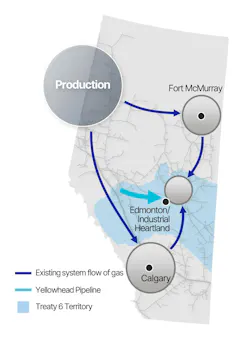
The 230 km high-pressure natural gas pipeline and related control and compression infrastructure from Peers, Alta.—where natural gas and liquids production from Deep basin continues to increase—to Alberta’s Industrial Heartland, is now estimated to cost C$2.9 billion, a $100 million increase from ATCO’s original estimate (Fig. 2).
In its 2025 earnings release on Feb. 26, 2026, ATCO said the Yellowhead Pipeline is now 100% contracted with customers, compared with 90% in August 2025.
Sturgeon terminal expansion
Since Dow’s Path2Zero project was the anchor tenant for its Sturgeon Multi-Purpose Rail Terminal expansion project, Cando was considering a construction delay until the federal government’s Canada Infrastructure Bank (CIB) provided a C$100 million loan in September 2025 to help derisk the rail terminal project and move it forward for the benefit of other customers, said Brian Cornick, president and CEO of Cando.
Construction on the C$200 million rail terminal expansion project started in second-quarter 2025 and is on track for startup in November 2026.
The expansion project will double the size of Cando’s Sturgeon rail terminal, adding up to 2,500 new railcar storage spaces in a storage-in-transit (SIT) yard, and additional car capacity of up to 1,150 spaces on arrival-departure tracks—including the capacity to stage 12,000-ft unit trains—over 320 acres.
The Sturgeon terminal can currently stage and store about 3,600 railcars across 302 acres and was commissioned and became operational at a cost of C$150 million in 2021.
About the Author
Vincent Lauerman
Vincent Lauerman is a freelance writer based in Calgary, Alberta. Over his nearly 4-decade career he has worked as an analyst and journalist focusing on global and North American energy markets and issues, including a stint as New York Bureau Chief for Energy Intelligence.