Obiafu–Obrikom flare-gas utilization unites gas-to-power, NGL recovery

A. Kayode Coker
AKC Technology
Routine flaring of associated petroleum gas remains one of the most persistent environmental and economic problems in global oil production. Despite decades of international initiatives, the World Bank’s Global Gas Flaring Tracker reports little improvement in global flaring intensity over the past 15 years. In 2024 alone, upstream operators released an estimated 389 million tonnes of carbon-dioxide equivalent (CO2eq), roughly the same as the entire annual natural-gas consumption of Africa.
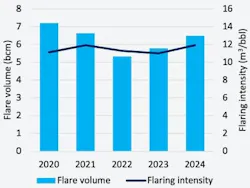
Nigeria exemplifies this issue. The country consistently ranks among the world’s top flaring nations, joining Russia, Iran, Iraq, and the US to account for more than three-quarters of global flared gas. In 2024, Nigerian producers burned off about 6.6 billion cu m (bcm) of associated gas even as electricity shortages left millions of households and industries reliant on expensive diesel generation. Flaring occurs onshore and offshore at wellheads, flow stations, and processing plants whenever operators cannot economically reinject or market the gas separated from crude oil.
The chemistry of the flared gas underscores its lost value. Typical streams contain methane (CH4), ethane (C2H6), propane (C3H8), butanes (C4H10), pentanes (C5H12), and varying concentrations of carbon dioxide (CO2), nitrogen (N2), and hydrogen sulfide (H2S). When combusted in open flare stacks, these hydrocarbons generate CO2, nitrogen oxides (NOx), volatile organic compounds, and particulates that degrade air quality, contribute to acid rain, and exacerbate respiratory disease in surrounding communities.
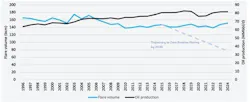
Although flaring is sometimes justified for safety during upsets or maintenance, much of the practice is driven by economics. Gathering pipelines, treatment plants, and market connections are often absent, and constructing them can be uneconomic for small or remote fields. The problem has intensified as international oil companies divest onshore assets and smaller domestic producers, often with limited technical ability by comparison, take control. From 2023 to 2024, Nigerian oil output rose just 3%, while flare volumes increased 12%, pushing the country’s flaring intensity to 12 cu m/barrel of oil, more than double the global average (Figs. 1-2).
The difficulty in monetizing this gas is identifying solutions that match the scale and location of each field. Large export projects such as LNG plants or Fischer–Tropsch gas-to-liquids (GTL) complexes can generate high value but require multibillion-dollar investments and decades of steady feedstock. For Nigeria’s many small and mid-size fields, modular approaches that generate local power or extract high-value liquids often offer a more practical and profitable path.
This article presents a case study of such a solution at Obiafu–Obrikom (OB/OB) field in Rivers State. Capturing roughly half of the site’s routine flare gas and converting it to electricity while recovering condensate and NGLs, the project demonstrates that flare-gas monetization can yield strong financial returns and major environmental benefits.
A Python-based techno-economic model was developed to simulate plant capacity, capital and operating costs, and revenue streams under varying gas-capture fractions and electricity-price scenarios. Results show a payback period of less than 2 years and an internal rate of return exceeding 60%, with avoidance of more than 650,000 tonnes/year (tpy) of CO2.
These findings provide both investors and policy makers with evidence that flare-gas utilization can be commercially attractive while delivering significant climate and health benefits.
Flare-gas utilization
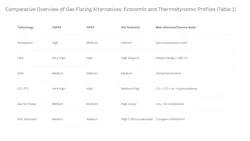
Multiple technologies can convert raw associated gas into marketable products or useful energy, each with distinct technical requirements, economic profiles, and environmental impacts. These include:
- Gas reinjection.
- LNG.
- Compressed natural gas.
- GTL.
- Gas-to-Power.
- NGL recovery.
When evaluated for Nigeria’s Niger Delta, two pathways stand out as the most practical and synergistic: gas-to-power and NGL recovery. Small-scale power generation directly addresses local electricity shortages, while liquid recovery taps a growing domestic market for LPG and condensate. Together they create diversified income streams, reduce flaring emissions, and require capital investments that are achievable for local operators or public-private partnerships (Table 1).
Integrated-process concept
The Obiafu–Obrikom flare-gas utilization project employs a single, modular configuration that unites gas-to-power generation with NGL recovery. Produced well fluids first enter a three-phase separator where oil, condensate, and raw gas are split. The gas stream is then dehydrated and treated to remove carbon dioxide (CO2) and hydrogen sulfide (H2S) before flowing to two parallel processing paths.
In the first path, the methane-rich residue gas is compressed and directed to a simple-cycle gas turbine designed for roughly 130 Mw of continuous output. Waste-heat recovery improves thermal efficiency and provides the option of future conversion to combined-cycle operation if grid conditions permit. In the second path, a portion of the treated gas undergoes cryogenic expansion at about –90 °C. in a turbo-expander, which condenses ethane, propane, and heavier hydrocarbons. Fractionation columns separate the condensed stream into marketable LPG and stabilized condensate.
This dual arrangement extracts the maximum value from a single gas source. Electricity sales create a stable revenue base while the liquids provide an additional income stream and a hedge against fluctuations in power prices. The use of skid-mounted, factory-built modules minimizes on-site construction and eliminates the need for new rights-of-way, an advantage in the environmentally sensitive and logistically difficult region.
Economic evaluation
A Python-based techno-economic model combined material and energy balances with financial analysis to evaluate the project. The model used a 65-MMscfd flare-gas feed with a capture fraction of 50%, a gas-turbine efficiency of 35%, and a capital cost of roughly $1,200kw-hr for the power plant, and included $15 million for gas treatment and compression. Including a 10% contingency, total installed capital requirement is about $229 million. Fixed operating costs were estimated at 4% of capital per year, and variable costs at roughly $1.00/MMbtu of gas processed.
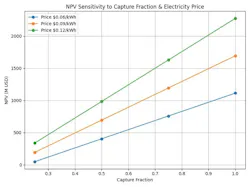
At an electricity tariff of $0.12/kw-hr and prevailing Nigerian market prices for LPG and condensate, annual revenue approaches $164 million, of which electricity sales provide roughly 80%. After operating expenses, net annual cash flow is about $142 million. These figures yield a payback period of roughly 1.6 years, an internal rate of return greater than 60%, and a net present value (NPV) close to $1 billion across a 20-year project life discounted at 10%.
Environmental performance is equally compelling. Capturing and utilizing just half of the flare gas prevents the release of about 650,000 tpy of carbon-dioxide equivalent (CO2eq), a material contribution toward Nigeria’s climate-mitigation goals.
Sensitivity analysis indicates that the project remains robust across a wide range of capture fractions and electricity prices. Increasing either parameter significantly boosts NPV, confirming that incremental investments in gathering or treatment capacity can be justified as market conditions improve (Fig. 3).
Obiafu–Obrikom shows that integrated flare-gas utilization can deliver exceptional financial and environmental returns for Nigeria’s onshore oil fields. By converting only half of the routine flare stream, the project generates diversified revenues from electricity and liquid hydrocarbons, achieves a rapid payback, and avoids hundreds of thousands of tonnes of greenhouse-gas emissions each year. With supportive government policy and strong local demand for power and LPG, similar modular projects can be replicated across the Niger Delta and other flare-intensive regions, transforming what was once an unavoidable liability into a driver of sustainable energy development.
In more detailed terms, benefits of this approach include: payback of about 1.6 years and an internal rate of return exceeding 60%.
Bibliography
Getu, M., Mahadzir, S., Long, N. V. D., and Lee, M., “Techno-economic analysis of potential natural gas liquid (NGL) recovery processes under variations of feed compositions,” Chemical Engineering Research and Design, Vol. 91, No. 7, pp. 1272–1283, July 2013.
IEA, “Global Gas Flaring Tracker Report,” International Energy Agency, 2024.
Ite, A.E., Ibok, U.J., and Ite, M.U., “Petroleum Exploration and Production: Past and Present Environmental Issues in Nigeria’s Niger Delta,” American Journal of Environmental Protection, 2016.
NNPC (Nigerian National Petroleum Corp.), “Nigeria Gas Flare Commercialization Program (NGFCP) – Official Documentation,” September 2022.
OPEC, “Annual Statistical Bulletin: Nigeria Oil & Gas Data,” 2024.
Smart, E. E., Odor, G. E., Owunna, I. B., Lawan, A.B., Otaru, K., Ogunkanmi, S.A., and Owolabi, Y., “Utilization of Flare Gas for Energy Generation as a Sustainable Approach in the Global Oil and Gas Sector,” Iconic Research and Engineering Journals, Vol. 8, No. 9, pp. 653–669, March 2025.
World Bank, “Global Gas Flaring Tracker Report,” July 2025.
Author
A. Kayode Coker is a globally recognized author, engineering consultant, and educator specializing in sustainable hydrocarbon processing, process safety, and digital simulation. With decades of experience in the oil and gas industry, he has authored numerous technical books (14) and articles that bridge engineering rigor with practical application. His work focuses on flare-reduction technologies, integrated energy systems, and Python-based modeling tools for zero-flaring operations. Through mentorship, outreach, and publication, he empowers engineers and educators worldwide to adopt ethical, scalable solutions for energy transition and environmental stewardship. Past roles include engineering coordinator at Saudi Aramco Shell (Jubail) Refinery Co. (SASREF).