Fourth-quarter 2025 earnings show strong refining results
Key Highlights
- US oil and gas net income rose to $20.2 billion in fourth-quarter 2025, driven by refining margins despite lower oil prices.
- Refining cash margins increased significantly across US regions, boosting independent refiners' earnings and operational performance.
- US crude oil production grew to 13.77 million b/d, with natural gas liquids also increasing, supporting higher export volumes.
- US crude and product stocks declined slightly, while strategic petroleum reserves increased, indicating inventory adjustments.
- Canadian firms posted higher net income, supported by record production and strategic asset swaps, despite slight revenue declines.

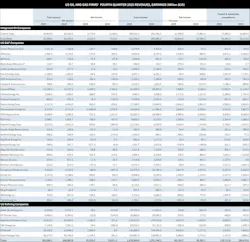
A group of 40 US oil and gas producers and refiners reported combined fourth-quarter 2025 net income of $20.2 billion, up from $16.8 billion in fourth-quarter 2024, even as total revenues edged down to $302.6 billion from $306 billion a year earlier. The year-over-year earnings increase was driven largely by stronger refining performance due to higher refining margins, offsetting the impact of lower oil prices.
Brent crude oil prices averaged $63.63/bbl in fourth-quarter 2025, compared with $74.61/bbl in the previous year's fourth quarter and $68.97/bbl in third-quarter 2025. West Texas Intermediate (WTI) averaged $59.6/bbl in fourth-quarter 2025, compared with $70.69/bbl in fourth-quarter 2024 and $65.74/bbl in third-quarter 2025.
US crude oil production in fourth-quarter 2025 averaged 13.77 million b/d, compared with 13.45 million b/d in fourth-quarter 2024, according to US Energy Information Administration (EIA) data. Natural gas liquids (NGL) production averaged 7.75 million b/d during the quarter, compared with 7.32 million b/d in fourth-quarter 2024.
US commercial crude oil stock at the end of December 2025 was 411 million bbl, compared with 413 million bbl at end-2024 and a 5-year average of 435.0 million bbl. US oil product stock at end-2025 was 874 million bbl, compared with 822 million bbl a year ago and a 5-year average of 814.4 million bbl. US Strategic Petroleum Reserve (SPR) at yearend 2025 was 413 million bbl, compared with 393 million bbl a year ago and a 5-year average of 470.0 million bbl.
For fourth-quarter 2025, US crude refinery inputs were 16.38 million b/d, compared with 16.48 million b/d the same period a year ago and 16.8 million b/d for the previous quarter. Refinery utilization rate was 92.4%, compared to 91.4% in fourth-quarter 2024 and 94.8% in third-quarter 2025.
According to Muse, Stancil & Co., refining cash margins in fourth-quarter 2025 averaged $35.20/bbl for Middle-West refiners, $20.91/bbl for West Coast refiners, $18.32/bbl for Gulf Coast refiners, and $14.29/bbl for East Coast refiners. In the same quarter of the prior year, these refining margins were $13.26/bbl, $9.87/bbl, $8.11/bbl, and $4.12/bbl, respectively.
Henry Hub natural gas spot prices averaged $3.75/MMbtu in fourth-quarter 2025, compared with $2.44/MMbtu a year earlier, while US dry gas production for the quarter grew to 109.737 bcfd from 104.412 bcfd a year earlier, according to EIA.
Natural gas inventory ended the quarter at 3313 bcf, compared with a 5-year average of 3216.4 bcf. US LNG exports averaged 17.37 bcfd in fourth-quarter 2025, an increase of 4.73 bcfd (37.4%) from the previous year's quarter.
A sample of 14 Canadian oil and gas producers and pipeline companies posted aggregate fourth-quarter 2025 net income of $10.4 billion (Canadian dollar), up from $5.2 billion a year earlier, on revenues of $70.5 billion compared with $71.9 billion in fourth-quarter 2024. Alberta’s WCS price dashboard shows the province’s official WCS/WTI series for the period, and the tighter heavy-oil differential remained a support for Canadian upstream realizations compared with prior years.
US oil and gas producers
ExxonMobil reported fourth-quarter 2025 revenue of $82.3 billion, down slightly from $83.4 billion a year earlier, while net income fell to $6.5 billion from $7.6 billion. Cash flow from operations totaled $12.7 billion and free cash flow reached $5.6 billion in the quarter. Exxon returned $9.5 billion to shareholders, including $4.4 billion in dividends and $5.1 billion in share repurchases.
Operationally, the company said full-year upstream production reached its highest level in more than 40 years at 4.7 MMboe/d, with annual records from both the Permian basin at 1.6 MMboe/d and Guyana at more than 700,000 gross b/d. Fourth-quarter net production climbed to 5.0 MMboe/d, including record quarterly output from advantaged assets, with Permian production at 1.8 MMboe/d and Guyana approaching 875,000 gross b/d.
Chevron posted fourth-quarter revenue of $46.9 billion, compared with $52.2 billion in the same period of 2024, while earnings slipped to $2.8 billion from $3.2 billion. Even so, the company highlighted record operating performance. Chevron said worldwide and US net oil-equivalent production reached quarterly and full-year records in 2025, with full-year worldwide production up 12% to 3.7 MMboe/d and US production up 16%. In the quarter, worldwide production rose to a record 4.045 MMboe/d. The company said the Permian basin delivered on its 1 MMboe/d production target, while the Tengiz expansion in Kazakhstan continued ramping up and several Gulf of Mexico deepwater projects contributed to growth.
ConocoPhillips reported fourth-quarter revenue of $14.2 billion, down from $14.7 billion a year earlier, and net income of $1.4 billion, compared with $2.3 billion in fourth-quarter 2024. The company said fourth-quarter production averaged 2.32 MMboe/d, up 137,000 boe/d from a year earlier, with Lower 48 output of 1.44 MMboe/d. That included 673,000 boe/d from the Delaware basin, 194,000 boe/d from the Midland basin, 370,000 boe/d from Eagle Ford, and 198,000 boe/d from Bakken. Full-year production averaged 2.37 MMboe/d, in line with guidance, and underlying total company production grew 2.5% in 2025. The company spent $3.1 billion on capital expenditures and investments in the fourth quarter and $12.6 billion for the full year. It distributed $2.5 billion to shareholders during the quarter, and guided to roughly $12 billion of capital spending in 2026.
Occidental reported fourth-quarter revenue of $5.4 billion, versus $5.7 billion a year earlier, and a net loss attributable to common stockholders of $68 million, compared with a loss of $297 million in fourth-quarter 2024. The company said lower realized commodity prices pressured upstream earning. Still, Occidental’s global production averaged 1.48 MMboe/d, led by strong contributions from the Permian and Rockies. Midstream and marketing pre-tax income rose to $204 million from $81 million in the previous quarter, helped by stronger gas margins, lower transportation costs, and improved sulfur pricing at Al Hosn.
At EOG Resources, fourth-quarter 2025 revenue rose modestly to $5.64 billion from $5.59 billion a year earlier, while net income fell to $701 million from $1.3 billion. Fourth-quarter volumes averaged roughly 1.40 MMboe/d, while full-year production reached 449.8 MMboe. EOG said total proved reserves increased 16% in 2025 to 5.5 billion boe, with extensions and discoveries adding 336 MMboe and net reserve additions excluding price revisions replacing 254% of 2025 production.
US independent refiners
US independent refiners all turned in sharply improved fourth-quarter 2025 downstream results as stronger refining margins, high utilization, and solid operating execution lifted earnings.
Marathon Petroleum reported fourth-quarter revenue of $33.4 billion, essentially unchanged from $33.5 billion a year earlier, while net income rose to $1.5 billion from $371 million. Adjusted EBITDA increased to $3.5 billion from $2.1 billion in fourth-quarter 2024, led by a much stronger Refining & Marketing segment. R&M adjusted EBITDA climbed to $2.0 billion from $559 million a year earlier, reflecting improved crack spreads and strong refinery execution. Segment margin rose to $18.65/bbl from $12.93/bbl, while crude capacity utilization reached 95%, resulting in throughput of 3.0 million b/d. Marathon said refining operating costs increased to $5.70/bbl from $5.26/bbl, reflecting heavier turnaround activity and higher energy costs. The company returned about $1.3 billion to shareholders during the quarter.
Valero Energy posted fourth-quarter revenue of $30.4 billion, down slightly from $30.8 billion in the prior-year period, while net income attributable to stockholders rose to $1.1 billion from $281 million. The improvement was driven primarily by refining, where operating income jumped to $1.7 billion from $437 million a year earlier; adjusted operating income was also $1.7 billion, compared with $441 million in fourth-quarter 2024. Refining throughput averaged 3.1 million b/d, and the company said both fourth-quarter and full-year 2025 refining throughput and ethanol production set records.
Phillips 66 generated fourth-quarter revenue of $36.3 billion, up from $34.0 billion a year earlier, while net income surged to $2.9 billion from just $8 million in fourth-quarter 2024. Operationally, the company delivered one of its strongest downstream quarters of the year. In refining, Phillips 66 reported record clean product yield of 88% and crude capacity utilization of 99%, underscoring strong refinery reliability and product optimization. The company also posted record NGL transportation and fractionation volumes of more than 1 million b/d each, showing the growing contribution from its midstream network.
Canadian firms
All financial figures are presented in Canadian dollars unless noted otherwise.
Canadian Natural Resources reported fourth-quarter 2025 revenue of $9.6 billion, up slightly from $9.5 billion a year earlier, while net income jumped to $5.3 billion from $1.1 billion, drive by a non-cash AOSP asset swap gain. The company returned about $2.7 billion to shareholders during the quarter and $1.2 billion through net-debt reduction. Operationally, Canadian Natural delivered record quarterly production of about 1.66 MMboe/d, up 13% from fourth-quarter 2024, including record liquids output of about 1.22 million b/d. The company also posted record annual production of 1.57 MMboe/d in 2025 and said oil sands mining and upgrading production averaged about 620,000 b/d with upgrader utilization of 105% and operating costs of $21.84/bbl. Its thermal in-situ business averaged 275,086 b/d for the full year, with Pike 1 brought onstream ahead of schedule in December.
Suncor reported fourth-quarter revenue of $12.3 billion, compared with $12.5 billion a year earlier, while net earnings improved to $1.5 billion from $818 million. Adjusted operating earnings were $1.32 billion, down from $1.57 billion in the prior-year quarter, as lower upstream realizations partly offset stronger operational execution. Suncor said total oil sands bitumen production rose to a quarterly record 992,700 b/d from 951,500 b/d a year earlier, driven by strong mining performance and record fourth-quarter output at Fort Hills, which reached 90% of nameplate capacity in 2025. Net synthetic crude oil production also hit a quarterly record 557,000 b/d, supported by improved upgrader availability and strong reliability.
Cenovus reported fourth-quarter revenue of $10.9 billion, down from $12.8 billion in fourth-quarter 2024, while net earnings rose to $934 million from $146 million. The company generated about $2.4 billion in cash from operating activities. Operationally, Cenovus posted record upstream production of 917,900 boe/d and downstream crude throughput of 465,500 b/d, representing overall downstream utilization of 98%. Record quarterly oil sands production reached 726,600 boe/d, including strong performances from Christina Lake, Foster Creek, and Sunrise. Christina Lake production climbed to 308,900 b/d following the MEG acquisition, while Foster Creek rose to 220,100 b/d as volumes from the optimization project ramped up ahead of schedule. Lloydminster thermal output also improved, helped by redevelopment activity and the restart of Rush Lake. Downstream operating margin, however, fell to $149 million from $364 million in the prior quarter because of weaker crack spreads. For full-year 2025, Cenovus averaged 834,200 boe/d of upstream production, including record annual volumes from its oil sands assets.
Imperial Oil posted fourth-quarter revenue of $11.3 billion, down from $12.6 billion a year earlier, while net income fell to $492 million from $1.225 billion. The company said earnings were hurt by lower upstream realizations, though cash flow from operations rose to $1.92 billion from $1.79 billion in the year-earlier quarter. Upstream production averaged 444,000 boe/d, compared with 460,000 boe/d a year earlier, as wet weather early in the quarter affected Kearl. In downstream, refinery throughput averaged 408,000 b/d with 94% capacity utilization, while petroleum product sales increased to 479,000 b/d from 458,000 b/d, supported by stronger supply and retail volumes.

About the Author
 Conglin Xu
Conglin Xu
Managing Editor-Economics
Conglin Xu, Managing Editor-Economics, covers worldwide oil and gas market developments and macroeconomic factors, conducts analytical economic and financial research, generates estimates and forecasts, and compiles production and reserves statistics for Oil & Gas Journal. She joined OGJ in 2012 as Senior Economics Editor.
Xu holds a PhD in International Economics from the University of California at Santa Cruz. She was a Short-term Consultant at the World Bank and Summer Intern at the International Monetary Fund.
 Laura Bell-Hammer
Laura Bell-Hammer
Statistics Editor
Laura Bell-Hammer is the Statistics Editor for Oil & Gas Journal, where she has led the publication’s global data coverage and analytical reporting for more than three decades. She previously served as OGJ’s Survey Editor and had contributed to Oil & Gas Financial Journal before publication ceased in 2017. Before joining OGJ, she developed her industry foundation at Vintage Petroleum in Tulsa. Laura is a graduate of Oklahoma State University with a Bachelor of Science in Business Administration.