Marcellus assessment shows continued expansion

Ray Boswell
National Energy Technology Laboratory
Pittsburgh, Pa.
Susan Pool
West Virginia Geological & Economic Survey
Morgantown, WV
BJ Carney
Northeast Natural Energy LLC
Charleston, WV
A prior article indicated substantial remaining resources in the Marcellus and Utica shales (OGJ, Nov. 1, 2021, pp. 24-29) based on estimated ultimate recoveries (EURs) as reported by Enverus. The study determined ultimate and remaining technically recoverable resources (uTRR and rTRR, respectively) on a bcfge/sq mile basis using multi-well development sites, factoring in well length and spacing, and assuming current technology. The assessment greatly exceeded those provided by public organizations.
This article leverages an additional 50 months of production data to provide an update of the Marcellus assessment and discuss ongoing issues with Utica play assessment. The updated results indicate that the Marcellus shale shows no evidence of declining resource quality or well productivity with continued maturation. The play shows clear evidence of ongoing expansion beyond earlier conceptions of the core area. No Utica update is available currently, however, due to limited drilling in the potentially prolific deep Utica trend and emerging considerations regarding EUR estimation in highly-overpressured reservoirs.
The Marcellus is now estimated at 1,112 tcfge uTRR and 919 tcfge rTRR (previously reported as 873 tcfge and 693 tcfge, respectively). A feature of this new report is the inclusion of rTRR volumes not only as a single best estimate but also as a range of volumes based on alternative resource density thresholds. For example, when excluding all areas in which resource density does not reach 30 bcfge/sq mile, the authors found a best estimate of 455 tcfge rTRR for the Marcellus play. At a cut-off of 50 bcfge/sq mile, the volume is 257 tcfge. The resource-density dependent assessments, therefore, provide a rough proxy for remaining economically recoverable resources (rERR).
Appalachian shale uncertainty
Increasing uncertainty regarding the remaining volume of recoverable gas in Appalachian shale plays provided the original motivation for this study. Assessments of the Marcellus and Utica shale plays published by the US Geological Survey (USGS) in 2019 established resource volumes dramatically lower than ongoing well performance would indicate. Further, as production in the Marcellus increased and wells matured, operators observed that wells were producing more than the estimated gas-in-place (GIP).
An initial study, focused on West Virginia, revealed that gas-bearing zones stratigraphically above the Marcellus previously excluded from the GIP estimates were likely contributing to production. Further work revealed numerous uncertainties in various GIP parameters and ultimately determined that recovery was likely 50% or greater in the play core and perhaps 30% or less on the play margins.
Methods
As with the previous study, this analysis uses estimates of uTRR for multi-well development sites and updates prior findings by incorporating about 50 additional months of production data. First, uTRR/sq mile estimates generated for each multi-well development site were recalculated using the most recent EUR estimates and any adjustments to lateral length values. Second, new development sites were assembled from wells drilled or sufficiently matured since the prior report (between 2018 and 2022). The Marcellus play assessment added 307 new development sites for a new total of 1,032 discrete resource density estimates.
Fig. 1 provides an example of this update for Tyler County, WV. Well paths in black show Marcellus wells as of Jan. 1, 2019. Green stars indicate development sites used in the 2021 study. Updated EURs indicate an average 2.3% increase in uTRR for these sites. Red well paths indicate recent developments that were selected for addition to this study. Values posted in red reflect assessed resource density in bcfge/sq mile. Dashed lines delineate uTRR contours from the prior study. Stars indicate recent development sites meeting (blue) or exceeding (yellow) predicted performance.
As with the previous report, the methodology focuses on the consolidation of well-level data into discrete and coherent multi-well development sites. These sites combine wells drilled over a short period of time by a common operator and at a consistent spacing. As such, each development site reflects an attempt, using best practices at the time, to fully drain a contiguous and definable area. Wells drilled before 2013 (before a noted step change in well stimulation effectiveness) were only included as needed, and no vertical wells were included. Further, wells with at least 2 years of production history were favored in order to provide increased confidence in the assessed EURs.
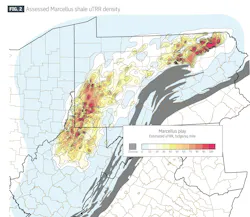
Resource density assigned to a site is, therefore, the sum of well EURs divided by the total area drained, with the total area assessed calculated as the sum of all well lateral lengths multiplied by the typical well spacing. All EURs in this study reflect the Enverus 50-year “best estimate” EURs reported on a total-gas equivalent basis. The analysis produced a database of development sites which were then mapped (Fig. 2) and determined a single estimate of uTRR per square mile (bcfge/sq mile). The map contains uTRR/sq mile calculations generated for 1,032 multi-well development sites with 5,332 wells.
Estimated rTRR resulted from subtracting developed technically recoverable resources (dTRR) (the sum of total volume produced and the remaining EUR in wells currently producing) from the uTRR.
Utica analysis limitations
High confidence exists in mapped uTRR for the Marcellus play due to the high density of data and observed stability of EUR estimates over time. Similar high-quality data were available for the western portion of the Utica gas play, but data remains scarce and EURs continue to be subject to large revisions over time for the eastern (deep) Utica play. Further, in the deep Utica, several key datapoints for single-well sites included uncertainty among the three key inputs (EUR, spacing, and lateral length) which could not be mitigated by consolidation into multiple-well sites.
This study relied on the consistency and reliability of the EUR estimate. Did an additional ~50 months of production data for the 2021 study-assessed wells result in significant changes in 50-year EURs? The table shows a comparison of the 2021 study and the current 2025 study EURs for the Utica wells and reveals a downward revision of ~5%, with some wells declining more than 70%. By comparison, EURs in the Marcellus declined by less than ~1%, attributed mostly to the ~2% of study wells which were plugged and abandoned in the past 50 months. In these cases, the reported EUR shifts from a 50-year projection to cumulative-to-date at the time of abandonment.
For Utica, however, the progressive reductions of EUR may indicate that earlier EUR estimates are less reliable and perhaps overly optimistic. This observation is consistent with recent reports indicating that traditional EUR analyses conducted early in the life of a well tend to overestimate EURs in highly overpressured reservoirs due to changes in pressure-dependent fluid properties with pressure decline. As a result of these issues, an update to the Utica assessment will likely require a different approach.
Key Marcellus findings
The accompanying table summarizes the gas resource assessment in the Marcellus play. Total rTRR increased to 919 tcfge, which includes all recoverable gas and volumes in the low resource-density margins of the play having highly unlikely economic recovery.
rERR assessment includes both geologic and a range of non-geologic factors and is difficult to assess from production data alone. rTRR occurring in areas meeting a certain threshold resource density provides a rough proxy to rERR. The table shows an estimate of remaining gas existing in areas where recoverable resource density exceeds 30 bcfge/sq mile. Fig. 3 shows a map of this area, assessed to contain 637 tcfge of uTRR and 455 tcfge of rTRR.

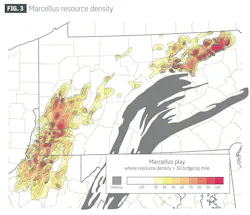
The nature of this minimum resource density is complex and would vary in time and space as various cost elements change. Fig. 4 shows the sensitivity of uTRR to density threshold in the Marcellus play.

The definition of TRR in this report is like that used by both the USGS and the Energy Information Administration (EIA). The USGS has not published subsequent revisions to its 2019 Appalachian shale assessments, and its estimate for Marcellus gas volume remains at 97 tcfg (mean). EIA, however, increased its estimate to 689 tcfge for the Marcellus in its 2025 Annual Energy Outlook (AEO2025). This represents a doubling from AEO2023 and closely matches the 693 tcfge reported in the 2021 study (Fig. 5, green star). Yellow stars summarize the current assessment, which is expanded to provide alternative totals for rTRR at different thresholds for recoverable resource density (rTRR/sq mile).

There is not yet any discernable decline in the performance of new Marcellus wells. Fig. 6 plots Marcellus EUR/sq mile for each of the 5,332 individual study wells. Per well recovery is averaged for each 3-month increment of production history. Green bars are the current recovery for wells of each vintage, and black dashes show the estimated recovery for those same wells based on 2021 data.
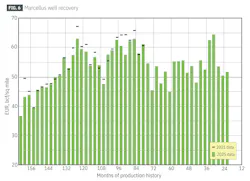
The plot shows a steady increase from about 40 bcfge/sq mile for early wells to about 55 bcfge/sq mile by about 2014. Since that time, productivity has varied but has shown no clear trend toward either decline or increase, indicating that the limit of the Marcellus core area has not yet been reached, or if it has, that increasing technology effectiveness is fully compensating for any diminishment in underlying resource quality.
Fig. 7 illustrates the ongoing expansion of the Marcellus core area by mapping apparent recovery efficiency based on the GIP map published in 2017 by Zagorski et al. The figure shows notable areas of unexpectedly high recovery beyond the originally conceived margin of the play (shown in red).
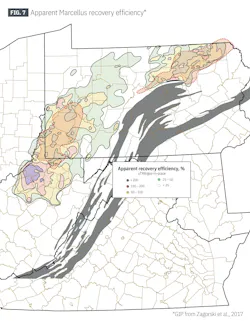
Well recoveries have subsequently exceeded the GIP in these areas. Northwestern West Virginia provides an example in which Marcellus production has been augmented by wells likely accessing gas in overlying Upper Devonian shales. Apparent recovery efficiency of greater than 100% has been reported for the Marcellus elsewhere and been reconciled via alternative explanations related to underestimation of GIP.
Comparing the 2017 2,322-tcf GIP estimate of Zagorski et al. and this study’s assessment of 1,112-tcfge technically recoverable reserves results in about 48% ultimate recovery efficiency in the basin. Unfortunately, this parameter is likely to remain poorly known until reliable means for estimating original GIP are available.
In summary, the volumes reported in this study assume full development of remaining acreage by wells that produce similarly to recent wells; therefore, additional technological advances could render these estimates slightly conservative. The approach, however, also assumes highly efficient development of remaining acreage without constraints caused by natural features, population areas, leasing complications, or other factors.
Bibliography
Blood, R., McCallum, S., Jalali, J., Douds, A., and Stypula, M., “Towards a more accurate gas-in-place model: reconciling gas storage with gas production in the Marcellus Shale, Appalachian basin, USA.,” URTeC: 2558, Unconventional Resources Technology Conference, Virtual, July 20–22, 2020.
Boswell, R., Carney, B., and Pool, S., “Using production data to constrain resource volumes and recovery efficiency in the Marcellus play of West Virginia,” SPE–201752–MS, SPE Annual Technical Conference and Exhibition, Virtual, Oct. 19, 2020.
Coleman, J., Milici, R., Cook, T., Charpentier, R., Kirschbaum, M., Klett, T., Pollastro, R., and Schenk, C., “Assessment of undiscovered oil and gas resources of the Devonian Marcellus Shale of the Appalachian basin province,” USGS Fact Sheet 2011–3092, 2011.
EIA, “Assumptions to AEO 2023,” Washington, DC, Feb. 23, 2023.
EIA, “Assumptions to AEO 2025,” Washington, DC, Apr. 15, 2025.
Engelder, T., “Marcellus 2008: report card on the breakout year for gas production in the Appalachian basin,” Fort Worth Basin Oil and Gas Magazine, Vol. 20, August 2009.
Enomoto, C., Trippi, M., Higley, D., Drake, R., Gaswirth, S., Mercier, T., Brownfield, M., Leathers-Miller, H., Le, P., Marra, K., Tennyson, M., Woodall, C., and Schenk, C., “Assessment of undiscovered continuous oil and gas resources in the Upper Ordovician Point Pleasant Formation and Utica Shale of the Appalachian basin province,” USGS Fact Sheet 2019–3044, October 2019.
Enverus, “Precalculated, proprietary EUR database,” Enverus, 2025.
Higley, D., Enomoto, C., Leathers-Miller, H., Ellis, G., Mercier, T., Schenk, C., Trippi, M., Le, P., Brownfield, M., Woodall, C., Marra, K., and Tennyson, M., “Assessment of undiscovered gas resources in the Middle Devonian Marcellus shale of the Appalachian basin province,” USGS Fact Sheet 2019–3050, October 2019.
Ikonnikova, S., Smye, K., Browning, J., Dommisse, R., Gherabati, A., Gulen, G., Hamlin, S., Lemons, C., Male, F., McDaid, G., Medlock, K., Scanlon, B., Shuster, M., Tinker, S., and Vankov, E., Final report on update and enhancement of shale gas outlooks, Bureau of Economic Geology at The University of Texas at Austin, 2018.
Jongkittinarukorn, K., Last, N., and Kabir, C., “Decline-curve analysis with decline rate for improving reserves estimation in gas reservoirs,” Gas Science and Engineering, Vol. 116., August 2023.
Kirschbaum, M., Schenk, C., Cook, T., Ryder, R., Charpentier, R., Klett, T., Gaswirth, S., Tennyson, and M., Whidden, J., “Assessment of undiscovered oil and gas resources of the Ordovician Utica Shale of the Appalachian basin province,” USGS Fact Sheet 2012–3116, September 2012.
Milici, R., Ryder, R., Swezey, C., Charpentier, R., Cook, T., Crovelli, R., Klett, T., Pollastro, R., and Schenk, C., “Assessment of undiscovered oil and gas resources of the Appalachian basin province,” USGS Fact Sheet FS–999–03, February 2003.
Muneez, I., Saad, M., Muhammad, H., Qazi, M., Jahangeer, Z., “Evaluation of over-pressured gas reservoirs: reserves estimation to production performance, a case study,” SPE-214141–MS, Gas & Oil Technology Showcase and Conference, Dubai, UAE, March 13–15, 2023.
Pool, S., Boswell, R., Saucer, J., and Carney, B., “Estimates of natural gas resources and recovery efficiency associated with Marcellus development in West Virginia,” WVGES Reports of Investigation 36, West Virginia Geological and Economic Survey, 2021.
Zagorski, W., Emery, M., and Ventura, J., “The Marcellus Shale Play: its discovery and emergence as a major global hydrocarbon accumulation,” AAPG Memoir 113, Giant gas fields of the decade 2000-2010, 2017, pp. 55-90.
The authors
Ray Boswell ([email protected]) is a geologist at the National Energy Technology Laboratory in Pittsburgh, Pa. Ray holds an MS and PhD (1988) in geology from West Virginia University.
Susan Pool ([email protected]) is a geologist and GIS analyst at the West Virginia Geological & Economic Survey in Morgantown, W.Va. She holds BS degrees in geology and mathematics/computer science (both 1985) from Waynesburg College and an MGIS with resource assessment focus (2013) from Penn State University.
B.J. Carney ([email protected]) is vice president of geoscience and innovation at Northeast Natural Energy in Charleston, W.Va. He holds a BS and MS (2000) in geology and geophysics from Virginia Tech. He is a member of the Society of Exploration Geophysicists, American Association of Petroleum Geologists, Society of Petrophysicists and Well Log Analysts, a past president of the Appalachian Geological Society, and is a member of the WV Water Resources Board.