P. 2 ~ Continued - Worldwide oil production steady in 2011; reported reserves grow

Displaying 1/2
View Article as Single page
Reserves in the US, Canada
Oil reserves in the US total 20.682 billion bbl, according to estimates released on Nov. 30, 2010, by the US Energy Information Administration. Dry gas reserves were estimated at 272.5 tcf. These totals reflect changes during 2009. No newer estimates were available at presstime last week.
EIA also reported that proved reserves of wet gas in the US, up 11% from a year earlier, total 284 tcf. This is their highest level since 1971, EIA said, despite an approximate one-third decline in the prices used to assess economic viability for 2009 reserves as compared to the prices used in 2008.
Shale gas development in Arkansas, Louisiana, Oklahoma, Pennsylvania, and Texas drove the increase in gas reserves, EIA reported, as Louisiana led the US in additions of proved wet gas reserves with a 77% net increase of 9.2 tcf mostly due to development of the Haynesville shale.
US oil plus lease condensate proved reserves rose 9% to 22.3 billion bbl, regaining 1.8 billion bbl of the 2.3 billion bbl decline posted a year earlier.
In 2009 proved oil reserves in the US increased in each of the five largest crude condensate areas: Texas, the Gulf of Mexico Federal Offshore, California, Alaska, and North Dakota.
Texas had the largest proved reserves increase with 529 million bbl, or 11%, nearly all in the Permian basin. North Dakota reported the second-largest increase at 481 million bbl, up 83%, due to Bakken formation development. A driver for these increases was the higher average level of 2009 oil prices relative to those of December 2008, EIA reported.
Canada's reserves of conventional oil at yearend 2009, the latest figures available from the Canadian Association of Petroleum Producers (CAPP), totaled 687.656 million cu m. In June, Canada's Energy Resources Conservation Board reported that total remaining established crude bitumen in Alberta totaled 169.3 billion bbl.
The latest gas reserves reported for Canada are pegged at 61 tcf, based on yearend 2009 figures from CAPP.
Oil production, demand
Worldwide oil production in 2011 is little changed from a year earlier, OGJ forecasts, declining to average 72.56 million b/d vs. a 2010 average of 72.618 million b/d.
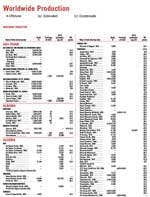
Combined oil output climbed by almost 2% this year in North America, Central America, and South America, led by increases in Canada, Colombia, and the US.
Oil production in Africa declined this year by 11% due to the loss of Libyan output during that country's popular uprising. OGJ forecasts that oil output in Libya in 2011 will average 440,000 b/d, down from last year's 1.55 million b/d.
Production in the North African nation dropped quickly starting in February, averaging just 200,000 b/d in April, then sinking further to record almost no output in August, according to the International Energy Agency. Then production began to ramp up, averaging 75,000 b/d in September and an estimated 350,000 b/d in October and 500,000 b/d in November.
Tullow Oil PLC started production at Jubilee field in Ghana in November 2010, sharply boosting oil production in the country to more than 100,000 b/d. Tullow expects plateau production from Jubilee field to reach 120,000 b/d by yearend.
Oil production in the Middle East will increase by 5% this year, OGJ forecasts, as Saudi Arabia, the UAE, Kuwait, and Iraq post healthy output gains from 2010 in response to a bump in worldwide oil demand. Oil production in Iraq this year is forecast to average 2.48 million b/d, up almost 5% from last year's average.
According to the latest IEA forecasts, 2011 oil demand will average 89.2 million b/d, up from 88.3 million b/d during 2010. Total non-OPEC oil supply is little changed over the period, leaving OPEC to meet demand without further depleting inventories.
While oil output this year will be nearly unchanged from 2010 in Eastern Europe and the former Soviet Union, Western European production will post a 12% decline from last year due to precipitous declines in aging fields. This drop is led by what OGJ estimates to be a 23% collapse in 2011 UK output to 970,000 b/d. In Norway, annual production will sink by about 7% from last year.
In the Asia-Pacific region, collective oil output this year will slide by 2.6%, as declines in Australia, Indonesia, and Malaysia outweigh an increase in India. Average oil production in China for 2011 will be little changed at 4.09 million b/d.
Displaying 1/2
View Article as Single page
More Oil & Gas Journal Current Issue Articles
More Oil & Gas Journal Archives Issue Articles
View Oil and Gas Articles on PennEnergy.com