
EDITOR'S NOTE:Darron Anderson, CEO of privately-held Express Energy Services, led his company through one of the shortest bankruptcies in the history of the energy industry. Nine weeks after filing for Chapter 11, the company emerged from the reorganization stronger and better prepared than ever. OGFJ recently visited with Anderson to learn more about the company and how he accomplished this feat. |
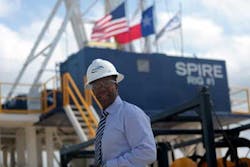
Express Energy Services emerged from Chapter 11 reorganization in 2010 stronger than ever and with a different mindset thanks to its new CEO, Darron Anderson.

OIL & GAS FINANCIAL JOURNAL: Tell us a little about the history of Express Energy Services.
DARRON ANDERSON: The company was founded in 2000. Like a lot of smaller oilfield service companies, a couple of entrepreneurs started the company. They were from Louisiana. During this early period, roughly 2000 to 2004, the mode of growth was to find and recruit talent from competitors. In the mid-2000s, the shale boom in the Barnett was getting started and the company needed to expand to accommodate new business. To keep up, the company began a series of acquisitions with a couple in the 2007 timeframe. By 2008, it had grown revenues to about $400,000 [a year], but it was still very much an entrepreneurial-managed organization.
OGFJ: Was there private equity money in the company?
ANDERSON: No. The original founders were just individuals who had 20 to 30 years' oil and gas service experience. They borrowed some local bank debt. In 2006, an institutional investor came in, but they were in the minority, and the company was still run by the founding partners. However, the investor did introduce them to avenues to greater growth capital and banking relationships. By 2008, as shale plays were really starting to take off and the company was growing, it attracted outside buyer interest, one being a large Australian institutional fund. They put in a bid to purchase the business, and the company was sold in July of 2008. Through that process, about $325 million in debt was added to the balance sheet, and in October 2008, the world changed. So you had a company with a level of debt on its balance sheet that had never been there before. You had a company that was still run with a management structure that did not know how to manage costs effectively because it had always been about growth from its inception. All that made for a combination that was not going to survive the market downturn. The rig count fell off by half, and our business fell off by half.
OGFJ: So the company's options were limited at that point.
ANDERSON: That's right. It became clear that the Chapter 11 process was going to have to occur. The original founders of the company were asked to leave by the board of directors, and I was moved into the CEO position in late 2008. So in a way, I drew the short straw to take the company through the bankruptcy process in a very, very depressed market.
OGFJ: What was your experience prior to this, and what was your position at the time you were appointed CEO?
ANDERSON: I had joined the company in 2005 from a previous company I had founded, and my focus here was on the offshore part of the business. We weren't big on titles, but I played a key role on the operations side. I have a degree in petroleum engineering from the University of Texas and worked for Chevron right out of college. I started my own business in 1998 and had a great mentor in Jim Woods, the former chairman and CEO of Baker Hughes. He was on the board of directors of the first company I sold, and it was great getting advice from him.
OGFJ: How did the downturn and the bankruptcy impact the number of employees you had?
ANDERSON: It had a major impact. We went from about 2,400 before the downturn to about 1,200 at the time of the bankruptcy. Today we're back to about 2,100. Our low point was in late 2009. To make it through this difficult time, we felt it was critical that we communicate effectively with our employees and our customers in order to turn things around. We rounded out the management team, retaining key individuals and replacing the naysayers. We concentrated on doing what we did well, knowing that the financial performance would follow.
OGFJ: Could you go over the timeline for the bankruptcy again and explain how you managed to emerge from it so quickly?
ANDERSON: We filed for bankruptcy protection in October-November of 2009 and we went 42 days. We were actually ready to emerge around the second week in December, but it was going to cause us to have two audits, so we decided to emerge on Jan. 1, 2010. As I said earlier, the economy was in a free-fall and the rig count, which is a crucial indicator in the oilfield services business, had fallen to about half of what it had been. Pricing across most basins fell about 40% to 50% as well. So the opportunity for revenue sustainment just wasn't there, so that meant that significant cost containment had to occur. As a growth company, cost containment just wasn't part of the process. But we had just taken on $326 million in debt. However, the company was basically financially sound. We had good assets and a nice, diverse geographical footprint. We had a couple of strong service lines. Personally, I felt that with the right management focus and team and long-term objectives rather than being a very reactionary entrepreneurial company, we had a foundation. But it was going to take a complete change-out of leadership and a complete change-out on culture. I used to say that the only metric of the old Express was EBITDA. Today, EBITDA is the result of all the work that we do. We have sets of metrics that drive our financial performance. Turning the organization around was not as hard as you might think, but it did take a different mindset.
OGFJ: Where do you operate currently and what are your expansion plans?
ANDERSON: We think we have a lot of opportunities in the Lower 48 and the Gulf of Mexico. Our service offerings include drilling support, water resource management, completion and production, and well intervention. We have two services – our casing laydown and our well casing services – that in any of the shale plays where we operate, we're going to have a No. 1 or No. 2 market share. So we're very strong across the US with our casing services. When it comes to other services – our wireline services and our rental services – we have room for a lot of growth even in the shale plays we're in. So there is still ample opportunity for growth in our current shale plays. In the Gulf of Mexico, we only offer P&A (plug and abandonment) services currently, so we still have the opportunity to bring our land-based services to the offshore market.That said, we have an international business development team that is looking at opportunities outside the areas we currently serve. For example, recently we have been looking at Canada from an M&A standpoint. However, South America is our primary focus right now from an organic growth standpoint but also M&A. We are bidding on at least one contract in Colombia right now. Since we have such a strong position with our casing services business that is what we would likely take international first. For the other product lines, we still have a lot of growth potential in the Lower 48. We have the asset base and the personnel to be able to serve all these areas.
OGFJ: Since emerging from bankruptcy, how is the company doing financially?
ANDERSON: For the year 2009, the company had $199 million in revenue. That went up to around $235 million in 2010 and to $350 million in 2011. Last year (2012), revenues rose to about $420 million. We went from break-even at the EBITDA level in 2009 to margins that are today very acceptable compared to our public company peers out there. We saw a significant amount of growth over that time period. Part of our strategic change was to focus on what we do well and be the best at it. We sold off five services lines during that time period – things that we were in that we had no business being in. For example, lines where we were only operating in one basin. We were the "Mom and Pop" with those lines. The downturn taught us which service lines we need in order to survive a down market. We were able to take the proceeds from the service lines we sold and reinvest it back into the business. During all this process, we never even touched our revolver until February 2012 when we used it to help fund an acquisition. So the Chapter 11 process was not about inability to pay our people. We burned minimal cash while we were in Chapter 11. On emergence, we wiped out our entire debt – all $325 million. We came out with zero debt, were cash-flow positive, and literally never touched our revolver for over two years until we needed it to help close an acquisition.
OGFJ: We are all fortunate that the oil and gas industry came back quickly from the recession.
ANDERSON: Yes, and Express Energy Services came back as a different player. As you saw from the tour we gave you this morning, our Express University is a state-of-the-art training facility. It opened in February 2012 with 8,000 square feet of classroom and office space and 10,000 square feet of training area, as well as on-site dormitories for 48 students and computer labs. We teach decommissioning skills like cementing, electric line training, core classes, and casing running and removal. We spend several million dollars each year in research and development, training, and upgrading the facility. With the old company, this place would never have been part of our process. It would have been viewed as a cost to the organization and something we didn't need. That's what I mean about the different mindset. A training facility like this one enables us to differentiate ourselves from our competitors. We get positive feedback about the quality of employees and our training from companies like Shell and Chevron all the time. We're proud of that, and we feel it gives us an edge in the business.
OGFJ: What does the future hold for Express? Where do you expect to be five years from now?
ANDERSON: Our five-year goal was to get to a $1 billion top-line revenue company. We're probably still two to three years away from that, but we're still focused on that goal. In addition to domestic growth, we expect to see significant international business within five years. We'll also have one or two additional service offerings to what we have today. We have a significant investment in and commitment to technology and R&D. We're not trying to find more oil and gas in the ground for our customers. What we're trying to do is to take our current service offerings and advance those. We want to make them safer, greener, and more efficient for our customers. Technology is crucial to advancing these aims. Once again, we want to differentiate ourselves from our competitors so we will become the service company of choice for them. On the financial side, I'd like to think that a public offering is in the future. With a few more key acquisitions and organic growth, we should get there in the future. We have about 35 institutional investors, and our company is run like a very small publicly-traded company now. We have a five-member board of directors. We have quarterly investor calls. We have an annual shareholder meeting. So we understand the need to provide information to our investors. We think going public will enable us to provide even greater value to our stakeholders.
OGFJ: Thanks very much for taking the time to talk with us today.