Galveston Bay gas prospects heating up
Alan Petzet
Exploration Editor
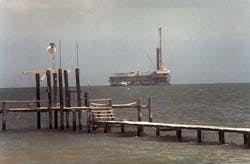
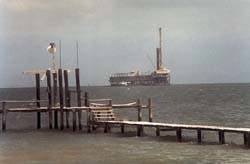
Falcon Drilling Rig 52 drilled the Eagle Point discovery in less than 10 ft of water in Galveston Bay. Photo by Alan Petzet.Two Houston independents will develop a large gas discovery in western Galveston Bay off Texas and will press exploration of more than a dozen other prospects there and in South Louisiana.
TransTexas Gas Corp. and Davis Petroleum Corp. plan to spend about $60 million to drill seven wells by late 1998 to develop a high-pressure gas and condensate discovery 1 mile off San Leon in the Galveston County portion of the bay (see map, OGJ, Aug. 11, 1997, p. 75).
The companies declined to release depth, reservoir, or other information about the discovery well, 1 State Tract 331, permitted to 18,000 ft on a 1,150 acre structure. Known as the Eagle Point prospect, the well is to be completed by October. Early data indicate it will flow gas and condensate at high rates, they said.
They previously disclosed potential reserves of at least 400 bcfe for the structure. The well encountered 9,600 psi surface pressure on May 6 while drilling in Tertiary Vicksburg at 15,400 ft. It kicked gas and 47° gravity condensate, requiring 19.3 lb/gal mud to control, and pressure collapsed the drill pipe. TransTexas later sidetracked the well.
The well topped Vicksburg 400 ft high to prognosis, and the company calculated that the gross Vicksburg interval might be as thick as 2,000 ft.
The well also cut significant hydrocarbon shows in shallower sands of Tertiary Frio. Drilling since May has not changed TransTexas' reserves outlook for the structure.
Information on the development scheme and gas connection was not available.
TransTexas-Davis controls six prospects in Galveston Bay and eight in South Louisiana, each of which, the companies estimate, holds potential reserves greater than 200 bcfe. The companies are drilling two other Galveston Bay prospects, including one known as Virginia Point on State Tract 88A. About 10 miles south of the S.T. 331 well, it spudded in June toward 19,000 ft.
Another operator, Meridian Re-sources Corp., Houston, is probing deep structures in the area.
Formerly Texas Meridian Re- sources Corp., it has permitted two 18,000 ft wildcats on State Tracts 329 and 312. They are within 3 miles northeast and east-northeast of the Eagle Point discovery well.
Meridian is drilling an 11,500 ft wildcat in East Bay about 15 miles northeast of Port Bolivar.
Copyright 1997 Oil & Gas Journal. All Rights Reserved.