How Oil, Gas Investment Prospects Compare For Azerbaijan, Kazakhstan

Richard R. Dion
Director of Economic Research
Center for American-Eurasian Studies and Relations
Washington, D.C.
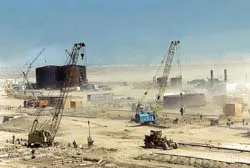
Work continues on a crude oil terminal at Sangachal, Azerbaijan, by contractors working for Azerbaijan International Operating Co. (AIOC), a group of companies developing giant oil fields in the Caspian Sea off Azerbaijan. The terminal will receive and store crude oil from AIOC's Caspian fields. Photo courtesy of Amoco Corp.
Kazakhstan and Azerbaijan have attracted billions of dollars of foreign investment during the last several years, predominantly in the oil and gas sector.
As two former Soviet Union (FSU) republics that hold significant oil and gas reserves, they are better able to assert their independence than other former Soviet republics.
Although both have received virtually nothing but accolades from investors and the public in general, Kazakhstan's ability to keep up with Azerbaijan as the co-leader of foreign investment in the oil and gas sector will probably start to wane in the next several years.
A large portion of Kazakhstan's potential drying-up in foreign investment could be precisely the reason why it has been able to exist the last several years.
Russia, as Kazakhstan's largest trading partner, has emerged as not only an ally, but also a friend. This relationship has flourished under the two countries' respective leaders, Boris Yeltsin and Nasultan Nazarbayev. Their relationship has taken them through many significant events together, which has cemented a relationship between the two countries. This relationship and the future of the Commonwealth of Independent States mechanisms could have the same effect that the relationship between France's Francois Mitterrand and Germany's Helmut Kohl had for the European Union.
Demographics are key
Nazarbayev-as well as any future Kazakhstani leader-is forced to uphold this relationship because of Kazakhstan's demographic situation.
At 46%, the titular ethnic group does not even make up a majority of Kazakhstan's 16 million population. Russians constitute about 34% of the population. The trend toward a consolidation of Kazakh culture is, however, increasing. In 1989, Kazakhs represented only 39.7% of the population, while Russians were just behind at 37.8%.
During 1994, nearly 25% of the migrants who returned to Russia were from Kazakhstan. While this consolidation is encouraging, it still poses a major threat to Kazakhstan's independence vis-a-vis Russia.
Many decisions that Kazakhstan makes virtually have to be cleared with Russia, or at least made in consideration of Russia's reaction because of its large minority there. This is further seen in the attempt at moving the capital to Akmola, about 600 miles northwest of the current capital, Almaty.
Whether or not this move will be beneficial has yet to be seen, but many observers predict a negative effect on Kazakhstan.
Russia's role
Russian dominance is seen daily with the Kazakh acknowledgment of Russian as the language of "inter-ethnic communication," despite Kazakh being the state language.
Just as in the Baltics, Russian influence is so strong that it gives Yeltsin (or any other Russian leader) carte blanche to meddle in a republic's internal affairs in the name of the Russian minority. The only difference between Russia's treatment of the Baltics (particularly Estonia) and Kazakhstan is that the latter has not done anything to provoke Russian anger. Geopolitics also has something to do with that.
Kazakhstan is also largely dependent on Russia for its security. With the Chinese conducting underground nuclear bomb testing in adjacent Xinjiang province, Nazarbayev wants to keep Russia and its might at his side.
Despite consisting of more than 2.7 million sq km, Kazakhstan is crammed between two nuclear giants after having disarmed itself of nuclear weapons in 1995; it would much rather align itself with Russia, with which it has co-existed with for the last 80 years.
Talks with the Chinese have led to a moratorium on nuclear testing and improved relations, but with China-widely predicted as the leader of the 21st century, at least in Asia-the threat has not completely eroded, particularly with a predicted energy shortage.
Good or bad?
Is dependence on Russia a bad thing? Of course not.
But overdependence on Russia can be disastrous for Kazakhstan and its future.
Mexico's at-times large dependence on the U.S. is hardly detrimental because the United States is a mature democracy with peaceful power transitions.
Russia will someday reach this level of reliability. But, in the meantime, it has a long way to go. Twice last year, Kazakhstan held its breath as its future lay in the balance. The first instance occurred in June, when Yeltsin won the presidency; the second time was when Yeltsin underwent open-heart surgery and regained powers only 23 hr after relinquishing them.
The dependence on Yeltsin's Russia does not only encompass geography and security; it unfortunately extends to the economic area.
In 1994, Kazakhstan exported 3.8 trillion rubles to C.I.S. states, with 80% going to Russia. Nazarbayev is aware of the relationship between Russia and Kazakhstan and has, therefore, pushed hard for furthering the integration of the C.I.S.
He knows full well that Kazakhstan's future depends on its economic integration with Russia.
CPC stake
Russia also has a large stake in the Caspian Pipeline Consortium (CPC), created to solve the oil shipment problem.
Russia and Russian oil companies constitute 44% of this consortium, which will transport oil from Tengiz oil field to Novorossiisk. In addition to containing a massive stake in the economics of CPC, the fact that the majority of the pipeline runs through Russia only adds to its dominance. In addition, under the terms of the deal, the companies involved have to fund the initial construction of the pipeline at $2.1 billion.
After the initial construction, the expansion will be completed by 2010, costing another $2 billion.
The massive project at Tengiz oil field envisions a peak output rate of about 489 million bbl/year (67 million metric tons/year). In order to handle this large influx of oil, a new loading facility is being built at Novorossiisk (Novorossiisk 2).
At this stage, port capacity does not appear to be a problem; however, the Bosporus Strait that divides Istanbul will never be able to handle that quantity of oil.
Currently handling close to 50,000 ships/year, the Bosporus is already bulging at the seams, and it just takes one accident to severely damage an already challenged environment, particularly in a densely populated city. Indeed, a recent accident in mid-February is evidence of this.
The exploitation of oil in Kazakh- stan, while initially very appealing, will run into problems (unless seriously discussed immediately with Turkey) regarding transportation that might undermine the project's economics. And given the unpredictability of Turkish politics, some form of anxiety would be justified.
Azerbaijan's appeal
Azerbaijan looks much more appealing when viewed with the same criteria.
What has been to Azerbaijan's advantage has been the political adroitness of its leader Hehdar Aliyev. A former member of the Soviet politburo, Aliyev has steered his country clear of dependence on any one country.
He has been openly defiant of further integration of the C.I.S. on several occasions and, to this day, refuses to allow C.I.S./Russian troops to patrol the Azeri-Iranian border.
Most importantly, Aliyev snubbed Moscow (with U.S. backing) by choosing a second route to export Caspian oil to the Georgian port of Supsa.
Recently, the World Bank approved a $1.4 million credit to Georgia for a feasibility study of the pipeline from Baku-Supsa. This is in addition to a $5 million loan last fall to Turkey for a feasibility study for the pipeline to Ceyhan.
This has allowed Azerbaijan to rely not too heavily on Moscow and, particularly, on Russian control over the Chechen republic.
Originally focused on only pumping the oil from Baku to Novorossiisk, the foreign oil companies comprising Azerbaijan International Operating Co. (AIOC) now have an option should Moscow become desperate and start meddling in Caucasian affairs again.
When extraction peaks, anywhere in 5-10 years, a pipeline will go from Baku-Ceyhan, bypassing the Black Sea.
A good neighbor
Azerbaijan is on good terms with some Russians, particularly men like Vagit Alekparov, who, as president of Lukoil, has considerable pull in the Russian government.
Alekparov was born and educated in Baku and moved to Moscow to become the youngest deputy energy minister in 1990. These are the sort of people that Aliyev wants to associate with in Moscow.
At home, Aliyev also has connections in the oil industry, having appointed his son Imkham to be the head of the state-owned State Oil Co. of Azerbaijan Republic (Socar). With connections like these, business gets done, with little left to chance.
Azerbaijan also possesses one trump card concerning neighboring Iran. About 15 million ethnic Azeris live in Iran (referred to as "Southern Azerbaijan" in some Azeri circles).
Iran will decline any confrontation over the Caspian Sea/Lake issue (the definition of which is crucial to determining territorial rights) if Azerbaijan makes a point of questioning Iranian treatment of the ethnic Azeri minority in Iran.
The inclusion of Iran's semi-private Oil Industries Engineering & Construction Co. in the Shah Deniz oil field development deal should be enough to appease Iran.
In addition, Azerbaijan is significantly better off than Kazakhstan concerning its Russian minority: Not only does it contain about 83% ethnic Azeris, with only a small minority of Russians (8%), but should it feel the need, it can also exert its influence toward its southern neighbor concerning its own minority-much the same way that Russia has exerted its influence in other FSU republics.
Problems, alternatives
This is not to suggest that Kazakhstan, or the companies that invest in it, will be holding onto a lot of oil with nowhere to go; but they will have problems unless they are resolved in the near future.
These potential hazards will not necessarily disappear once the Yeltsin-Nazarbayev years come to an end; they could possibly be aggravated, depending on who succeeds them.
For this reason, different routes and options are part of any business plan. These deals being closed in the Caspian should be no exception, all the more so because of the lack of quality infrastructure.
The following serve as possible alternatives, which are only meant for the entities involved to consider, as well as any potential investors:
- One possible solution could be to pump the oil to Novorossiisk, put it on a tanker that would cross the Black Sea (landing perhaps at Samsun or Trabzon on the Turkish Black Sea coast), and then pump it through to Ceyhan on the Turkish Mediterranean coast.
- A pipeline could even be laid on the floor of the Black Sea between Novorossiisk and the chosen city. Actually, Gazprom's board has given the approval for such a project at an estimated cost of $2.5 billion. This option could even be better than a pipeline from Baku-Ceyhan because it would be out of Kurdish-controlled territory, eliminating the terrorist threat.
- Another possibility would be to pump the oil north to the Urals and then pump it though the Druzhba pipeline that splits in Belarus-one branch proceeding north through Poland, while the other descends into Hungary and Slovakia. Whether or not these two possibilities are entertained depends on the confidence of the parties involved.
The future and Aliyev
There could be one significant problem for Azerbaijan: Aliyev is 73.
He does have connections in the industry who could be selected as his successor.
Could his son rule Azerbaijan as adroitly as his father?
The hope here might be that Aliyev, no matter how much of a figurehead he becomes in his old age (like China's Deng Xiaoping), he will have ensured the safety of his country, both economically and politically. However, given the freeze currently in the Armenian-Azerbaijani war, a post-Aliyev Azerbaijan might be a little unstable.
The fact that Nagorno-Karabakh's leader has just been appointed Prime Minister of Armenia only serves to reinforce that possible doubt.
It was also confirmed not too long ago that Russian military equipment during the last few years has been shipped to Iran and has landed in Armenia. This could lead to instability in the next several years.
Both Azerbaijan and Kazakhstan contain great potential for investment that could be very beneficial to all parties involved-if the proper research and forethought are carried out. However, given the current politics, economics, and geography of the region, Azerbaijan could spurt ahead, leaving Kazakhstan in the steppe.
The Author

Richard R. DionCopyright 1997 Oil & Gas Journal. All Rights Reserved.