Risks to global crude oil flow sustain need for strategic reserve
Adapted from comments to an Energy Department request for comments
on the future of the Strategic Petroleum Reserve
Petroleum Industry
Research Foundation Inc.
Washington, D.C.
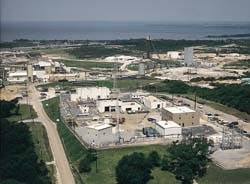
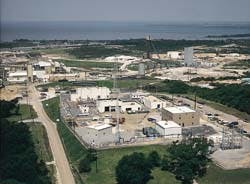
The remaining crude at the Weeks Island, La., SPR site is being removed through skimming operations and the oil is being moved by barge to the Big Hill, Tex., site. DOE will complete decommissioning of Weeks Island in 1999. Photo courtesy of the U.S. Department of Energy.
- An employee checks equipment at an SPR site. The U.S. Energy Department spends about $200 million/year to maintain and operate the reserves. Photo courtesy of the Department of Energy.
- U.S. Emergency Stocks Status [54,756 bytes]
The Strategic Petroleum Reserve (SPR) is one of the cornerstones of U.S. energy policy. It remains the most effective policy tool in minimizing the dislocations to the U.S. economy that would result from a sudden disruption in the international flow of oil. Yet, the SPR is threatened once again.
- Current SPR Crude Oil Inventory [54,756 bytes]
The Congress, in its annual budget balancing dance, has come to realize that the SPR has no natural constituency. It is therefore a deep and easy pocket to pick.
Various bills would again reduce the SPR level despite the fact that the potential of supply disruptions is not only ever-present but changing and growing.
We warned of this danger several years ago, when we suggested that even a small sale of the SPR for budgetary purposes would set a dangerous precedent, i.e., "the camel's nose under the tent."
Since that warning, the Congress has authorized the sale of about 30 million bbl of SPR crude oil for just such a purpose and is about to authorize another 10-12 million bbl sale.
The Petroleum Industry Research Foundation Inc. (Pirinc) wants to reiterate its view that any sale of a strategic asset to fund current consumption is penny-wise and pound-foolish.
It's in this context that we are pleased to respond to the Department of Energy's invitation for public comment on SPR policy. We will address each of the seven primary issues described in the Federal Register.
Key tool
Pirinc thinks the U.S. should continue to maintain the SPR.As the Department of Energy re-examines its SPR policy, oil markets are becoming more vulnerable to short-term supply disruptions.
Although the nature of potential supply disruptions is changing, the total risk over the coming decade will be at least as high as it was when the SPR was created in the early 1970s and in some respects could be higher.
The SPR remains the most viable, secure, and cost-effective tool for preventing and mitigating an oil supply disruption. While the optimal size of the reserve, the method of financing oil acquisitions, and the timing and procedures of a response are open for debate, long-term security should not be compromised for short-term budget balancing.
Yet, for the third consecutive year, SPR oil is under attack by revenue seekers, through an appropriations bill before a House-Senate conference committee. The SPR should be maintained and improved, not abandoned, neglected, or reduced.
The presence of the SPR affords the administration important diplomatic flexibility to fully assess the supply disruption in a calmer environment. Moreover, the mere presence of a sizable reserve may actually prevent foreign government action aimed directly or indirectly against the U.S.
The National Petroleum Council has estimated that the 1973 and 1979 oil supply shocks cost the U.S. economy a cumulative 2.5% and 3.5%, respectively.
Each percentage point loss of GDP today would equate to about $75 billion/year. In contrast, the operating and maintenance costs of the SPR are about $200 million/year. Thus, it can be calculated if the SPR can stave off or significantly reduce the cost of an oil disruption on the economy any time in the foreseeable future, its positive impact on the economy will outweigh the cumulative cost of maintaining and operating the reserve.
Our dependency on imported oil is much higher today than it was in the mid-1970s, when we established the SPR (36% in 1975 vs. 48% in 1997) and, according to an Energy Information Administration forecast, it will increase to 50-70% by 2015.
Similarly, the share of oil that can be substituted by other fuels is much lower today than it was in the mid-1970s. Currently two-thirds of all oil is consumed in the transportation sector, where there is no fuel substitution; in 1975 the transportation sector's share was about 50%.
Transit risks
In the international arena, a new development that may increase the risk of a disruption is the growth in pipeline transportation to export crude.Except for the Suez Canal closure in 1956, all postwar oil disruptions involved oil producing countries.
In the future, there will be an additional risk-the pipeline transit countries.
This could be of particular importance in the Caspian Sea region. According to a recent State Department report, the "Caspian region could become the most important new player in world oil markets over the next decade."
By 2010, the region may export 3-4 million b/d, all of which will transit other countries by pipeline to maritime harbors. Several of these transit countries and regions, such as Chechnya, Dagestan, Georgia, Armenia, and Azerbaijan, are either politically unstable or have territorial disputes or other conflicts with each other. Thus, temporary disruptions in the transit of Caspian oil exports are a real, new risk.
To mitigate pipeline risks, recent developments in drag reduction agents could prove very effective. State of the art technological changes in reducing drag resistance in pipelines could effectively increase flow capacity.
This is an area that International Energy Agency member countries, in conjunction with large producing and transit regions, also need to explore. Strategic storage of these additives may very well prove to be very cost-effective in minimizing transit disruptions in the future.
Effect on prices
In evaluating the continued maintenance of the SPR, the question has been raised whether our recent shift in imports from the Middle East to the Western Hemisphere reduces the risk of an oil import disruption and, hence, the need for an SPR of its present size.It should be pointed out that currently the Middle East accounts for nearly half of the world's interregional oil exports, has the lowest production cost, the biggest growth potential based on its proved reserves, and contains virtually all of the world's readily available spare producing capacity.
Thus, the Middle East is, and will remain, a key determinant in world oil supplies and prices. Because oil is now truly a global commodity with global prices and price mechanisms, any individual country's dependence on Middle East oil imports is irrelevant to the country's oil price structure. This was clearly demonstrated during the Persian Gulf crisis of 1990, when world oil prices rose everywhere at similar rates.
Regarding the Middle East's spare capacity, it currently totals 3 million b/d, or just 4% of world oil production, and two thirds of it are located in one country, Saudi Arabia. This is less than half the spare capacity that existed during the 1980s. There is no significant spare capacity outside the Middle East.
DOE has asked how public stocks affect private inventories. In a word, they don't. Private stocks and public stocks serve two very distinct purposes. The size of one bears little (if any) relationship to the size of the other.
First, stocks have been declining in response to global economic pressures. Companies in their attempt to remain competitive have been under pressure to reduce their working capital requirements. Oil companies have accomplished this in part by reducing their level of discretionary stocks.
Second, experience has suggested that private companies initially do not know when, how much, or for how long strategic stocks will be offered to the market. Thus, they are unlikely to look at the SPR as complementary to their own ordinary inventories.
Industry stocks are part of the cost of doing business. They are necessary in order to complete a sale.
These stocks will fluctuate seasonally as well as in anticipation of sharp price moves either up or down or when the market is backward dated or in contango.
Thus, it is impossible to know at any given moment what the level of private stocks will be. On the other hand, public stocks (SPR) are designed to meet sudden, large, unanticipated disruptions in supply. Its level of inventory therefore needs to be both large and stable.
Thus, the government-controlled SPR will continue to be the only emergency oil inventory in the U.S.
Size, composition
According to the International Energy Agency, emergency stocks of member countries will fall this year to their lowest levels since 1980.In the U.S., emergency stocks are even lower. The SPR's 1997 inventory of 564 million bbl now covers only 67 days of net imports (see table, p. 21).
If the present inventory of the SPR were kept at the current level, net import cover would fall to 47 days by 2010.
While an in-depth study should be conducted to determine the appropriate level of the SPR, an interim goal should be to fill the reserve to its 680 million bbl capacity.
This would still only allow for 53 days of net import cover in 2010, but would at least utilize the existing infrastructure. Three times in the past decade, Congress has provided for a higher SPR level: 750 million bbl in the Omnibus Budget Reconciliation Act of 1986; 1 billion bbl in the Energy Policy and Conservation Act Amendments of 1990; and again 1 billion bbl in the Energy Policy Act of 1992.
However, these levels look politically infeasible in today's environment, especially after decommissioning the Weeks Island caverns reduced total capacity to 680 million bbl from 750 million bbl.
Even a move back towards 750 million bbl would result in only 58 days of cover, approximately half the level of protection that existed in the mid- 1980s.
Sanctions issue
While the risks of traditional supply shocks remain, increased risks have emerged as a result of sanctions policies and, as pointed out, the growing transport of oil through volatile regions.Sanctions create new risks by reducing the diversity of supply, a cornerstone of U.S. energy policy. In addition, sanctions reduce the total level of investment and slow down the rate at which these investments are made.
In addition to creating new risks, sanctions further exacerbate already increasing transit risks.
DOE identifies six major "chokepoints" in world oil transit: the Strait of Hormuz, the Strait of Malacca, the Suez Canal and Sumed Pipeline, Russian export pipelines and ports, the Bosporus, and the Panama Canal.
These bottlenecks account for about 40% of world oil transit. At most, only about one quarter of this transit could be diverted at medium cost. More than one third would be effectively blocked, while the remaining 15% could be diverted at high cost.
Critically, the Strait of Hormuz alone accounts for more than 12 million b/d, or more than one third of internationally traded oil. This affords Iran enormous potential political leverage.
When the new risks and increased transit risks are combined with the global production risks that have continued to grow since the SPR was created, total risk is at least as high now as anytime during the last 3 decades.
Therefore, our policy should be to fill the SPR gradually, at least to its current capacity of 680 million bbl.
Drawdown
The purpose of the reserve is to calm oil markets and to help make physical barrels incrementally available.The plan and mechanics of the current reserve distribution system seem to have functioned relatively well. The basic terms and conditions of a sale are generally known and well-documented.
The mere announcement that a sale will occur will alone help to calm an overheated market, as was demonstrated during the Persian Gulf war in 1991. Thus the 15-day period between notice to proceed and the deliverability of the oil is not in itself a problem.
However, since the purpose of the reserve is to minimize the economic dislocations to the economy, its greatest benefits will accrue if it is used early in the disruption.
Using the reserve as a last resort may result in the SPR being an insurance policy whose benefits are never fully received.
The current maximum drawdown rate is 3.2 million b/d. By next April, it will be 3.7 million b/d and by 2000, 3.9 million b/d, under current announced plans. However, these maximum rates can be maintained for only 90 days, after which they decline (see chart, this page).
At first, the maximum rates decrease slowly, but after 150 days, they decrease very rapidly. Thus, the maximum average drawdown rate for the 240 days shown to drain the SPR is about 2 million b/d, given the present level of 546 million bbl.
The planned increases in the drawdown rate for the first 90 days will accelerate the maximum drawdown rate but will, of course, not extend the drawdown period, as long as the SPR volume remains at its present level.
Yet as we have seen, recent major disruptions have lasted years, not months. The Iran-Iraq war, which started in 1980, reduced the two countries' oil exports from 5.5 million b/d in 1979 to about 2 million b/d in 1981-83, causing explosive oil price increases worldwide. Similarly, after Iraq's invasion of Kuwait in August 1990, the combined export loss of nearly 4 million b/d continued unabated for nearly 2 years before the first Kuwaiti exports entered the market.
Fortunately, several OPEC countries, most importantly Saudi Arabia, had enough spare production capacity to offset the entire loss of Iraq/Kuwait exports within a few months. Today's available spare capacity would offset only about two thirds of such a loss.
It would therefore seem that, while the SPR's planned maximum drawdown rate of 3.9 million b/d by 2000 is adequate, our SPR volume of 564 million bbl is inadequate to cope with potential disruptions, given our rising import level.
Thus, a gradual increase in the SPR volume to its 680 million bbl capacity level seems indicated. A very positive byproduct of this increase would be that it would raise the SPR's 90-day drawdown rate to 4.4 million b/d.
Sales, other uses
There is no appropriate federal policy to raise revenues by selling SPR oil.Former Energy Sec. Hazel O'Leary, in her last press interview, said the last two sales for budgetary purposes were a mistake.
Nonetheless, sales of SPR oil are yet again being proposed in Congress as a revenue source for the fiscal 1998 budget.
The SPR represents probably one of the lowest-cost national security investments relative to its potential benefit. It takes much of the economic vulnerability out of our oil dependency. The dependence is inevitable and will keep growing; the vulnerability can be greatly reduced by the SPR.
DOE also has suggested alternative uses of the SPR, primarily the leasing of excess storage capacity.
It is certainly reasonable for the government to consider leasing some of its current spare capacity of about 116 million bbl, provided that the facilities are properly maintained. However, such leasing would restrict the government's ability in filling the SPR with its own oil, the most advantageous option.
Since the SPR is not a commercial storage facility that can be drawn down and refilled on a continuing basis, private companies are unlikely to lease any of its spare capacity.
However, the SPR's ready existence may make it a lower-cost option for foreign governments and thus might encourage some countries at the margin to store strategic barrels.
The risk to the U.S. of letting a foreign entity have access to the SPR does not seem large. The increase in oil prices that would likely occur during a disruption would probably be a sufficient incentive for this entity to want to sell barrels.
Given the location of the SPR, the natural market for any sales would be the U.S. Gulf Coast. Moreover, through swaps and exchanges these governments could also get access to physical barrels in an efficient and timely fashion.
Other proposals
Some opponents to the SPR propose that the money tied up in the oil reserves, roughly about $10 billion, could be better spent on other oil emergency response programs. However, none of the other options are politically or economically able to protect the economy as the SPR would.Oil futures or options would not prevent a physical supply shortage. While they might affect the timing of the release of the SPR oil, they can't create a physical barrel of oil.
Government price controls exacerbated the crises of the 1970s, and demand-side responses, such as restraints and fuel substitution, are a very limited counterweight. Only the SPR can mitigate a large supply disruption and facilitate the rebalancing of the market.
Any sale of options is likely to generate little revenue, but it will clearly place the government where it doesn't belong: in the oil business.
In addition, it would require the government to make market-timing calls and set formally stated specific trigger prices. When this trigger is broached, the government would have to be prepared to sell SPR barrels whether or not the reason for the price spike was due to a physical disruption in the international flow of oil or simply due to a transient act that occurs from time to time.
In conclusion, we would like to answer a question raised both in the first and the last issues: Who should pay for the SPR? Conceptually, all Americans should share in its cost, because the SPR is a national security device affecting literally everyone.
Its existence and use minimize the economic dislocations during supply disruptions. As a result, the GDP, net income, and employment are higher, while inflation is lower.
Thus our SPR expenditures should be viewed as an insurance premium against a national economic catastrophe. As with any catastrophe insurance, we should do everything possible to prevent the catastrophe. However, as long as it is a realistic possibility, we should pay the premium, which, as we have shown, is very small relative to the potential cost of a major oil supply disruption.
The Author


![U.S. Emergency Stocks Status [54,756 bytes]](http://images.pennwellnet.com/ogj/images/ogj2/95372101.gif)
![Current SPR Crude Oil Inventory [54,756 bytes]](http://images.pennwellnet.com/ogj/images/ogj2/95372201.gif)
Lawrence J. Goldstein
Copyright 1997 Oil & Gas Journal. All Rights Reserved.