Joint tester reduces hydrocarbon leaks
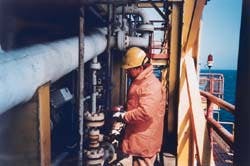
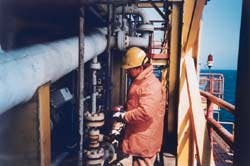
Hydra-Tight's Joint Integrity Management (JIM) system (photo on left) uses a hand-held recorder to check on pipeline flange and valve maintenance status and to perform leak tests in conjunction with a gas detector. The JIM hand-held reader can be plugged into a docking station so that recorded flange and valve data and leakage readings can be downloaded into a computer's data base (photo at right). Photos courtesy of Hydra-Tight.Petroleum companies are reluctant to admit to releases of hydrocarbons from their production units and refineries but are eager to eradicate leaks.
A new pipeline joint integrity checker from Hydra-Tight Ltd., Darlaston, U.K., is designed to reduce leaks from process plant joints and valves, keep records of joint and valve maintenance, and reduce service costs.
The Joint Integrity Management (JIM) system was conceived by Steve Jackson, U.K. service development manager at Hydra-Tight, after an argument with an operator over leak testing results.
Jackson says that recent U.K. Health & Safety Executive figures show there have been 888 reported hydrocarbon releases on U.K. offshore platforms over the past 31/2 years.
The largest leak was of 1.4 million kg of gas, said Jackson. There were also 63 reported ignitions during the period.
New approach
Hydra-Tight in 1995 introduced a systematic approach to pipeline joint and valve testing that relied on paper records. This had no means of identifying individual joint and valves-one of the issues in the debate with the operator.So Jackson devised JIM, which comprises: radio frequency transponders, not much bigger than a coin, which are fitted to each joint and valve; a hand-held intrinsically-safe reader; and a docking station through which the reader can download data to a computer.
The transponder carries a code that identifies a joint or valve. The reader is programmed with information on each joint or valve, including size, rating, bolt load, and drawing number, and on competent operators.
The operator uses the reader to "interrogate" a transponder and goes through a simple question-and-answer routine that enables the reader to record what the operator is planning to do.
JIM trials
Jackson explained that JIM has been tried out successfully in a couple of U.K. offshore fields. One trial involved pressure testing of plant on a large platform that had been closed down for refurbishment."Our objective was to reduce nitrogen leak testing to a minimum," said Jackson, "by ensuring that we made the connections right the first time. If each joint passes the leak test the first time, overall downtime is reduced."
Jackson claims a zero failure rate on 280 pipeline flanges assembled and tightened in 8 days on the platform. The project contractor said previously a 20% failure rate would be expected on start-up.
In another field, two platforms were shut down for maintenance and modification. When the first platform's pipeline system was tested with nitrogen, the contractor reported 50 leakages on 2-in. flanges.
Jackson said 100 flanges were to have been tightened and 70 machined as part of the maintenance work. All the leaks were on pipeline flanges of less than 6-in., which were subsequently found not to have been tightened.
"Hydra-Tight had worked on only a small proportion of the flanges less than 6 in.," said Jackson. "In the subsequent discussion with the operator, the idea of joint management control of pipelines developed.
"On the second platform, we took control of all joints and used JIM for the first time. We tightened 443 joints and machined 58, and when the system was leak tested, only 10 joints leaked."
Lessons learnd
From this project, Hydra-Tight learned to put an engineer in the project office to make sure the right equipment is on site and to decide which equipment is appropriate for each task.The JIM system incorporates joint tightening procedures developed specifically: "Some of the operators' existing procedures for tightening joints were written in the 1970s."
JIM also contains optimum bolt loading for each piping specification: "The system works out loadings for each joint and valve, so there is a greater chance of it being leak-free first time."
Another benefit of JIM is that the transponders can be used for keeping track of valves that are taken offline for maintenance. The system can hold a complete historical record of each flange or valve.
"JIM is a cheap, simple system," said Jackson. "It is most easily applied to new plant since the transponders can be fitted before installation.
"Also, data from JIM can be incorporated into plant environmental reports. Although fugitive emissions reports are not yet required under U.K. law, they are required twice yearly under U.S. legislation."
Copyright 1997 Oil & Gas Journal. All Rights Reserved.