Oxy's Strategy On Environment, Community Issues Key To Success Of Project In Ecuador's Rain Forest
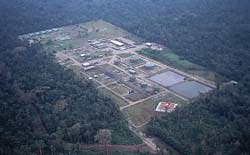
An aerial view of Occidental Exploration & Production Inc.'s central producing facility, accommodations, and ancillary facilities on Block 15 in Ecuador's Oriente jungle region shows rigorous care for the environment: a smokeless, horizontal flare; no open pits; and facilities designed to blend in with the rain forest surroundings. Photo by Paul Marggraff, Quito, courtesy of Oxy.
Bob Williams
Managing Editor-News
- Block 15 locale [44195 bytes]
- Oxy's Block 15 project layout [45877 bytes]
- Block 15 communities [47880 bytes]
- Block 15 indigenous peoples' self-sufficiency initiatives [41423 bytes]
- Block 15 indigenous peoples' health status [35079 bytes]
![Block 15 locale [44195 bytes]](http://images.pennwellnet.com/ogj/images/ogj2/9516jox01.jpg)
![Oxy's Block 15 project layout [45877 bytes]](http://images.pennwellnet.com/ogj/images/ogj2/9516jox02.jpg)
![Block 15 communities [47880 bytes]](http://images.pennwellnet.com/ogj/images/ogj2/9516jox03.jpg)
![Block 15 indigenous peoples' self-sufficiency initiatives [41423 bytes]](http://images.pennwellnet.com/ogj/images/ogj2/9516jox04.jpg)
![Block 15 indigenous peoples' health status [35079 bytes]](http://images.pennwellnet.com/ogj/images/ogj2/9516jox05.jpg)
While such measures may not be unique by themselves, Oxy's efforts to incorporate these measures as a cornerstone of its exploration and development campaign-at the earliest possible stage-can serve as something of a paradigm for oil and gas industry operations in the rain forest.
The upshot is that Oxy has a world-class (at least from an environmental standpoint) oil drilling-production operation at the heart of a world-class biological reserve in a pristine rain forest. Even against a backdrop of politically charged concern over industry work in the Amazon region, the project is an unqualified success to Oxy, the government of Ecuador, and most importantly, the native inhabitants there.
Background
In January 1985, Oxy signed a risk service contract to explore for oil on Block 15 in the Oriente region of northeastern Ecuador.
Under this 20-year contract, the oil belongs to the Ecuadorian government; Oxy recovers its exploration and development costs from oil production and is paid a fee for its services.
Since 1992, Oxy has developed five oil fields near Limoncocha in the western part of the 500,000-acre Block 15, where it has built a central production facility and laid a 16-mile pipeline to state-owned Petro ecuador's Transecuadorian pipeline.
Production from the 125-acre complex of fields around Limoncocha started up in mid-1993, with cumulative output to date exceeding 25 million bbl of oil.
Production currently averages about 17,000 b/d of oil, and additional planned drilling is expected to boost Oxy's Block 15 annual average output for 1997 to 20,000-21,000 b/d.
In December 1995, Oxy agreed with the government to explore the remaining 97% of Block 15 that has not been explored. The first exploratory well under that program, 1 Eden-Yaturi, was drilled last year, resulting in confirmation of a 1970 heavy oil discovery and discovery of higher-gravity oil in two other zones in the far southeastern corner of Block 15.
The Eden-Yaturi find could have oil reserves totaling 100-200 million bbl, which by itself could justify construction of a pipeline to the western end of the block to connect with the Transecuadorian pipeline. That pipeline, in turn, could render economic a number of smaller prospective accumulations along its hypothetical route.
In all, Oxy estimates Block 15's potential oil reserves at 300-400 million bbl.
In a country prone to smallish accumulations, that's a lot of oil at stake and even more reason to maintain high standards for addressing environmental and community concerns.
Environmental guidelines
Prior to beginning work, Oxy made four primary commitments to minimizing the effects of its petroleum operations in the highly sensitive tropical rain forest environment of Ecuador's Oriente region:
- Minimize disturbance of surface vegetation. That calls for cluster drilling of multiple deviated wells from a central drillpad and burying pipelines. In addition, Oxy installed a central production facility for treating, separating, and pumping the crude vs. installing individual production stations for each field. This cuts the number of access roads, drillpads, and structures in the area.
- Protect against pollution. All produced water is reinjected. All flow lines and pipelines are buried and feature internal and external corrosion protection. A comprehensive waste management plan requires treating of rainwater runoff, drilling fluids, and sewage and sink waters and disposal of solid waste in a lined landfill.
- Operate "invisibly." Burying flow lines and pipelines not only helps reduce the risk of a rupture, it reduces the visibility of oil operations on Block 15. In addition, gas is flared in a horizontal, smokeless flare that is invisible to nearby communities, compared with the traditional stack-type gas flares whose flame and smoke plume could be seen for miles.
- Reclaim natural resources. If any tree is cut during Block 15 operations, it is inventoried, and trees of the same species are planted after construction is finished. Oxy maintains native botanical nurseries, giving special care to preserving endangered trees. As a result, a volume equivalent to the total biomass that has been removed from Oxy's fields will have been completely replaced during the first 10 years of operation.
Environmental management plan
Oxy incorporated an environmental management plan as part of its initial development proposal from the beginning, notes Oxy Ecuador Safety and Environmental Manager Patricio Rivera.
While the company was required to provide an environmental impact statement for each stage of its work on Block 15, it took the extra step of developing a state-of-the-art environmental management plan for its seismic program in a protected area of the block.
As part of that initiative, the company set about to develop a computerized environmental information management system (EIMS) that would provide Oxy environmental managers with the basic tools they would need to monitor and gauge environmental effects of any of the company's or its contractors' operations. The EIMS database also serves to handily respond to environmental audits of Oxy operations on Block 15.
A major hurdle in setting up the EIMS database was a lack of comparable historical data on environmental parameters from earlier industry operations in the rain forest, Rivera said. There simply was not a call for such information in decades past.
So Oxy started with Landsat satellite images of Block 15 acquired in 1995 and compared them with Landsat images of the same area taken in 1985. With the changes shown by the Landsat image comparisons-notably, first looking at the effects of shooting seismic lines vs. natural and manmade events-Oxy was able to create a model of the environmental effects of a seismic campaign that could predict the amount of deforestation and subsequent regeneration it would entail.
By using the EIMS, Oxy is able to also determine the effect of other factors on environmental parameters in Block 15. One surprising lesson learned was how the dynamics of changes in the Amazonian river basins contribute to deforestation, Rivera noted.
The EIMS also offers some protection to Oxy against claims of pollution that might be attributable to others. (Oxy's Block 15 operations are downstream of a vast African palm plantation.)
Because the company must submit an EIS for each stage of its work in Block 15, Rivera says Oxy is pushing for the government to allow it to rely on the EIMS database for future EISs.
Environmental concerns
Environmental conscientiousness has permeated every aspect of Oxy operations in Block 15. For example, while Oxy's drilling strategy focuses on the lowest-cost wells, that strategy is also guided toward wells that have the least effect on the environment; so there is a heavy reliance on helirigs and slimhole drilling.
Oxy has developed an oil spill contingency plan for Block 15 in which it is expected to share equipment, information, and contacts in coping with a spill in the region.
As part of its waste management plan, Oxy constructed a sanitary landfill in Block 15 to U.S. Environmental Protection Agency standards, complete with a PVC double-liner where contractors could dispose of waste chemicals, scale, cuttings, etc. In addition, the company focuses on onsite source waste minimization.
Oxy also is looking at alternatives to its reinjection of produced water. It dispensed with the idea of discharging produced water from the beginning, but the extremely high water cut (80%) of wells in Block 15 means an expensive procedure with huge reinjection volumes. Block 15 wells currently produce about 17,000 b/d of oil and 68,000 b/d of water, and Oxy is treating and disposing of the water at a rate of 23,000 b/d/injection well. The water is injected into a Cretaceous Napo formation at 7,000 ft. Produced water injection accounts for 12% of Oxy's Block 15 production costs.
In addition, Oxy has developed a monitoring program for Block 15's natural resources and wildlife and requires its contractors to undertake environmental awareness training.
The company has no open pits at its central producing facility and has eliminated an oil/water pit, replacing it with cement sump tanks that pump oily wastewater to storage tanks for oil recovery and cleanup of wastewater.
Rather than use the kind of tall flares with smoke plumes visible for miles that have been commonplace in rain forest operations, Oxy has installed a smokeless horizontal flare. Not only does this reduce emissions and does not impinge on neighboring viewsheds, Oxy rain forest veterans note a sharp falloff in the loss of airborne wildlife typically attracted to such flares.
Indigenous people
Block 15 is inhabited mainly by natives who have not seen the effects of widespread colonization from other regions of Ecuador that have marked other oil-producing regions in the country.
As is usually the case in the oil-producing rain forest regions of South America, any new oil development is preceded by building an access road, which in the past has inadvertently served as a pathway to colonization by largely agrarian settlers. That has been restricted in Block 15.
About 5,000 people live within Block 15, mainly the Shuar communities in the west, Quichua in the east, and Secoya in the north. There are several smaller indigenous communities and colonists scattered throughout the block.
Both the Quichua and Shuar communities, which received legal title to their lands, have traditionally practiced subsistence farming combined with hunting, fishing, and gathering. Around Limoncocha, sources of cash income have been sparse, and basic government services, including education and health care, and infrastructure such as potable water and roads were scarce.
Oxy has focused on four objectives to guide its relationship with the other inhabitants of Block 15:
- Respect indigenous cultures
- Encourage government agencies to provide basic services that are available to other Ecuadorians
- Live in harmony with local communities
- Help native villages pursue sustainable, self-reliant forms of economic development.
What Oxy is attempting with this approach is to avoid creating a long-term dependency on Oxy for income from oil-related operations. The company has sought to establish a link between indigenous groups and the appropriate government service agencies.
Oxy also imposes the same standards in this regard for contractors and consultants working for it in Block 15 that it does for itself. Previously, it was not unusual for a contractor, with tight deadlines looming, to ignore agreements established with local communities or promise those communities something they could not deliver in order to overcome some hurdle. Oxy requires all contractors to conform to its guidelines on environmental control, industrial safety, and community relations. Each infraction of the guidelines involves a fine of as much as $10,000.
Community development
Oxy's initiatives on community development in the Limoncocha area are fourfold: infrastructure, education, sustainable small business enterprises, and health.
Since it started work on Block 15, Oxy has helped local communities build 11 primary schools, one clinic, three rural health stations, three day care centers, and a boarding school in Limoncocha for students who complete primary grades in their own villages. Ecuador's ministries of Education and Public Health provide services for these initiatives.
A critical need in the area is bilingual education and teacher training. Oxy has provided study grants through the Bilingual Intercultural Institute in order for 16 of the teachers to pursue university-level correspondence programs in agriculture, engineering, and administration. And many students from local communities have received scholarships to attend the institute.
At the same time, Oxy has worked with local communities to create adult training programs in carpentry, agriculture, leadership skills, administration, mechanics, and other subjects. The Central University of Ecuador and ministries of Education, Agriculture, and Social Welfare provide services for these programs. As of late 1995, Limoncocha area residents had received more than 19,000 man-hr of training.
The micro-enterprise initiative focuses on developing sustainable small businesses that boost the local economy. One example is a carpentry shop on the Jivino River that has increased community income while producing low-cost wood products. That, in turn, also creates a forum for how better to use local resources.
One of the showcases of the micro-enterprise initiative is the Tarpucmac demonstration farm. It demonstrates new agricultural technology while remaining mindful of traditional management practices and native cultures. With it, local farmers are able to increase their yields of existing crops and diversify their overall production. For example, one villager was able to boost his coffee yield to 278 sacks/hectare/year from 93, creating a big jump in family income without affecting more of the rain forest lands.
Tarpucmac is the centerpiece of efforts to enhance agricultural and livestock management practices in the region. It also supports community and even family fish farms and two new commercial poultry farms. As a result of such efforts, the local communities are able to develop a more diversified economy while providing a healthier diet with more sources of protein.
Public health
Oxy's community relations efforts also have contributed to dramatic gains in public health in the Limoncocha area.
It first undertook, together with the Ministry of Public Health, an assessment of local health problems. That resulted in these initiatives:
- Improvements in sanitation. Currently, 30% of local residents have latrines, 45% use treated water, and 10% have access to sanitary waste disposal facilities.
- Training of "health promoters" in each community. These individuals provide basic education in preventive health care, maternal/child health care, and parasite control, among other areas.
- A program of regular pre and post-natal care, including vaccinations, made available at the Limoncocha clinic and local health posts.
- A school breakfast program, started with the Ministry of Education, that serves all schools in the area, benefiting almost 500 children
- Creation of a self-supporting local pharmacy.
- The upshot of all of these health initiatives? Malnutrition among children has almost disappeared. And infant mortality dropped to zero as of August 1996 from 42 deaths/1,000 in 1993.
- Because community relations and environmental protection concerns are make-or-break issues for companies operating in sensitive rain forest regions, those kinds of results augur well for Oxy's future oil and gas operations in Ecuador's Oriente-and for the petroleum industry at large in other sensitive environments around the world.
Copyright 1997 Oil & Gas Journal. All Rights Reserved.