Flare stack cuts smoke from N. Slope site

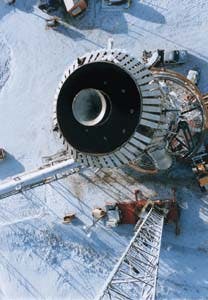
Flare stack eliminates black smoke emissions during flaring of heavy hydrocarbon gases in BP's Prudhoe Bay field in Alaska. At right is an aerial view of the flare tip.
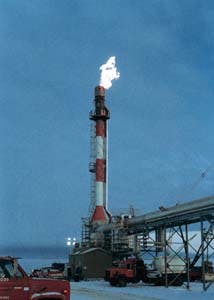
British Petroleum Co. plc and Hamworthy Combustion Engineering Ltd., Poole, U.K., have developed a novel flare stack to reduce smoke from flaring at a Prudhoe Bay oil storage site on Alaska's North Slope.
Hamworthy said engineers from Alyeska Pipeline Service Co. were anxious to solve the problem of black smoke emissions when flaring excess heavy hydrocarbon gases from oil storage tanks.
The companies developed a system that consists of a series of natural gas nozzles fitted to the body of the flare and a flare scan device.
"When the flare starts to smoke, the system automatically squirts high pressure natural gas into the base of the flame," said Steve Warren, Hamworthy process sales director.
The jets have two purposes: to inspirate combustion air and lift the body of the flame away from the top of the flare. This places air into the base of the flame and is the main factor in reducing the amount of smoke.
The system can also inject ferrocene, an organic compound of iron, via the jets. Ferrocene acts as a catalyst to give better combustion and reduce smoke output even further.
Hamworthy said the technology may be used wherever smokeless combustion of heavy hydrocarbon gases is required-specifically, where a source of natural gas at "reasonable" pressure is available.
Dirtiness of smoke is measured in Ringleman numbers, in which Ringleman 0 is clear flame and Ringleman 8 is black smoke.
"The flares originally were generating Ringleman 8 smoke, which was thick black smoke trailing across the horizon," Warren said. "Now they are down to Ringleman numbers of 0 and 1."
The Prudhoe Bay system, designed for a 42 in. riser and flare tip, costs about $200,000. Costs for similar installations will vary, depending on size and complexity of the flare tip.
The system is patented worldwide.
Copyright 1996 Oil & Gas Journal. All Rights Reserved.