Alliance lowers compression costs for U.K. southern gas field
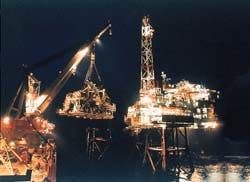
A derrick barge installs the topsides of the Cleeton field compression platform in the southern gas basin of the U.K. North Sea.An alliance between vendors and the operating company substantially reduced the cost for installing a compression platform in the British Petroleum-operated Cleeton field, in the southern gas basin of the U.K. North Sea.
In alliance with BP, owner and operator of the field, were:
- Dresser-Rand Turbo Products Division, manufacturer of the compressor
- Trafalgar House Engineering, design contractors
- Brown & Root McDermott Fabricators Ltd. (Barmac), fabricators of the jacket, piles, and topsides
- Seaway, installation and marine operations
- Trafalgar House Offshore Services, commissioning.
Dresser-Rand said that the alliance provided a more effective and efficient operation that eliminated the sometimes-confrontational relationship between vendors and operators.
The alliance was formed in June 1994, and the platform began operations in November 1996.
Installed on the platform was a Dresser-Rand 463B compressor with an ABB GT35 gas-turbine driver and gear.
Dresser-Rand indicates that the alliance was effective in addressing several issues, such as needed changes to handle salt contamination (20,000 ppm) and providing a location for testing the compression.
A coalescer filter was included in the process stream to try to remove salt. A nearby platform, with another manufacturer's compressor, had been completely blocked off by salt after only operating for 300 hr, according to Dresser-Rand.
The fabricator's yard was selected for testing the compressor. Dresser Rand believes that without an alliance, testing in the fabrication yard would have been contractually difficult.
During the planned 12-year life of the facility, BP expects to compress 470 bcf of gas, with daily compression of 414 MMcf.
Compressor intake is at 315 psi, and discharge pressures range from 1,025 to 1,885 psi.
Operating plans include three rerotoring jobs on the compressor during the expected 12-year life, according to Dresser-Rand.
Copyright 1997 Oil & Gas Journal. All Rights Reserved.