U.K. launches commercial dual-fuel car
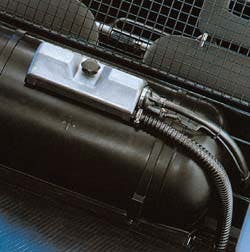
A 56-l. LPG tank is fitted behind the bulkhead of Vauxhall's Combo duel-fuel van. Vauxhall claims the fuel costs of the vehicle in LPG mode are 30% less than for gasoline. The Combo van is also available in a version fueled by compressed natural gas. The manufacturer says CNG is best for short delivery trips, while LPG is better for longer trips and larger vehicles. Photos courtesy of Vauxhall Motors Ltd.Vauxhall Motors Ltd., the U.K. unit of General Motors Inc., has launched Britain's first commercial dual-fuel cars and vans.
![The CNG engine with in-line filter [15,921 bytes]](http://images.pennwellnet.com/ogj/images/ogj2/9621jnca2.jpg)
The company's Vectra and Omega saloon cars and Combo light vans are now available in a version that can run on either LPG or gasoline, changing fuels via a switch on the dashboard.
Vauxhall claims that drivers will notice only a small deterioration in acceleration when the engine is switched from gasoline to LPG, and that LPG otherwise gives similar performance levels to gasoline.
LPG is said to cost about 39 pence/l. (63¢/l.) compared with 67 pence/l. ($1.07/l.) for unleaded gasoline. The Vectra's 46-l. LPG tank weighs 67.1 kg, while the Omega's 68-l. tank weighs 80.1 kg.
The Vectra has a range of 250 miles on LPG, while the Omega's range is 325 miles; the Combo, with a 56-l. LPG tank, will travel up to 335 miles, depending on payload.
The vehicles start up in gasoline mode, but if LPG is already selected they will change fuels after a few seconds. Vauxhall points out that the U.K. government has pledged to raise gasoline and diesel fuel prices by at least 6%/year while not increasing taxes on gas used for transport.
Vauxhall is aiming the dual-fuel vehicles at fleet operators, claiming they help reduce emissions and fuel costs. The dual-fuel vehicles typically cost £2,725 ($4,360) more than gasoline or diesel-engine versions.
Development work at General Motors is continuing, with a production-line hybrid electric car scheduled for introduction in 2001 and a full electric car anticipated by 2004.
Copyright 1998 Oil & Gas Journal. All Rights Reserved.