UAE's OPEC exit highlights strategic value of Fujairah exports amid Strait of Hormuz disruption
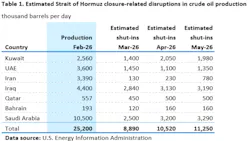
The disruption of crude flows through the Strait of Hormuz has sharpened the strategic importance of the UAE's bypass export infrastructure, underscoring the timing of its formal May 1 OPEC departure. At exit, the UAE ranked as the group's third-largest producer by capacity behind Saudi Arabia and Iraq, with an estimated 4.2 million b/d before the Iran conflict began. Its ability to move those barrels to market now depends heavily on infrastructure outside the Strait.
With roughly 20 million b/d of oil and petroleum products normally transiting the Strait, about one-quarter of global seaborne oil trade, the closure forced regional producers to rely on alternative routes or absorb reduced exports. The UAE and Saudi Arabia hold the region's primary bypass capacity, a distinction that has taken on new weight since the onset of the Iran war late February.
The UAE has rerouted crude exports through the Abu Dhabi Crude Oil Pipeline (ADCOP), which connects the Habshan processing hub to the Fujairah export terminal on the Gulf of Oman, outside the Strait. The pipeline's current capacity of about 1.8 million b/d represents less than half the country's pre-conflict production of 3.4 million b/d, a gap that helps explain Abu Dhabi National Oil Co.'s decision to accelerate construction of a second west-east pipeline. Reuters reported in May that the project would double export capacity through Fujairah by 2027.
Saudi Arabia has similarly redirected volumes through its East-West pipeline system to the Red Sea terminal at Yanbu, which offers roughly 5 million b/d of export capacity.
As a result, both countries have avoided the steeper production shut-ins that have constrained regional peers without access to routes beyond the Strait.
Other producers in the Middle East lacking comparable bypass infrastructure have faced tighter limits on shipments regardless of their OPEC+ output allocations, exposing a practical divide between export capability and production capacity.
The International Energy Agency noted that the UAE has grown production from 3.1 million b/d in 2016 to nearly 4.4 million b/d by 2026. The agency indicated that while the OPEC exit may clear the path for further capacity growth, restoring normal export and production levels remains the near-term priority.
About the Author
 Laura Bell-Hammer
Laura Bell-Hammer
Statistics Editor
Laura Bell-Hammer is the Statistics Editor for Oil & Gas Journal, where she has led the publication’s global data coverage and analytical reporting for more than three decades. She previously served as OGJ’s Survey Editor and had contributed to Oil & Gas Financial Journal before publication ceased in 2017. Before joining OGJ, she developed her industry foundation at Vintage Petroleum in Tulsa. Laura is a graduate of Oklahoma State University with a Bachelor of Science in Business Administration.