Morningstar DBRS: Global diesel squeeze boosts US refiners
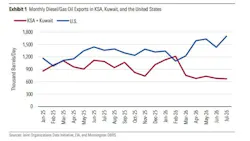
US refiners are benefiting from a tightening global diesel market as disruptions in the Middle East and Russia constrain supply, lift crack spreads, and keep refinery utilization near capacity, according to Morningstar DBRS.
Morningstar DBRS said the current market is creating a strong but likely temporary earnings and cash-flow tailwind for US refiners. High utilization, low inventories, and elevated diesel margins are supporting operating cash flow and EBITDA, although the benefit could fade if geopolitical disruptions ease.
Global diesel supply has tightened since the start of the Iran war as refinery outages, lower crude runs, and constraints on product exports through the Strait of Hormuz reduced Middle East supply. Saudi Arabia and Kuwait diesel exports were down about 40% year over year in July. Russia, meanwhile, extended restrictions on most diesel exports into October. Russia exported more than 780,000 b/d of diesel in 2025, just under 10% of global exports.
US refiners have increased output and exports to help fill the gap. Distillate production averaged 5.1 million b/d during January-August, the highest since 2019. Refinery utilization is already near capacity in several regions, leaving limited room for further increases in output.
PADDs 2 and 4 are operating at or near capacity, supported by discounted Canadian crude, strong diesel export demand, and agricultural and rural consumption. Together, the two regions account for more than 27% of US refining capacity and have an average distillate yield of 32%, DBRS said. On the Gulf Coast, PADD 3 refinery utilization exceeded 98% in September. More than half of US refining capacity is concentrated in PADD 3, where complex refineries serve both export markets and other US regions.
The stronger operating environment is translating into higher refining margins. The US Gulf Coast ultra-low-sulfur diesel premium over crude has risen to its highest level this year, above levels seen during the post-COVID supply squeeze.
US distillate inventories fell below the 5-year average in April, and EIA expects stocks to fall below 100 million bbl in September and remain below that level into 2027, according to DBRS. Strong international prices and export demand are limiting the ability of inventories to rebuild even with refiners running hard.
For refiners, the combination of high utilization, strong distillate demand, and wider crack spreads is boosting operating cash flow and EBITDA and could improve cash flow-to-debt metrics, while credit benefit will also depend on capital allocation, including whether companies use excess cash to reduce leverage or for other purposes. DBRS cautioned, however, that current margins are unusually high and could weaken when geopolitical tensions ease.
US diesel export ban
A potential US diesel export restriction could complicate that outlook. According to a Sept. 23 Politico report, the Trump administration was considering limits on diesel exports to increase domestic supply and moderate prices.
According to DBRS, such a move could initially lift US inventories and lower diesel prices, but it could also weaken Gulf Coast refinery economics. Export markets are a critical outlet for the region, and surplus diesel cannot easily be redirected to other US markets because of storage, infrastructure, and transportation constraints.
If margins weaken materially, refiners could adjust product yields, advance planned maintenance, or reduce crude runs and utilization. Lower throughput would also reduce gasoline and jet fuel output, potentially tightening those markets.
Lower refinery crude demand could also weaken WTI relative to Brent. If reduced runs raise US crude inventories while high freight costs and limited vessel availability constrain exports, the Brent-WTI spread could widen, DBRS said.
About the Author
 Conglin Xu
Conglin Xu
Managing Editor-Economics
Conglin Xu, Managing Editor-Economics, covers worldwide oil and gas market developments and macroeconomic factors, conducts analytical economic and financial research, generates estimates and forecasts, and compiles production and reserves statistics for Oil & Gas Journal. She joined OGJ in 2012 as Senior Economics Editor.
Xu holds a PhD in International Economics from the University of California at Santa Cruz. She was a Short-term Consultant at the World Bank and Summer Intern at the International Monetary Fund.