US, Venezuela reach deal covering 65 billion bbl of oil reserves
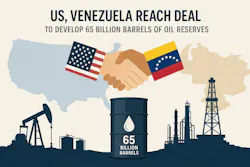
The US and Venezuela have reached an agreement giving the US majority control over development of more than 65 billion bbl of Venezuelan proven oil reserves, President Donald Trump said Aug. 28. Trump said the deal was negotiated by Secretary of State Marco Rubio, Defense Secretary Pete Hegseth, and Venezuelan acting President Delcy Rodríguez.
The agreement covers 17 fields, which Venezuela's government said hold proven oil reserves of 65 billion bbl—roughly a fifth of the country's total proved reserves—and would involve a partnership with private industry to develop them. The fields are concentrated in Venezuela's Orinoco Belt and Lake Maracaibo producing regions.
Under the arrangement, the US government and an unnamed private Venezuelan operator would form a new private company with rights to develop the fields. An administration official, speaking on condition of anonymity, said the US would control 55% of the company's effective output through a combination of an ownership interest and rights to purchase crude at cost.
Crude purchased by the US through the venture would be used in part to replenish the Strategic Petroleum Reserve (SPR) and supply the US military, according to the official.
Venezuela said the projects could attract about $100 billion in investment and generate more than $209 billion in taxes for Caracas. Rodríguez described the agreement as a step toward economic recovery that would modernize the country's oil industry.
Trump said the agreement would increase US access to crude supplies and help lower domestic fuel prices. He did not disclose the structure of the transaction, the fields or companies involved, or how the US would exercise control.
The agreement comes as the US seeks additional crude supplies. The war with Iran reached its 6-month mark Aug. 28, and the SPR fell below 300 million bbl in early August, down more than 100 million bbl since the start of the year.
Venezuela holds about 303 billion bbl of proved crude oil reserves, the world's largest, but years of underinvestment and deteriorating infrastructure have constrained output to about 1.25 million b/d. Developing the fields covered by the agreement would require tens of billions of dollars in infrastructure spending.
Some analysts remain skeptical that the agreement can overcome long-standing obstacles to investment in Venezuela's oil industry, including legal and regulatory uncertainty. Venezuela's constitution reserves ownership of petroleum resources to the state, and oil projects generally operate within a framework involving state oil company Petróleos de Venezuela SA (PDVSA). With no agreement text released, it remains unclear how the new structure would fit within that framework.
Amos Hochstein, a senior energy adviser under former President Joe Biden, said the agreement enters uncharted legal and diplomatic territory and could expose participating companies to major risk. He said the deal could face challenges from a future Democratic administration in Washington or a future Venezuelan government.