Dangote refinery boosts Nigeria’s petroleum product exports
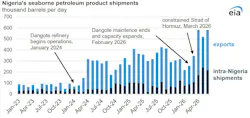
Nigeria’s seaborne petroleum product exports have surged since the startup and expansion of Dangote Industries Ltd. (Dangote Group) subsidiary Dangote Refinery and Petrochemicals Co.'s (DRPC) integrated refining and petrochemical complex in southwestern Nigeria’s Lekki Free Trade Zone, in Ibeju-Lekki, Lagos, increasing the country’s role as a regional and international supplier as refined-product markets face supply constraints elsewhere.
Nigeria’s seaborne petroleum product shipments averaged 561,000 b/d in the second quarter of 2026, up nearly sevenfold from an annual average of 79,000 b/d in 2023, according to data from Vortexa Analytics cited by the US Energy Information Administration (EIA). Exports accounted for about 350,000 b/d of the quarterly total, compared with 46,000 b/d in 2023.
The increase has been driven primarily by DPRC's complex, which began operations in January 2024 and has significantly expanded Nigeria’s domestic refining capacity. The refinery’s impact has become more pronounced following maintenance and expansion work completed in February 2026.
The February 2026 work increased DRPC’s crude distillation capacity to 700,000 b/d from 650,000 b/d. Higher refinery runs, combined with disruptions to petroleum product flows through the Strait of Hormuz, helped push Nigeria’s total seaborne product shipments higher during second-quarter 2026.
The increase in domestic refining has also reduced Nigeria’s dependence on imported petroleum products. Seaborne imports averaged less than 130,000 b/d in second-quarter 2026, down sharply from nearly 400,000 b/d in 2023.
At the same time, Intra-Nigerian shipments increased to 211,000 b/d in second-quarter 2026, compared with 81,000 b/d in 2025 and 33,000 b/d in 2023. The growing domestic distribution network has allowed Dangote to supply more products to parts of the country that previously depended on imports.
Before DRPC's complex came online, Nigeria’s existing state-owned refineries collectively shipped less than 100,000 b/d of petroleum products to domestic and international destinations, EIA said.
Europe, Africa as key markets
Nigeria’s rising product availability has also translated into higher exports to overseas markets.
Seaborne petroleum product exports from Nigeria to Europe averaged 130,000 b/d in second-quarter 2026, more than three times the 40,000 b/d recorded in 2025 and nearly nine times the 15,000 b/d average in 2023.
Exports to other African countries also increased, reaching nearly 120,000 b/d in second-quarter 2026, compared with 89,000 b/d in 2025.
The increase comes at a time when petroleum product supplies from several other regions have been constrained. Disruptions to flows through the Strait of Hormuz have added to the need for alternative sources of refined products, creating additional opportunities for Nigeria’s growing refining sector.
Dangote Group plans to expand the refinery further by adding a second 750,000-b/d crude distillation unit by 2028, which would substantially increase the complex’s potential contribution to Nigeria’s domestic market and international product trade.
About the Author
 Conglin Xu
Conglin Xu
Managing Editor-Economics
Conglin Xu, Managing Editor-Economics, covers worldwide oil and gas market developments and macroeconomic factors, conducts analytical economic and financial research, generates estimates and forecasts, and compiles production and reserves statistics for Oil & Gas Journal. She joined OGJ in 2012 as Senior Economics Editor.
Xu holds a PhD in International Economics from the University of California at Santa Cruz. She was a Short-term Consultant at the World Bank and Summer Intern at the International Monetary Fund.