Slowed vessel traffic and new sanctions on Iran raise oil prices
Oil, fundamental analysis
Crude prices have stair-stepped higher this week as tanker shipments through the Strait of Hormuz slow once again and as Iran continues to indicate it will permanently operate the key bottleneck. Proposed new economic sanctions on Iran by the US have heightened tensions as well. Another large increase in commercial oil inventories was overshadowed by continuing drawdowns in the SPR and increased refinery utilization.
WTI’s High was Wednesday’s $87.70/bbl for September while the Low was Monday’s $80.80. October Brent crude hit its High on Thursday at $94.70/bbl with the low on Monday at $88.00. Both grades settled higher on the week. WTI is down about $7.00 over the last 3 weeks. The WTI/Brent spread has now widened to $7.10. September’s WTI futures contract expired on Thursday bringing October to the forefront on Friday.
US President Donald Trump announced a switch in the approach with Iran from one based upon military action to sweeping economic sanctions which would also include those conducting business with Iran. China is currently the No. 1 importer of Iranian crude. Traders view the economic sanctions as only firming Iran’s resolve, leading to further restrictions on Hormuz passage and additional attacks on its neighbors. The seemingly unending market optimism regarding a resolution of this conflict appears to be diminishing as prices look to stay higher for longer. The US/Iran 60-day MOU signed on June 17, 2026, expired this week without any agreed upon settlement.
Iran has continued talks with Oman about the joint operation of the Strait of Hormuz leading to a threat by Pres. Trump to bomb the latter should it proceed with the arrangement. And despite Pres. Trump’s claim that the US is in “total control” of the Strait, only one or two tankers per day are getting through with an estimated 2.0 million b/d, down from July’s 4.0 million b/d.
Meanwhile, Iraq seeks to increase its output from the current 2.9 million b/d but will need both OPEC approval and new routes to deliver its shipments. The country claims it can reach 8-10 million b/d within the next 6 years. Venezuela’s production has climbed to 1.25 million b/d with US refiners receiving about 500,000 b/d.
The Energy Information Administration’s (EIA) Weekly Petroleum Status Report indicated that commercial crude oil inventories for last week increased while production remained flat. The Strategic Petroleum Reserve (SPR) was down 5.3 million bbl to 293 million bbl (the lowest level since 1983). The EPA is allowing refineries to sell E10, the winter blend, earlier than normal. The oxygenators, such as ethanol, could reduce the cost per gallon depending on oil prices. Meanwhile, diesel crack spreads broke the $100/bbl mark this week, an all-time high as refining capacity worldwide remains constricted.
Oil, technical analysis
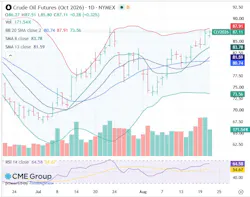
October WTI NYMEX futures are trading above the 8-, 13-, and 20-day Moving Averages and near the Upper-Bollinger Band limit. Volume is below the recent average at 175,000. The Relative Strength Indicator (RSI), a momentum indicator, is overbought at 65. Resistance is now pegged at $87.90 (Upper-Bollinger Band) while near-term Support is $86.85 (Thursday’s Close).
Looking ahead
Time will tell if the new economic sanctions on Iran will result in a reopening of the Strait of Hormuz and return to the negotiating table. The US Naval blockade in the region has successfully stifled shipments of Iranian crude while Iran is running out of storage capacity. Traders will be watching for any definitive arrangement between Iran and Oman to administer the strait and, if completed, the reaction by the Trump administration. Given the worldwide shortage of refined products, look for US refineries to run at higher utilization rates past Labor Day weekend. To produce winter blends earlier than normal, refineries must undergo a turnaround period, which would temporarily take a considerable amount of capacity offline.
Natural gas, fundamental analysis
September NYMEX Henry Hub Natural Gas futures are only slightly higher this week even with increased power generation due to hotter weather as production increased again. A smaller-than-forecasted storage injection spiked prices Wednesday but they would fall back by week’s end. The week’s High was Wednesday’s $2.87.5/MMbtu while the Low was Monday’s $2.64. The Henry Hub contract still remains in a 6-week downtrend. Natural gas demand this week has been estimated at about 115 bcfd with power consumption increasing 2.4 bcfd while supply was thought to be 116-117 bcfd. LNG exports were 17.0 bcf while exports to Mexico were higher at 9-10 bcfd.
A heat wave continues across the EU and UK with wildfires in several areas. In the UK, natural gas prices at the NBP were most recently higher at $22.30/MMbtu. Dutch TTF futures were also higher at $22.40/MMbtu. Asia’s JKM was quoted at $22.60/MMbtu as Asian and European markets are essentially competing for the same shipments. (The US has become the largest supplier of LNG to Japan.) The EIA’s Weekly Natural Gas Storage Report indicated an injection of 16 bcf vs. a forecast of +36 bcf and a 5-year average of +29 bcf. Total gas in storage is now 3.169 tcf, 0.9% below last year and 6.2% above the 5-year average.
Natural gas, technical analysis
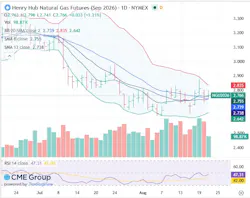
September 2026 NYMEX Henry Hub Natural Gas futures are trading around the 8-, 13- & 20-day Moving Averages. Volume is about the recent average at 100k. The RSI is neutral at 47. Critical Support is $2.75 (20-day MA) with Resistance at $2.85 (Upper-Bollinger Band).
Looking ahead
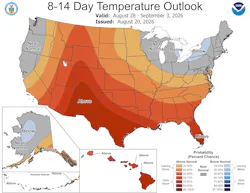
The 8–14-day forecast looks favorable for natural gas-fired generation for most of the US as record high temperatures continue in the Southern tier states. While global LNG prices are strong, the US is currently exporting at maximum output. Look for supply surpluses to continue which will continue to increase storage injections. The EIA is currently projecting a 4.0 tcf level before winter.
About the Author
 Tom Seng
Tom Seng
Dr. Tom Seng is an Assistant Professor of Professional Practice in Energy at the Ralph Lowe Energy Institute, Neeley School of Business, Texas Christian University, in Fort Worth, Tex.