Global product trade disruptions lift refining margins to record highs

Global refined product markets are tightening sharply as disruptions to Middle East supplies coincide with lower Russian exports and reduced refinery activity across parts of Asia, pushing product trade lower and refining margins to record levels.
Global seaborne oil product trade averaged 27.7 million b/d in July, down 3.8 million b/d from a year earlier, according to tanker-tracking data from Kpler and the International Energy Agency (IEA). The decline has been broad-based, with particularly steep losses in diesel, naphtha, fuel oil, jet fuel, LPG, and gasoline shipments.
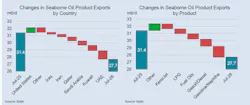
Diesel has been among the hardest-hit products, with global shipments falling about 1 million b/d year-on-year. The supply squeeze has forced importers to seek alternative barrels and pushed Atlantic Basin diesel cracks to all-time highs.
The Middle East has accounted for most of the decline in global product exports. Gulf countries contributed 2.9 million b/d of the year-on-year reduction as shipping restrictions and attacks on energy infrastructure continued to disrupt refinery operations and gas processing.
Stay updated on oil price volatility, shipping disruptions, LNG market analysis, and production output through OGJ's Iran war content hub.
Russian exports have also fallen sharply. Ukrainian drone attacks on Russia's refining sector prompted Moscow to restrict exports of gasoline, kerosene, diesel, and other key products. Russian product exports declined 1.2 million b/d in July year-on-year.
Asian supply has provided little relief. Lower refinery throughputs and export restrictions reduced China's product exports from 850,000 b/d in February to about 500,000 b/d during April-June. Although exports recovered to prewar levels in July, they remained 180,000 b/d below year-earlier levels.
US exports have provided a partial offset, rising 700,000 b/d year-on-year. Latin America has been a key outlet, with US product inflows to the region reaching 2.5 million b/d in July, up 420,000 b/d from pre-conflict levels.
That support, however, has weakened since May. US product exports to other regions have declined by 150,000 b/d, led by reductions in shipments to Asia and Europe of 250,000 b/d and 240,000 b/d, respectively.
Europe is also facing tighter product availability despite a recovery in crude imports. OECD Europe's crude imports returned to prewar levels in July, while product imports fell 135,000 b/d month-on-month and 470,000 b/d year-on-year, to 5.5 million b/d.
Diesel imports accounted for most of the decline, falling 600,000 b/d between February and July. Middle East shipments to Europe fell 350,000 b/d, while supplies from the US and Russia declined 200,000 b/d and 130,000 b/d, respectively. Saudi Arabia, Oman, and Kuwait are now the only Middle Eastern suppliers maintaining diesel flows to the region.