Venezuela pitches oil, gas investment opportunities at Houston showcase
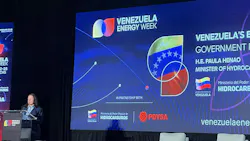
Venezuela used an energy industry gathering in Houston on Aug. 19 to promote investment opportunities for US oil and gas companies, independent operators, service companies, technology providers, and investors as the country seeks to rebuild its energy sector.
Venezuela Energy Week Houston Showcase, held at The Post Oak Hotel, brought together 600 energy executives, investors, and industry leaders. Venezuelan Minister of Hydrocarbons Paula Henao, and Jovanny Martínez, executive vice-president of Petróleos de Venezuela SA (PDVSA), joined industry representatives in highlighting the country's large hydrocarbon resource base and the need for capital, technology, equipment, services, infrastructure, and workforce training to support future development.
Speakers said development of Venezuela's resources will require rebuilding the broader energy “productive chain,” including pipelines, wells, drilling rigs, power systems, equipment, and other infrastructure.
Venezuela has about 303 billion bbl of proven crude oil reserves and 195 trillion cubic feet (tcf) of natural gas reserves, according to the Oil & Gas Journal (OGJ) and the US Energy Information Administration (EIA). Government and industry representatives said the scale of those resources provides significant opportunities for companies prepared to invest in development and modernization.
Global supply outlook
A Rystad Energy presentation provided a broader backdrop for the investment discussion, emphasizing resilient oil demand and the need to develop new sources of supply.
Oil demand forecasts have been repeatedly revised upward as selected sectors have proved more resistant to changes in consumption patterns than previously expected, according to the presentation. The outlook points to continued significant demand for oil even as the energy transition progresses.
At the same time, new liquids discoveries and developments remain critical to meeting future demand, while several traditional sources of supply growth face constraints. Conventional discoveries have remained persistently below replacement rates, increasing the importance of developing large, resource-rich basins.
Rystad estimates that $14 billion in investment could restore 250,000-300,000 b/d of Venezuelan production within 2-3 years through brownfield workovers, infrastructure repairs, and short-cycle investments. Reaching 3 million b/d by 2040 could require about $183 billion, according to the firm.
Independents eye opportunities
A panel of independent operators highlighted opportunities and challenges associated with returning international capital to Venezuela.
Eric McCrady, founder and chief executive officer (CEO) of Crossover Energy, said Venezuela offers substantial conventional resource opportunities but will require technology, equipment, services, and international partnerships to develop them. Crossover has established an operational foothold in eastern Venezuela and is pursuing additional opportunities with PDVSA and the Ministry of Hydrocarbons.
“When we turned an eye to Venezuela, we found there are more conventional resources and opportunities in the country than anywhere else in the world,” McCrady said.
Scott Gilbert, co-founder and non-executive chairman of Apertura Energy, said Venezuela's greenfield opportunities are significant but that building sufficient operating capacity will be a major challenge as international capital returns.
Blake London, managing partner of Formentera Partners, said the company is assessing both conventional and unconventional opportunities, including Venezuela's shale resources.
“We see an opportunity to expand and grow and we’re looking at Venezuela and Libya and there’s such a unique opportunity there, especially in Venezuela, which has just been reopened to the market. We see an opportunity that will complement the conventional opportunity, and you can’t find a better set-up than Venezuela,” London said.
Danny Jimenez, CEO and managing partner of Selten Group, said new independent operators can participate in Venezuela's reopening but will have to address constraints involving equipment, electricity, personnel, and project financing.
The panel also emphasized the need for partnerships that can provide capital, equipment, technical expertise, and operating capabilities at different stages of development.
The Houston event was positioned as an initial opportunity for US industry participants to establish relationships and evaluate potential projects ahead of Venezuela Energy Week, scheduled for Feb. 22-25, 2027, in Caracas.