IEA: Emergency reserve withdrawals slow
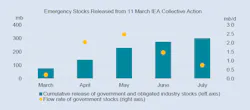
The International Energy Agency (IEA) member countries continued to release emergency oil stocks in July, but the pace of withdrawals slowed sharply as crude supply availability improved in parts of the Asia Pacific and the market faced increasing product tightness.
IEA countries released 26 million bbl of emergency stocks in July, bringing cumulative releases to 300 million bbl since the agency announced a coordinated 400-million bbl action on Mar. 11. Government stock draws averaged 750,000 b/d in July, down from 1.5 million b/d in June and 2.5 million b/d in May.
The slowdown was particularly pronounced among IEA members in Asia Oceania, which released 4 million bbl from emergency stocks in July, compared with 8 million bbl in June and 44 million bbl in May. The decline reflected improved crude oil supply availability in Japan and Korea.
The US also reduced the pace of emergency stock releases. Withdrawals from the Strategic Petroleum Reserve totaled 17 million bbl in July, roughly half the volume released in June.
More than 100 million bbl of the emergency stocks committed under the IEA's 400-million bbl coordinated action has yet to reach the market. The timing of the remaining releases will depend on market developments and broader oil supply security considerations in coming months, according to the agency.
Most of the remaining emergency stocks consist of crude oil, however, limiting their ability to ease increasingly tight oil product markets, IEA said.
At the same time, global observed oil inventories fell sharply in July amid severely constrained shipping through the Strait of Hormuz. Stocks declined by 69 million bbl, equivalent to 2.2 million b/d, with oil on water accounting for more than 90% of the decline.
Oil on water fell by 63 million bbl, or about 2 million b/d, reflecting higher arrivals and lower exports amid renewed risks to transit through the Strait of Hormuz and Bab el-Mandeb. The decline partly reversed the 3.7-million-b/d surge in oil on water recorded in June, when an interim US-Iran ceasefire agreement temporarily allowed Gulf shipments to resume.
By the end of July, global observed oil inventories had fallen below 7.9 billion bbl for the first time since April 2025. Cumulative stock draws from the end of February through July reached 410 million bbl, or 2.7 million b/d on average.