Status of the Strait of Hormuz still impacts oil prices
Oil, fundamental analysis
Crude prices are higher this week as tanker shipments through the Strait of Hormuz slow once again and as Iran continues to indicate it will permanently operate the key bottleneck. An unexpectedly large increase in commercial oil inventories was seemingly ignored by the markets this week and the IEA forecasted both lower production and lower demand for this year. WTI’s High was Tuesday’s $83.35/bbl for September while the Low was Monday’s $76.80.
October Brent crude hit its High on Tuesday at $90.05/bbl with the low on Monday at $83.35. Both grades settled higher on the week. WTI is about $7.00 down over the last 3 weeks. The WTI/Brent spread has now widened to $6.10.
Global crude oil prices moved higher this week as Iran has increased attacks on ships attempting to traverse the Strait of Hormuz while the US continues its blockade of Iranian vessels as well indicating it could maintain this indefinitely. This has led to a drop in overall traffic as tanker-tracker Kpler reports about 11 ships per day are now successfully making way vs. over 100 per day pre-war.
Iran still espouses the idea of permanently controlling the Strait while charging administrative fees for passage. Countering that stance, US President Trump declared this week that the US has total control of the Strait. This ongoing uncertainty continues to gyrate prices daily. And, as they look for viable alternatives and new projects to move their oil, refined products, and LNG out of the region, petrostates in the Persian Gulf region are conceding that the future of the Strait of Hormuz will be controlled by Iran.
Despite increasing its output by over 1.0 million b/d, Saudi Arabia has only been able to move an incremental +200,000 b/d and has been forced to store the remainder due to the new disruptions at the Bab el-Mandeb Strait on Saudi Arabia’s west coast in the Red Sea. Its domestic inventories are now the highest since 2016. Meanwhile, Ukraine continues its assault on Russian oil refining infrastructure which is part of the higher refined products market along with the Strait of Hormuz debacle.
The International Energy Agency (IEA) is forecasting an average drop in global oil production of 4.3 million b/d this year which will result in a third-quarter 2026 deficit of 1.8 million b/d. Meanwhile, higher prices for refined products could lead to 1.6 million b/d in demand destruction. On the other hand, OPEC sees a more moderate demand decline of about 580,000 b/d. The US Energy Information Administration (EIA) expects domestic US oil production to average a record 13.8 million b/d this year.
The EIA's Weekly Petroleum Status Report indicated that commercial crude oil inventories for last week increased substantially while production remained flat. The SPR was down 6.1 million bbl to 299 million bbl (the lowest level since 1983).
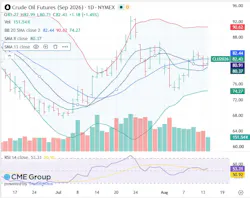
September WTI NYMEX futures are trading above the 8- and 13-day Moving Averages and right on the 21-day MA. Volume is below the recent average at 155,000. The Relative Strength Indicator (RSI), a momentum indicator, is neutral at 53. Resistance is now pegged at $83.00 (Friday’s High) while near-term Support is $80.10 (Thursday’s Low).
Looking ahead
While the US and Iran debate who actually controls the Strait of Hormuz, Persian Gulf petrostates are looking for existing alternative routes and proposing entirely new projects. Three to five years from now, a much smaller amount of crude and refined products may pass through the Strait especially if there are fees for transit. In the short term, the level of attacks in the region and confirmed vessel traffic will dominate the market. The overall demand picture will change once the peak summer travel season is over in about 3 weeks. Phillips66, along with Kinder Morgan and HF Sinclair, announced a $5 billion pipeline project that will deliver refined products from West Texas to California which has lost two refineries this year.
Natural gas, fundamental analysis
Despite continuing production increases, hotter weather, and peak LNG production boosted September NYMEX Henry Hub Natural Gas futures this week although they traded in a tight, $0.15 range. A larger-than-forecasted storage injection capped any rally. The week’s High was Wednesday’s $2.85/MMbtu while the Low was Monday’s $2.70. The Henry Hub contract still remains in a 5-week downtrend.
Natural gas demand this week has been estimated at about 115 bcfd with power consumption increasing while supply was thought to be 113 bcfd. LNG exports have topped-out at 18.0 bcf while exports to Mexico were lower at 6.0 bcfd. A heat wave continues across the EU and UK with wildfires in several areas.
In the UK, natural gas prices at the NBP were most recently higher at $20.17/MMbtu. Dutch TTF futures were also higher at $20.47/MMbtu. Asia’s JKM was quoted at $21.20/MMbtu as Asian and European markets are essentially competing for the same shipments.
The EIA’s Weekly Natural Gas Storage Report indicated an injection of 36 bcf vs. a forecast of a 30 bcf increase and a 5-year average of 33 bcf. Total gas in storage is now 3.153 tcf, 0.8% below last year and 6.7% above the 5-year average.
Natural gas, technical analysis
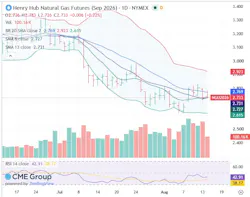
September 2026 NYMEX Henry Hub Natural Gas futures are trading below the 8-, 13-, and 20-day Moving Averages and have breached the Lower-Bollinger Band limit. Volume is about the recent average at 105,000. The RSI is oversold at 35. Critical Support is $2.60 (Lower Bollinger Band) with Resistance at $2.70 (8-day MA).
Looking ahead
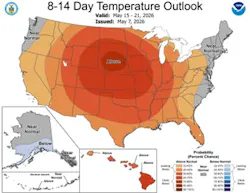
The 8–14-day forecast looks favorable for natural gas-fired generation for most of the US. While global LNG prices are strong, the US is currently exporting at maximum output. Look for supply surpluses to continue which will continue to increase storage injections.
About the Author

Tom Seng
Dr. Tom Seng is an Assistant Professor of Professional Practice in Energy at the Ralph Lowe Energy Institute, Neeley School of Business, Texas Christian University, in Fort Worth, Tex.