IEA revises down 2026 oil demand forecast

Global oil demand is now projected to decline by 1.6 million b/d in 2026, 510,000 b/d more than forecast in the previous month, according to the International Energy Agency’s (IEA) August Oil Market Report (OMR). The downward revision reflects the ongoing closure of the Strait of Hormuz and persistently high fuel prices, which are weighing on consumption.
Still, “reported delivery data suggest that the worst may be behind us,” IEA said. May’s 5.8 million b/d year-on-year (y-o-y) decline likely marked the nadir. June, for which several major economies have reported preliminary or final data, showed an improvement, with demand down 4.8 million b/d y-o-y. Assuming continued normalization, global demand is expected to return to growth by November, according to IEA.
Specifically, IEA forecasts that the annual decline in demand will narrow from 4.9 million b/d in second-quarter 2026 to 2.8 million b/d in the third quarter, before returning to growth in the fourth quarter. Global oil demand is projected to grow by 2.4 million b/d in 2027.
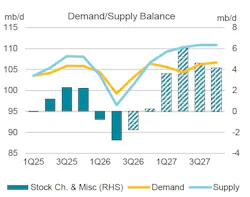
Global oil supply, market balance tighten
Global oil supply increased by 2.4 million b/d in July to 101.5 million b/d but remained 6.3 million b/d lower than the same period last year, with 8.3 million b/d of production still shut down in the Gulf region.
“Renewed hostilities and maritime disruptions in July and early August undermined the recovery efforts, reducing projected third-quarter 2026 oil supply by 1.7 million b/d compared with last month’s report,” IEA said. Global oil supply is now projected to decline by 4.3 million b/d on average in 2026 and rebound by 8.3 million b/d next year to 110.3 million b/d.
The global oil balance is now expected to show a deficit of 1.8 million b/d in third-quarter 2026, IEA said, more than double the estimate of around 800,000 b/d in last month’s report.
“Although the market is projected to return to surplus towards the end of this year, risks remain substantial and the urgency of reopening the Strait has increased, as previously available inventory buffers are rapidly depleting,” IEA said.
Refinery runs remain under pressure
Global refinery crude throughputs increased further in July, but remained nearly 5 million b/d lower than the same period last year, at 80.9 million b/d. Continued disruptions to Middle Eastern refined product exports and attacks on Russian refineries are expected to lead to a further decline of 370,000 b/d in refinery utilization rates in the third quarter of 2026.
Global throughputs are currently projected to decline by an average of 2.5 million b/d in 2026, before rebounding by 3.5 million b/d in 2027. Tightening supply in the light and medium distillate markets has pushed up crack spreads and margins in the Atlantic Basin to record highs.
Global monitored crude oil inventories plunged by 69 million b/d in July, due to renewed disruptions to exports from the Gulf and Caspian Sea regions, resulting in a significant decrease in offshore crude oil volumes. Meanwhile, due to a slowdown in the IEA emergency inventory releases and a continued decline in Chinese crude oil inventories, onshore crude oil inventories decreased only slightly by 6 million bbl. Currently, globally observed crude oil inventories are slightly below 7.9 billion bbl, a decrease of 410 million bbl since the outbreak of the war.
About the Author
 Conglin Xu
Conglin Xu
Managing Editor-Economics
Conglin Xu, Managing Editor-Economics, covers worldwide oil and gas market developments and macroeconomic factors, conducts analytical economic and financial research, generates estimates and forecasts, and compiles production and reserves statistics for Oil & Gas Journal. She joined OGJ in 2012 as Senior Economics Editor.
Xu holds a PhD in International Economics from the University of California at Santa Cruz. She was a Short-term Consultant at the World Bank and Summer Intern at the International Monetary Fund.