Morningstar: Global biofuel demand surges amid energy security concerns
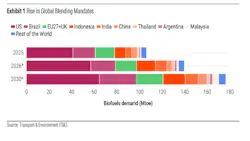
Global biofuel consumption is projected to grow 30% this year, with upside potential extending through 2030, according to Morningstar DBRS. That growth is being fueled by a combination of higher oil costs, geopolitical shocks, and new blending mandates.
Much of this momentum traces back to the conflict involving Iran and the resulting shipping constraints in key routes such as the Strait of Hormuz and the Red Sea. These disruptions have heightened energy security concerns and pushed governments to accelerate biofuel adoption. With oil prices running roughly 25% above 2025 levels year to date, the economic case for alternatives like ethanol, biodiesel, and renewable diesel has strengthened considerably, while new and expanded blending mandates are reinforcing demand growth, Morningstar said.
Still, biofuels remain a relatively small slice of total transport energy demand and are unlikely to materially displace crude-derived fuels in the near term. Their growth is also highly sensitive to oil prices and policy support, which raises questions about how sustainable the current expansion really is. Morningstar points to the industry's history of boom-and-bust cycles as a cautionary note—the early 2000s saw overexpansion followed by margin pressure and plant closures—and warns that growth could moderate if fossil fuel prices fall or government subsidies and mandates are scaled back.
Looking ahead, demand growth is expected to be led by emerging markets, particularly in the Asia Pacific, where rising fuel consumption and stronger policy support are driving expansion. While the US will remain the largest biofuel market overall, countries such as India, Brazil, and Indonesia are projected to account for much of the incremental demand growth through 2030.
Despite these favorable dynamics, structural challenges persist. Feedstock constraints, land-use pressures, and competition with food supply could all limit long-term growth, while lower oil prices or weaker policy support could erode biofuel competitiveness, Morningstar cautioned. As a result, investment is increasingly shifting toward advanced biofuels derived from waste and non-food sources.
For large integrated oil companies, this expansion looks more like an opportunity than a threat, Morningstar said. The firm reports that ExxonMobil Corp., bp plc., Chevron Corp., Shell PLC, TotalEnergies SE, and Eni SPA collectively have more than 40 biofuel projects either operating or planned through 2030, with many centered on sustainable aviation fuel (SAF), renewable diesel, and hydrotreated vegetable oil.
Company strategies differ in focus: ExxonMobil is emphasizing waste-based renewable diesel, while Shell leads in sugarcane ethanol and holds the strongest SAF position among the majors. Chevron is consolidating its US renewables footprint through its Renewable Energy Group acquisition, and bp has broadened its platform through ethanol, renewable diesel, SAF development, and full ownership of its Brazilian joint venture, Bunge Bioenergia.