Galp boosts earnings, advances Sines renewable projects
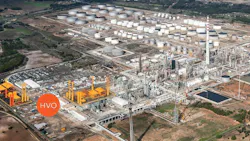
Galp Energia, SGPS, SA reported higher adjusted earnings for first-half 2026, amid increased oil production in Brazil and stronger crude oil pricing.
Adjusted net income (RCA) reached €812 million in the first 6 months of the year and €540 million in the second quarter, Galp said on July 27.
Galp attributed the improvement to a 17% year-over-year (y-o-y) increase in oil and natural gas production, supported by the start of operations and ramp-up of Bacalhau field in Brazil, as well as a 28% y-o-y increase in the average Brent crude price to $92.30/bbl.
RCA earnings before interest, taxes, depreciation and amortization (EBITDA) rose by more than 70% in both the semi-annual and quarterly periods. During first-half 2026, upstream RCA EBITDA increased by more than 70% y-o-y to a level representing 62.5% of Galp’s total EBITDA, which exceeded €2.2 billion. During the second quarter, upstream RCA EBITDA accounted for more than half of total group EBITDA, reaching €1.27 billion, the operator said.
A second source of earnings support during first-half 2026 came from Galp’s industrial and midstream segments, including refining. The company linked refining results to historically high differentials between international crude benchmarks such as Brent and refined product prices, with refining margins averaging $15.80/bbl in the first half of the year.
Capital spending
The operator’s total first-half 2026 spending stood at €696 million, with second-quarter 2026 capital expenditures totaling €496 million. Capex primarily reflected the €318-million acquisition of a 351-MW portfolio of operational onshore wind assets in Spain.
Galp said an organic capex of €177 million during the second quarter covered ongoing execution of a low-carbon hydrogen and advanced biofuels projects at its 226,000-b/d Sines refining and industrial complex at the Port of Sines, in Setúbal, Portugal, as well as upstream Brazilian pre-salt investments, including its Bacalhau field development and infill drilling at Tupi field.
Galp said it directed more than 70% of first-half 2026 investments to the Iberian Peninsula, including €109 million for the Sines refinery’s low-carbon projects.
Sines low-carbon initiatives
Ongoing investments at Galp’s Sines complex—Portugal’s sole refinery—come as part of the operator’s broader industrial transformation strategy, which aims to gradually replace the site’s production of fossil fuels with sustainable alternatives, the operator said in its 2025 annual report published in March 2026.
Taken for final investment decision in 2023, the two low-carbon projects include installation of a 100-MW electrolyzer plant for large-scale production of green hydrogen that aims to replace about 20% of the refinery’s current consumption of grey hydrogen, as well as construction of a new plant designed to flexibly produce—depending on market conditions—about 270,000-tonne/year (tpy) combined of renewable diesel (hydrotreated vegetable oil; HVO), sustainable aviation fuel (SAF), bio-naphtha, and bio-propane using green hydrogen, according to Galp.
Developed as part of a joint venture between Galp (75%) and Mitsui & Co. Ltd. (25%) inside the Sines refinery and an adjacent area belonging to the Sines Industrial and Logistics Zone (ZILS) across 9.3 hectares, Galp said it expects the €400-million Sines renewable fuels plant—which will include a renewable feedstock pretreating unit—to replace up to 263,000 tpy of conventional diesel, 193,000 tpy of fossil-based jet fuel, and between 4-69,000 tpy of fossil-sourced naphtha.
The €250-million green hydrogen unit and HVO-SAF plant at Sines are scheduled for startup by yearend 2026, according to the operator.
About the Author
 Robert Brelsford
Robert Brelsford
Downstream Editor
Robert Brelsford joined Oil & Gas Journal in October 2013 as downstream technology editor after 8 years as a crude oil price and news reporter on spot crude transactions at the US Gulf Coast, West Coast, Canadian, and Latin American markets. He holds a BA (2000) in English from Rice University and an MS (2003) in education and social policy from Northwestern University.