Supply resilience has emerged as a central theme, speakers say at OGJ LNG breakfast
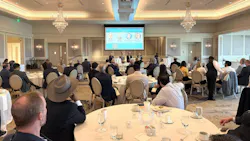
The global LNG market is increasingly being shaped by geopolitical risk and the need for greater supply resilience, speakers said during Oil & Gas Journal's LNG Mid-Year Forecast & Review breakfast held June 9 in Houston.
The event featured a keynote presentation by Rob Cordray, partner and managing director for the Americas at Rystad Energy, followed by a panel discussion including Kenneth Medlock, senior director of the Center for Energy Studies at Rice University's Baker Institute; Glenn Wilson, chief financial officer of Coastal Bend LNG; and Steven Borsos, vice-president of LNG for Fluor.
Cordray's keynote, titled "Global LNG: Rebalancing in an Era of Conflict, Constraint and Optionality," focused on how the LNG market is responding to escalating geopolitical tensions and uncertainty surrounding Middle East trade routes.
"The key swing factor is not the restart, but normalization of shipping access and insurance," Cordray said, noting that emerging Asia and China are learning the same lesson that supply resilience beats import dependence.
According to Rystad's analysis, a prolonged disruption to traffic through the Strait of Hormuz could result in global LNG volume losses ranging from 43 million tonnes to 68 million tonnes during 2026, depending on the duration and severity of the disruption.
Cordray argued that the market ultimately balances through demand destruction rather than runaway prices, warning that today's supply shock risks creating longer-term demand losses in Asia as consumers seek alternatives to imported LNG. He noted that supply growth continues to advance despite near-term disruptions, increasing the possibility of oversupply later in the decade.
During the panel discussion, speakers examined whether recent demand reductions across Asia represent a temporary response to higher prices or the beginning of more permanent structural changes in LNG consumption patterns.
Medlock pointed out that the LNG market is undergoing a strategic shift from prioritizing cost optimization to prioritizing resilience. Buyers are increasingly willing to diversify their supply portfolios and secure multiple LNG sources to enhance their ability to withstand geopolitical turmoil and supply chain shocks.
The discussion also explored the competitive outlook for future LNG supply projects. Panelists noted that Canada's Pacific Coast projects and Argentina's Vaca Muerta resource base continue to attract industry attention as potential sources of future LNG exports to Asian markets. However, speakers generally agreed that project economics, commercial contracting, and access to capital will determine which developments ultimately advance.
Drawing on Coastal Bend LNG's experience navigating both permitting requirements and legal challenges, Wilson discussed the increasingly complex regulatory environment facing LNG developers. Providing confidence that projects can navigate permitting and legal processes has become an increasingly important factor in securing support from investors, lenders, and prospective customers.
Borsos discussed ongoing efforts to improve project competitiveness through modularization, standardization, and construction efficiencies aimed at reducing costs and improving schedule certainty.
The panel also fielded numerous questions from the audience on topics ranging from US natural gas pricing and LNG project economics to EPC execution, tariffs, and emerging technologies.