IEA: Global LPG markets struggle to replace disrupted supply
Tightening LPG supplies following the disruption of Middle East exports through the Strait of Hormuz have left global propane and butane markets unable to fully replace lost volumes, the International Energy Agency (IEA) said.
In 2025, Gulf countries exported almost 1.5 million b/d of LPG through the Strait of Hormuz, primarily to Asian markets. By April, those flows had fallen to 270,000 b/d, overwhelmingly from Iran, according to Kpler data.
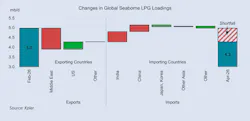
The IEA said a 50,000 b/d increase in Saudi Arabian LPG exports from Yanbu compared with 2025 levels still left a supply shortfall of about 1 million b/d that other exporters have so far been unable to offset.
Several smaller exporting countries increased shipments in April compared with 2025 averages, including Australia, Argentina, Türkiye, and Nigeria, each by 20,000 b/d. The UK and Oman each increased exports by 10,000 b/d. Algeria, Canada, and Norway showed little change in export volumes.
The US provided the largest increase in supply. US LPG loadings rose by 450,000 b/d, or 20%, from 2025 average levels, lifting exports to 2.7 million b/d. According to the IEA, that represented 69% of total global seaborne LPG supply.
Preliminary US Energy Information Administration (EIA) stock data through early May indicated the increase in exports has had limited impact on inventories. US propane inventories, which bottomed out in February, remained at an all-time seasonal high despite what the IEA described as a relatively cold winter.
Export terminal capacity has become a key constraint on additional US LPG shipments. Installations with ethane-propane flexibility appeared to prioritize propane exports. Ethane is used primarily in petrochemical applications, while propane serves a broader range of markets.
The IEA said petrochemical feedstock flexibility, particularly in China, along with inventories of polymers and intermediates, has helped cushion supply disruptions temporarily. However, it warned that shortages of plastics and fibers linked to reduced Gulf exports could increasingly affect manufacturing, agriculture, and construction sectors as inventories decline.
India was identified as one of the countries most affected by the disruption. LPG arrivals into India in April fell by more than 40% from January-February levels despite increased US volumes. The disruption was felt quickly because of the proximity of Indian ports to Hormuz, while replacement cargoes from alternative suppliers can take more than 4 weeks to arrive.
Most Indian LPG demand is used for household and commercial cooking. The IEA estimated Indian LPG demand declined by 16% in April. The government implemented a range of interventions aimed at stabilizing the market and limiting impacts on consumers.
About the Author

Conglin Xu
Managing Editor-Economics
Conglin Xu, Managing Editor-Economics, covers worldwide oil and gas market developments and macroeconomic factors, conducts analytical economic and financial research, generates estimates and forecasts, and compiles production and reserves statistics for Oil & Gas Journal. She joined OGJ in 2012 as Senior Economics Editor.
Xu holds a PhD in International Economics from the University of California at Santa Cruz. She was a Short-term Consultant at the World Bank and Summer Intern at the International Monetary Fund.