Oil, fundamental analysis
Conflicting statements emanating from both sides of the Iran war this week continue to baffle a market seeking direction. What is becoming more and more apparent, however, is that there has been substantial damage to oil and gas infrastructure in the Persian Gulf region which will lead to a longer-term impact on global prices.
Last Sunday’s trading jumped higher to over $100/bbl for WTI on Pres. Trump’s threats to bomb Iran’s power generation if they did not open the Strait of Hormuz. But, by Monday’s regular trading session, he announced a 5-day waiting period for those attacks and the market fell back only to rally higher later in the week.
The week’s Low was $84.40/bbl on Monday with the High of $101.70/bbl also occurring Monday. Brent crude followed a similar pattern hitting a High of $114.45/bbl on Sunday evening and a Low of $99.95 on Monday. And, while WTI is traded higher than last week, Brent is slightly lower. The WTI/Brent spread fluctuated throughout the week but now sits at $3.00. A large gain in commercial stocks had little impact on the week’s rally.
With Pres. Trump’s 5-day pause on his threat to attack Iran’s power plants along with statements he made that negotiations were taking place and Iran is seeking peace, crude prices fell Monday. However, Iran denied any such conversations but did issue the conditions under which they would consider halting the hostilities, none of which are acceptable to the US and Israel currently. Iran also rejected the US proposals for ending the war. Trump later extended his pause on strikes for 10-days while continuing to demand that Iran free-up the Strait of Hormuz. Furthermore, thousands of US special forces are being moved into the region in anticipation of an invasion of Kharg Island where 90% of Iran’s oil exports are loaded onto tankers.
The continuing attacks by both sides have kept oil at the current higher levels. The risk premium has become reality with the continuing interruption of flows through the Strait.
The International Energy Agency (IEA) has identified about 40 damaged oil and gas infrastructures so for across the spectrum from oil and gas fields to pipelines, refineries, and export ports. Shell plc, specifically, reported that its gas-to-liquid (GTL) plant in Qatar has suffered extensive damage that will take at least a year to repair. And it’s already been reported that Qatar’s LNG export infrastructure have lost 17% of capacity that could take 3-5 years to fix.
Both India and China have reached out to Iran requesting passage of tankers bearing crude and refined products. Some of those have been allowed to pass while the IRGC is charging a toll of $2.0 million for other, “non-enemy” ships to traverse through. So, while not 100% open, we are seeing some oil, refined products and LPG getting moved out of the area.
Meanwhile, Iraq has had to cut production as its ability to store crude that can’t be exported is diminishing. It is now estimated that 7-12 million b/d of production has been halted due to a lack of outlets. Saudi Arabia’s East-West pipeline has provided some alleviation but, despite a design capacity of up to 7.0 million b/d, it’s currently only able to ship about 4.0 million b/d.
Countries dependent on energy coming from the conflict area are desperately seeking any/all other sources. India is looking to Russian LNG and has received permission from the US to buy Urals. They are also reported to be buying from Iran. Japan is now allowing a higher level of coal usage for power generation given the higher global LNG prices which so no sign of abating.
Meanwhile, South Korea has halted all exports of the important petrochemical feedstock naphtha. The Philippine government has declared an energy emergency as it nears only 45 remaining days of refined products supplies.
Outside of the Persian Gulf region, Ukraine continues to conduct drone attacks on Russian port infrastructure while the IEA considers another withdrawal from the collective members’ reserves.
The Energy Information Administration’s (EIA) Weekly Petroleum Status Report indicated that commercial crude oil inventories for last week increased for the 5th straight week. The Strategic Petroleum Reserve (SPR) remains at 415 million bbl while production held at 13.7 million b/d vs. 13.6 a year ago.
The Iran war oil shock continues to weigh heavily on the US and global economies. Business activity slowed to an 11-month low this month with higher energy prices and other inputs as the PMI flash index fell to 51.4. Rising prices for gasoline and food has caused a drop in the Consumer Confidence Index from 56.6 last month to 53.3 while analysts are forecasting a rise in inflation to 3.8%. Forecasts for next week’s jobs report expect a gain of 48,000 and an unemployment rate of 4.5%. All 3 major US stock indexes are lower week-on-week at down to levels not seen since last August. The USD is higher than last week which may be helping keep a ceiling on oil prices. Gold remains below the $5,000/oz. mark.
Oil, technical analysis
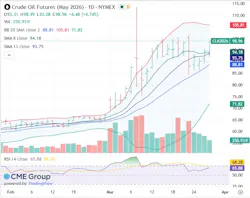
May 2026 WTI NYMEX futures are trading around the 8- and 13-day Moving Averages but above the 20-day MA. Volume is below the recent average at 225,000. The Relative Strength Indicator (RSI), a momentum indicator, is in overbought territory at 66. Resistance is now pegged at $100.00 while near-term Support is $92.0.
The Friday Effect is also in place as traders have to worry about events over the weekend that could further increase prices while the market is closed until Sunday evening.
Looking ahead
There needs to be some concrete sign of the ceasing of hostilities on both sides or we will continue to see more oil and gas production and infrastructure degradation. Iran is taking a very hardline stance on Hormuz so markets must now assess the likelihood of a US military intervention at the Strait or Kharg Island or both. Traders must now be ever vigilant this weekend and stay on top of any developments this weekend since, thus far, the major events impacting oil markets of late have occurred on the weekend.
US inventories of both crude feedstocks and refined products are currently in a good situation. But a prolonged conflict could change that as we are 2 months from the starting of the summer driving/traveling season. The tanker tracker map below does show fewer ships stranded upstream from Hormuz than last week.
Natural gas, fundamental analysis
April NYMEX natural gas futures reached Final Settlement Friday after trading lower on mostly mild weather, a small storage withdrawal and despite rising global LNG prices. This week’s High was Monday’s $3.15/MMbtu while the Low was Wednesday’s $2.85.
Natural gas demand this week has been estimated at 102 bcfd while production was thought to be 109 bcfd. LNG exports held at 19.0 bcf. In the UK, natural gas prices at the NBP were most recently at $18.05/MMbtu while Dutch TTF futures were $18.95. Asia’s JKM was quoted at $20.40/MMbtu as Asian markets have to compete with Europe.
The EIA’s Weekly Natural Gas Storage Report indicated a withdrawal of 54 bcf vs. a forecast of -51 bcf. Total gas in storage is now 1.829 tcf, now at 5.2% above last year and 0.8% above the 5-year average.
Natural gas, technical analysis
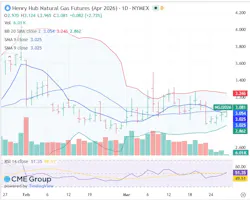
April 2026 NYMEX Henry Hub Natural Gas futures are holding near the 8-, 13-, and 20-day Moving Average. Volume is below the recent average at 6,000 as April settled Friday. The RSI is now neutral at 51. Support is $3.00 with key Resistance at $3.10.
Looking ahead
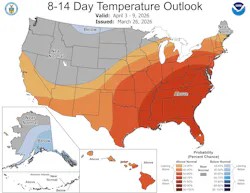
Despite higher global prices for LNG, US exporters are maxed-out which minimizes the impact on domestic natural gas prices. With March ending, April is normally a shoulder demand month and we could see a storage injection next week. The 8-14-day outlook appears bearish for heating and power demand for natural gas.
Iran war coverage hub
This Iran war compilation hub highlights news, insights, and updates from Oil & Gas Journal and Offshore, both EndeavorB2B brands, concerning the war in Iran.
About the Author

Tom Seng
Dr. Tom Seng is an Assistant Professor of Professional Practice in Energy at the Ralph Lowe Energy Institute, Neeley School of Business, Texas Christian University, in Fort Worth, Tex.