No action in US-Iran conflict reduces market risk premium

Oil, fundamental analysis
With little progress being made in the US-Iran talks and, with no military action by either side, traders reduced the market risk premium this week with a 'wait-and-see' attitude. An unexpectedly large gain in crude inventory and an increase in gasoline stocks provided bearish momentum for prices to move lower. US prices still remained above the key $60/bbl level. WTI had a High of $65.85/bbl on Wednesday with a weekly Low of $61.15 on Friday.
Brent crude’s High was $70.70/bbl on Wednesday while its Low was $66.90 Friday. Both grades settled lower week-on-week. The WTI/Brent spread has widened to ($4.90) on the earlier week rally. Look for this to tighten next week.
US-Iran talks are scheduled to continue which lends an optimistic tone however, a second US aircraft carrier is reported to be heading into the Middle East, a move that could add risk premium back into oil markets. US-flagged ships were told to avoid Iranian waters when traversing the Strait of Hormuz. Israeli PM Netanyahu visited the White House this week to present his countries demands for limitations on Iran’s uranium enrichment and its backing of rebel groups like Hamas and Hezbollah.
With near-term concerns regarding supply disruption abating, the market has returned to a focus on over supply. The International Energy Agency (IEA) in Paris has lowered its forecast for global crude demand for this year while stating that global inventories last year grew at their strongest pace since 2020. On the other hand, the OPEC+ group output for January fell by 440,000 b/d.
As part of a wider trade deal, India has agreed to halt its purchases of Russian crude. In return, the US will slash the tariffs on imports from India from the punitive 50% back down to the 18% level.
US exploration and production (E&P) companies such as Continental Resources and EOG Resources are looking to take hydro-fracturing technologies to countries like Argentina, Turkey, Australia, and the UAE as some industry analysts have indicated a 15% decline in productivity in the Permian basin since 2020.
India’s total imports of Urals has already dropped to 435,000 b/d last month from prior months at 1.5 million. The ultimate US goal is to lessen Russia’s largest source of revenue which is funding the Ukraine war.
The Energy Information Administration’s Weekly Petroleum Status Report indicated that commercial crude oil inventories for last week increased while the Strategic Petroleum Reserve held at 415 million bbl. Total US oil production was 13.7 million b/d last week vs. 13.5 last year at this time.
There were several positive signs for the economy this week. Consumer prices rose 2.4% last month vs. January 2025, an eighth-month Low and down from December’s +2.7%. Forecasters had expected a similar number to December. Lower gasoline prices helped while food costs continued to rise. The US economy added 130,000 jobs last month representing the strongest growth in more than a year. Analysts were calling for +55,000. December numbers were revised downward to only +48,000.
For last year, however, only a total of 185,000 jobs were added for the entire year. The January report has caused concern that the Fed will now have no reason to lower rates again in the near future. Despite the positive data, all 3 major US stock indexes are lower week-on-week and the Dow is back below the 50,000 mark after trading above for the first 3 days of the week. The USD is lower as well which is supportive for oil prices. Gold stayed above $5,000/oz as the USD declined.
Oil, technical analysis

March 2026 WTI NYMEX futures have fallen back to their 21-day Moving Average and below the 8- and 13-day MAs. Volume was below the recent average at 200,000. The Relative Strength Indicator (RSI), a momentum indicator, is still in neutral territory at 53. Resistance is now pegged at $63.85 (the convergence of the 8- and 13-day MAs). while near-term Support is $62.15 (Friday’s Low).
Looking ahead
Crude markets will be looking to see if China will step-in and take India’s volumes of Russian Urals which are heavily-discounted due to price sanctions. China has already increased its purchases with January’s 1.8 million representing a 46% year-on-year increase and more than they currently buy from Saudi Arabia. And, once again, the market will ebb-and-flow with the latest US-Iran talks or military action by either party.
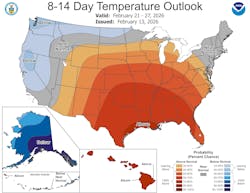
Unfortunately for traders, should anything happen over the weekend, the market is closed until Sunday evening at 6:00 pm EST. The 8-to-14-day forecast is still looking bearish for the use of heating oil.
Natural gas, fundamental analysis
March NYMEX natural gas futures fell this week on warmer weather and a less-than-forecasted storage withdrawal. Yet the total storage level is now below last year and the 5-year average. The week’s High was Thursday’s $3.32/MMbtu while the Low was Wednesday’s $3.05. Natural gas demand this week has been estimated at up to 110 bcfd while production was thought to be 107 bcfd. LNG exports held at 18.5 bcf. In the UK, natural gas prices at the NBP were most recently lower at $10.45/MMbtu while Dutch TTF futures were also lower at $11.30. Asia’s JKM was quoted at $11.00/MMbtu. The Energy Information Administration's (EIA) Weekly Natural Gas Storage Report indicated a withdrawal of 249 bcf vs. a forecast of -264 and a 5-year average of -146 bcf. Total gas in storage is now 2.214 tcf, now 4.2% below last year and 5.5% below the 5-year average.
Natural gas, technical analysis

March 2026 NYMEX Henry Hub Natural Gas futures started the week on a rare “gap-down” where Sunday evening’s “Open” price was below the Low from Friday. Prices have fallen to below the 8-, 13-, and 20-day Moving Averages. Volume was below average at 109,000. The RSI is still in neutral territory at 47. Support is $3.05 (week’s Low) with key Resistance at $3.45 (convergence of the 13- and 21-day MAs).
Looking ahead
There has been a rapid warm-up for most of the country and the 8-to-14-day forecast looks bearish for natural gas demand. Also, there will be a much smaller storage withdrawal for this week. Additionally, if the mild weather continues, holders of gas in storage will want to get it all out before Apr. 1 so they can re-inject for next year. Barring another sustained blast of cold from the Arctic, prices will be under pressure.
About the Author

Tom Seng
Dr. Tom Seng is an Assistant Professor of Professional Practice in Energy at the Ralph Lowe Energy Institute, Neeley School of Business, Texas Christian University, in Fort Worth, Tex.