A volatile week for crude ends with lower prices

Oil, fundamental analysis
Several factors whipsawed crude prices this week with WTI seeing a $12/bbl Hi/Lo spread. Varying accounts of flowing oil, ongoing infrastructure attacks, and sparse diplomatic efforts provided a great deal of market uncertainty.
WTI’s High was Monday’s $101.10/bbl for October while the Low was Wednesday’s $88.70. October Brent crude hit its High on Thursday at $108.25/bbl with the low on Tuesday at $97.35. WTI is down on the week while Brent is essentially flat. The WTI/Brent spread has blown out to $11.70. Analysts attribute this anomaly to a possible US diesel export ban making the domestic crude less desirable.
Saudi Arabia reported that flows in their East-West pipeline have resumed. However, Houthi rebels continue their strikes against Saudi Arabia which now includes attacks near Riyadh. The Yemeni-based rebel group has also targeted Saudi Aramco facilities at the port of Yanbu, the terminus for the East-West oil pipeline where it is loaded for export. The Kingdom’s military has been able to intercept several missiles launched by the Houthis. France has promised to send varied aid to help protect this key port and refinery there. Both the Saudis and Oman have appealed to Washington to keep the economic and military pressure on Iran even if the Iranians wish to start diplomatic talks again. Qatar is proposing that negotiations begin again as soon as next week in Oman. Some sources are indicating that Iran would consider opening the Strait of Hormuz if the US would rollback the naval blockade. This despite the strong words of defiance spoken by the leaders of both Iran and Israel at the UN this week.
Even with the continuing attacks, an estimated 5.5 million b/d of oil has been moving out of Yanbu and from UAE's Fujairah port in the Gulf of Oman. However, that is down from June’s 7.8 million b/d. And the ship-to-ship transfers utilized are very costly. Meanwhile, the International Energy Agency (IEA) reported that global oil inventories have dropped by 507 million bbl since the start of the Iran war (about 2.8 million b/d). Estimates for August are another 95 million bbl decline.
The Energy Information Administration’s (EIA) Weekly Petroleum Status Report indicated that commercial crude oil inventories for last week increased while production held at 13.9 million b/d. The SPR was down 400,000 bbl to 284.5 million bbl (the lowest level since 1982).
Orders for durable goods in August were even with July vs. an expectation that they would be 0.3% lower. Claims for unemployment benefits were 197,000 vs. a forecasted 201,000. All three major US stock indexes are positive on the week due to the lower oil prices. The USD is higher also which does put downward pressure on crude prices. Gold is down.
Oil, technical analysis
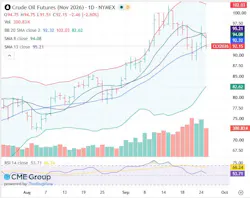
November WTI NYMEX futures entered the prompt month spot this week but at less than October’s close. The technical move lower that started last week continued into this week as well. Prices have retreated to below their 8- and 13-day Moving Averages but right at the 20-day MA. Volume is about the recent average at 300,000. The Relative Strength Indicator (RSI), a momentum indicator, is back into neutral territory at 53. Resistance is now pegged at $95.20 (8-day MA) while near-term Support is $91.50 (Friday’s Low).
Looking ahead
Unfortunately, diplomatic signals in the Iran war are as mixed as ever. Iran very recently declared they would not open the Strait of Hormuz until both US President Trump and Israeli Prime Minister Netanyahu were out of office. Then, we hear rumors of a willingness to negotiate some type of settlement over the strait. Markets will have to see if the proposed Oman summit does take place next week. Next, will France’s pledge to help Saudi Arabia defend the port city of Yanbu guarantee oil exports there? And will some type of regional coalition work against the Houthis and take back control of the Bab El-Mandeb Strait? Diesel ban or no diesel ban?
As we move towards fall weather, sustained high diesel prices will translate into high heating oil prices which will impact the US from Washington DC to Boston. Homeowners and business interests may join the farmers pushing for a ban.
Natural gas, fundamental analysis
October NYMEX Henry Hub Natural Gas futures moved higher this week on pockets of extended summer heat, and a much lower-than-average storage injection which is reducing the surplus to the 5-year average. A reported natural gas pipeline outage also spooked the market for a day. The week’s High was Thursday’s $3.32/MMbtu while the Low was Monday’s $2.82.
Natural gas demand this week has been estimated at about 98 bcfd with a large drop in power generation while supply was thought to be 109 bcfd. LNG exports were 18.5 bcf while exports to Mexico were 7.7 bcfd. In the UK, natural gas prices at the NBP were most recently a little lower at $24.25/MMbtu. Dutch TTF futures were also lower at $25.10/MMbtu. Asia’s JKM was quoted at $25.75/MMbtu as Asian and European markets are essentially competing for the same shipments.
The EIA’s Weekly Natural Gas Storage Report indicated an injection of 53 bcf vs. a forecast of +53 and a 5-year average of +95 bcf. Total gas in storage is now 3.351 tcf, 4.2% below last year and 2.9% above the 5-year average.
Natural gas, technical analysis
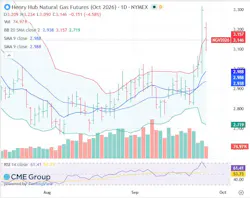
October 2026 NYMEX Henry Hub Natural Gas futures shot past the Upper-Bollinger Band this week but has retreated somewhat since. Price well-above the 8-, 13, and 20-day Moving Averages, signaling a reversal in the making. Volume is below the recent average at 75,000 as traders turn their attention to November with October expiring on Monday. The RSI is oversold at 61. Support is $3.00 with Resistance at $3.16 (Upper-Bollinger Band).
Looking ahead
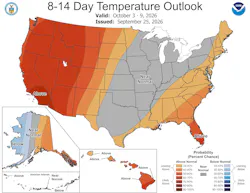
Fall is here and temperatures will moderate into October. There is some heat out West in the 8-to-14-day forecast along with Florida. Space heating with natural gas or heating oil is not seen in the near-term. While natural gas storage volumes are above the 5-year average, weekly injections are falling below that average. With 5 weeks to go in the official storage injection season, 130 bcf per week would have to be stored to hit 4.0 tcf by Nov. 1.
About the Author
 Tom Seng
Tom Seng
Dr. Tom Seng is an Assistant Professor of Professional Practice in Energy at the Ralph Lowe Energy Institute, Neeley School of Business, Texas Christian University, in Fort Worth, Tex.