Bilateral hostilities raise oil prices

Oil, fundamental analysis
Renewed US attacks on Iran, who then countered with attacks on its neighboring petrostates, rallied crude prices this week to mid-June levels. A larger-than-expected commercial inventory draw added momentum to the rally as did further declines in the Strategic Petroleum Reserve (SPR). A new deal for oil reserves in Venezuela was meant to provide some bearish sentiment, but traders largely ignored its impact on near-term supplies. WTI’s High was Thursday’s $93.15/bbl for October while the Low was Monday’s $84.10. October Brent crude also hit its High on Thursday at $97.60/bbl with the low on Monday at $89.05. Both grades settled much higher on the week. The WTI/Brent spread has now tightened to $4.60.
The US hit several Iranian targets early this week including rocket launchers on Larak Island. Iran hit two oil tankers attempting passage through the Strait of Hormuz nearer Oman. They also attacked US military bases in Jordan as well as the US-allied neighboring countries of Kuwait, Bahrain, Iraq, and the UAE. Meanwhile, reports of actual flowing shipments of oil through the Strait of Hormuz continue to be conflicting. The US government stated that as much as 18 million b/d has been sneaking through with the Navy escorts while actual tanker-tracker companies have confirmed about 6-8 million b/d traversing the Strait.
The Trump administration announced a deal this week to acquire roughly 65 billion bbl of oil reserves in Venezuela. This proposal involves a joint venture with a private company to develop 17 different fields with the Department of Defense retaining a stake. First oil won’t appear for several years given the current state of Venezuela’s oil infrastructure. Some members of Congress are saying that the use of a special Defense Department provision for weapons and munitions being used is illegal.
Meanwhile, Chevron has pledged to invest $7 billion in Venezuela to double its current production.
Pres. Trump also met with major US refiners encouraging them to lower prices and build new refining capacity. The former is really market-driven while the latter would take years and not impact gasoline and diesel prices in the near term. Refiners will also have to be confident that gasoline and diesel demand will be sufficient for decades to come in order to justify the major investments. Additionally, both Exxon and ConocoPhillips may lay claim to any oil produced as each is owed billions of dollars due to Venezuela’s past nationalization of their respective assets.
The SPR continues to be drawn-down as part of the call by the International Energy Agency (IEA) for member countries to utilize their strategic reserves to help offset volumes disrupted coming out of the Persian Gulf. The US pledged 172 million bbl and has 39 million bbl yet to deliver. This would put the SPR at below the 250 million bbl operators state is necessary for optimal withdrawals.
The Energy Information Administration’s (EIA) Weekly Petroleum Status Report indicated that commercial crude oil inventories for last week decreased while production held at 13.8 million b/d vs. 13.4 last year. The SPR was -3.1 million bbl to 286.6 million bbl (the lowest level since 1982). The US has 39 million bbl remaining of its 172 million bbl pledge to the IEA.
The private sector added 127,000 jobs last month while the government added 35,000. The total was double the forecast. August unemployment stood at 4.1% matching expectations. Analysts believe the increase in jobs will only provide more incentive for the Fed to raise interest rates since there were concerns about the impact on new jobs such a move would have. Factory orders for July were 0.9%, higher than expected after 2 months of declines. The Dow is lower week-on-week while both the NASDAQ and S&P are higher. The USD is higher, which may be keeping a cap on oil prices. After hitting near-term highs last week, gold is lower this week.
Oil, technical analysis
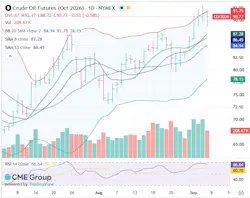
October WTI NYMEX futures shot past the Upper-Bollinger Band limit this week and well into overbought territory on the war-related rally. Prices are above the 8-, 13-, and 20-day Moving Averages. Volume is below the recent average at 200,000. The Relative Strength Indicator (RSI), a momentum indicator, is very overbought at 67. Resistance is now pegged at $91.80 (Upper-Bollinger Band) while near-term Support is $88.70 (Friday’s Low).
Looking ahead
We do know that oil is moving through the Strait of Hormuz but there’s disagreement on how much. There’s been little mention of any peace talks this week, and it may take that to bring prices down. US refineries have been running at very high rates this summer and peaked last week at 98%. Traditionally, the period from Mid-September through Mid-November is used for maintenance and switching to the winter blends of gasoline. Given the record high prices for diesel and crack spreads, it will be interesting to see how much actual downtime takes place. The very same high-pressure front bringing record heat to much of the country is also serving to quash tropical storms in the Atlantic Ocean. The shearing effect is keeping tropical systems from both further development and is steering them away from the US September is normally the most active months for hurricane formation
Natural gas, fundamental analysis
October NYMEX Henry Hub Natural Gas futures saw gains this week on continuing hot weather and a smaller-than-forecasted storage injection provided most of the support. The week’s High was Thursday’s $3.03/MMbtu while the Low was Monday’s $2.83. Natural gas demand this week has been estimated at about 115 bcfd with power consumption decreasing 2.3 bcfd while supply was thought to be 120 bcfd. LNG exports were 18.2 bcf while exports to Mexico were 7.6 bcfd. Europe’s natural gas storage, at 66%, is at the lowest level for this time of year in almost 20 years. Buyers were reluctant to pay the war-induced high prices all summer but must now scurry to find supply at whatever cost. And Persian Gulf LNG has yet to return to pre-war levels. In the UK, natural gas prices at the NBP were most recently higher at $22.10/MMbtu. Dutch TTF futures were also much higher at $24.50/MMbtu. Asia’s JKM was quoted at $24.10/MMbtu as Asian and European markets are essentially competing for the same shipments.
The EIA’s Weekly Natural Gas Storage Report indicated an injection of 30 bcf vs. a forecast of +31 and a 5-year average of +37 bcf. Total gas in storage is now 3.214 tcf, now at 1.5% below last year and 5.2% above the 5-year average.
Natural gas, technical analysis
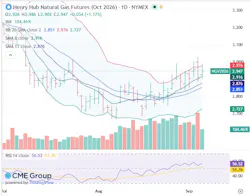
October 2026 NYMEX Henry Hub Natural Gas futures are trading above the 8-, 13-, and 20-day Moving Averages. Volume is below the recent average at 105k. The RSI is neutral at 57. Support is $2.90 with Resistance at $3.00.
Looking ahead
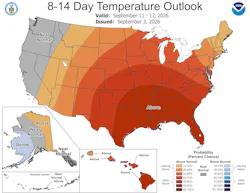
The 8–14-day forecast looks favorable for natural gas-fired generation for most of the US as record high temperatures remain post-Labor Day. Look for weekly stored volumes to start to increase each week leading up to Nov. 1. LNG exports should remain strong given the storage situation in the UK and the EU. Cheniere LNG has completed Stage 3 expansion at its Corpus Christi facility and now has 7 trains totaling 10 metric tones/year.
About the Author
 Tom Seng
Tom Seng
Dr. Tom Seng is an Assistant Professor of Professional Practice in Energy at the Ralph Lowe Energy Institute, Neeley School of Business, Texas Christian University, in Fort Worth, Tex.