Crude falls on possible Hormuz arrangement
Oil, fundamental analysis
Crude prices are lower this week overall as US-Iran talks muddle along and as a surprise US inventory gain was reported. Also, Iran and Oman are reported to be working on an administrative deal for the future operation of the Strait of Hormuz. WTI’s High was Tuesday’s $82.33/bbl for September while the Low was Wednesday’s $74.25. October Brent crude hit its High also on Tuesday at $86.35/bbl with the low on Wednesday at $78.10.
Both grades settled lower on the week. WTI is about $7.00 down over the last 2 weeks. The WTI/Brent spread has now widened to $5.30.
US-Iran relationships remain strained leading to pessimism regarding a long-term peace deal. While President Trump claims a deal is at hand, Iran continues to attack some of its neighboring petrostates and has told Persian Gulf countries to demand that the US halt its hostilities towards Iran or these will continue. Talks regarding the future operations of the Strait of Hormuz are being conducted between Iran and Oman and indicate a possible 'administrative' fee of up to 7% of the value of the cargo. Presently, Iran’s proposal would block US and Israeli-flagged ships from passage. Transits through the Strait of Hormuz were at their lowest levels this week since June as there have been attacks by Iran on both crude tankers and cargo ships as only 33 vessels made passage vs. 55 last week. Tanker-tracker, Kpler identified 6 crude tankers making the journey this week.
Due to concerns regarding passage through the Strait of Hormuz and now, Bab al-Mandeb, Saudi Arabia is considering a new route for crude exports which would utilize the Red Sea, the Mediterranean Sea and passage around the Cape of Good Hope in Africa. This could add as much as $5.00/bbl to the cost of crude delivered to Asia.
Despite its East-West pipeline which can deliver oil to the Red Sea, tankers there have to pass south through the Bab al-Mandeb Strait which Houthi rebels can block. And there is no guarantee that Hormuz will open permanently as well as the prospect of some sort of fee to be imposed.
Refined product shortages have also led to higher crude prices as Ukraine continues to hit refineries in Russia, a key exporter of diesel and gasoline. Global inventories are also shrinking. In the US, refiners are realizing historically high 'crack' margins while pump prices remain elevated above the $4.00/gal. level. The US will extend the Jones Act waivers which have helped with the shipping of refined products.
The Energy Information Administration’s (EIA) Weekly Petroleum Status Report indicated that commercial crude oil inventories for last week increased while production remained at 13.8 million b/d vs. 13.3 last year. The Strategic Petroleum Reserve was down 2.8 million bbl to 305 million bbl.
Venezuela averaged 1.0+ million b/d in June while estimates to restore production to historical levels will take 10 years and $100 billion. Meanwhile, Chevron plans to increase its output there by up to 50% by 2028 through reinvestment of cash flows from operations. And OPEC+ members agreed to a final output increase of 188,000 b/d for September, which would totally unwind the 1.65 million b/d cuts announced in 2023.
The labor market lost 23,000 jobs last month vs. a forecast of an increase of 83,000. Additionally, revisions to both May and June payroll numbers represented a further loss of 103,000 for that 6-day period. Unemployment dipped to 4.1% from 4.2% as more people dropped out of the job market. The private sector did add 30,000 jobs while the federal government shed 53,000.
The Federal Reserve must now weigh current inflation vs. a need for job creation in its interest rate policy. Wholesale inventories for June rose 0.2% vs. a forecasted +0.3% while sales fell 3.0%. The Dow set a new record high on Wednesday, slipped back Friday, but still settled higher on the week.
Meanwhile, the S&P reached a new high on Friday, and the NASDAQ was higher week-on-week but lower than its record high from May. The USD has fallen throughout the week and may have provided some support for oil prices late week. Gold saw a resurgence this week and is now at mid-June levels.
Oil, technical analysis
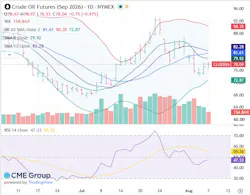
September WTI NYMEX futures are trading below the 8-, 13- and 20-day Moving Averages. Volume is below the recent average at 155,000. The Relative Strength Indicator (RSI), a momentum indicator is neutral at 47. Resistance is now pegged at $79.90 (8-day MA) while near-term Support is $74.25 (Wednesday’s Low).
Looking ahead
The broken record continues as there is still no clarity on a US-Iran peace accord while Iran and Oman discuss the future of the Strait of Hormuz. Israel continues to attack Hezbollah positions in southern Lebanon which Iran has stated must cease before they will agree to any settlement. The first greenfield oil refinery to be built in the US since 1976 was announced this week. The 168,000 b/d complex will be in Brownsville, Tex., and will be designed to process the lighter shale oil which comprises upwards of 70% of US domestic production. With each passing day this month, we do move closer to the end of the peak summer travel season on Labor Day Weekend. However, refined product prices should remain elevated until then.
Natural gas, fundamental analysis
Despite warmer weather, September NYMEX Henry Hub Natural Gas futures traded lower this week on a larger-than-forecasted storage injection as a supply surplus hangs over the market and September normally brings cooler temperatures. The week’s High was Monday’s $2.80/MMbtu while the Low was Friday’s $2.62. The Henry Hub contract has now been on a 4-week downtrend.
Natural gas demand this week has been estimated at about 108 bcfd with power consumption below expectations while supply was thought to be 113 bcfd. LNG exports have topped-out at 18.1 bcf while exports to Mexico were 8.4 bcfd. In the UK, natural gas prices at the NBP were most recently higher at $18.20/MMbtu. Dutch TTF futures were also higher at $18.90/MMbtu. Asia’s JKM was quoted at $21.15/MMbtu as Asian and European markets are essentially competing for the same shipments.
The EIA’s Weekly Natural Gas Storage Report indicated an injection of 33 bcf vs. a forecast of +31 and a 5-year average of +23 bcf. Total gas in storage is now 3.117 tcf, now 0.4% below last year and 6.7% above the 5-year average.
Natural gas, technical analysis
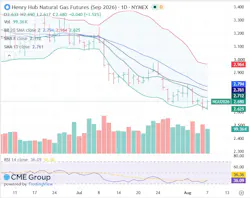
September 2026 NYMEX Henry Hub Natural Gas futures are trading below the 8-, 13- & 20-day Moving Averages and have breached the Lower-Bollinger Band limit. Volume is about the recent average at 105,000. The RSI is oversold at 35. Critical Support is $2.60 (Lower Bollinger Band) with Resistance at $2.70 (8-day MA).
Looking ahead
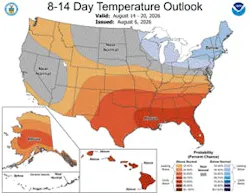
The 8–14-day forecast looks favorable for natural gas-fired generation along the southern tier but below-normal temperatures are predicted for the Northeast. While global LNG prices are strong, the US is currently exporting at maximum output. Look for supply surpluses to continue.
About the Author

Tom Seng
Dr. Tom Seng is an Assistant Professor of Professional Practice in Energy at the Ralph Lowe Energy Institute, Neeley School of Business, Texas Christian University, in Fort Worth, Tex.