M&A wave lifts OGJ50 assets, output; lower prices squeeze 2025 earnings
In 2025, the 50 largest US oil and gas companies by assets posted robust growth in total assets, stockholders' equity, and capital spending, powered by a fresh wave of consolidation led by Chevron Corp.'s completed acquisition of Hess Corp. Net income fell by roughly 12%, however, as Brent crude oil prices dropped to their lowest annual average since 2020.
Even as earnings narrowed, the group posted broad, strong gains in liquids and natural gas production and reserves, both in the US and worldwide, reflecting full-year contributions from recent mega-mergers, record output at the supermajors, and a double-digit increase in capital and exploration spending.
The OGJ150 report has long served as a comprehensive benchmark for evaluating the performance of the largest US-based oil and gas companies. Initially covering 150 companies, this report provided valuable insights into the financial, production, and reserves metrics of a broad spectrum of firms. However, over the years, the US oil and gas sector has experienced substantial transformations due to mergers and acquisitions (M&A), leading to consolidation of the companies.
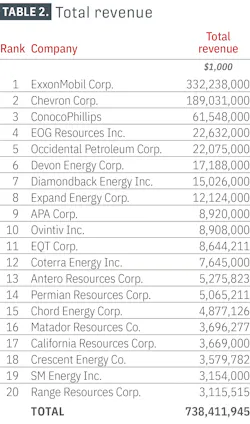
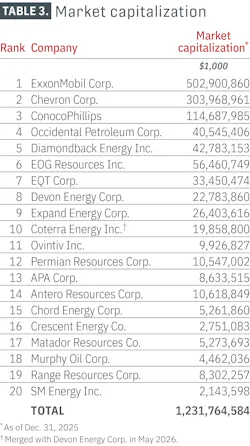
In response to this dramatic reduction in the number of oil and gas companies, the OGJ150 report has evolved into the current OGJ50 report. This change reflects the new reality of the industry, where the top 50 companies dominate the landscape in terms of assets and market influence. The OGJ50 report continues to provide critical insights into the industry's metrics but with a sharper focus on the most significant firms that shape the market.
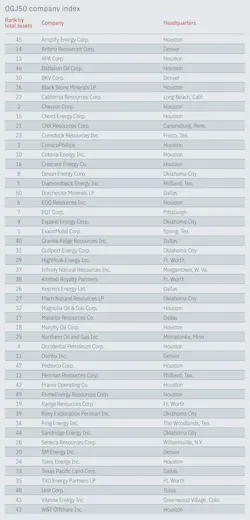
As before, to qualify for the OGJ50, oil and gas producers must be US-headquartered, publicly traded, and hold oil or gas reserves in the US. Companies that appear on the list are ranked by total yearend assets but are also ranked by revenues, earnings, capital expenditures, production, reserves, and US net wells drilled.
As usual, the data for this year's list reflects the operations of the previous year.
Market snapshot
In 2025, Brent crude oil averaged $69/bbl, down from $81/bbl in 2024 and the lowest annual average since 2020. Monthly average prices ranged from a high of $79/bbl in January to a low of $63/bbl in December, as global supplies outpaced demand for most of the year. Strong crude oil inventory builds in China absorbed part of the surplus and helped limit further price declines. Prices briefly spiked after Israel struck Iran on June 13, 2025, but the market quickly refocused on oversupply.
According to the December 2025 International Energy Agency (IEA) Oil Market Report, global oil demand grew by about 830,000 b/d in 2025, a relatively modest pace reflecting subdued economic activity and the continued impact of structural factors such as electric-vehicle adoption, particularly in China. Meanwhile, global oil supply increased by roughly 3 million b/d, driven by the restoration of OPEC+ production and continued output growth from non-OPEC+ producers led by the US, Brazil, Canada, Guyana, and Argentina. As supply outpaced demand, global oil inventories rose sharply through 2025, contributing to a significant market surplus.
TTF in Europe averaged around $12.06/MMbtu for the year, up from $11/MMbtu in 2024, as European buyers competed for LNG cargoes to rebuild storage drawn down during colder-than-normal 2024-2025 winter. In Asia, JKM tracked closely with TTF for much of the year, with narrow spreads between the two benchmarks as ample Atlantic Basin LNG supply, including new US export capacity, kept both markets well supplied; both benchmarks eased to their lowest levels in more than a year by December amid mild weather and abundant supply.
In North America, Henry Hub natural gas prices strengthened significantly in 2025, driven by rising LNG feedgas demand; the annual average price climbed to about $3.53/MMbtu, a 60% increase from the $2.21/MMbtu recorded in 2024. Prices briefly surged over $5/MMbtu during a winter cold snap.
Refining margins were soft through first-half 2025 amid ample product inventories and weak demand, but strengthened sharply in the second half. Ukrainian drone strikes on Russian refineries, new EU restrictions on products derived from Russian crude, and a round of unplanned outages and heavy maintenance pushed global refining margins to multiyear highs by November.
Group facts
ExxonMobil Corp. retained its position as the largest oil and gas company in the US, with assets reaching $449 billion as of year-end 2025. At the other end of the ranking, the smallest company on the list is Dorchester Minerals LP, with assets of about $310 million.
The list includes four limited partnerships (LPs): Mach Natural Resources LP, TXO Energy Partners LP, Black Stone Minerals LP, and Kimbell Royalty Partners. Royalty trusts remained below the OGJ50 asset threshold this year, continuing to leave passive royalty structures off the list. Two companies made their first appearance on the OGJ50 this year: Infinity Natural Resources Inc. and Prairie Operating Co. Three additional companies returned to the top 50 after falling below the threshold last year: Pedevco Corp., Unit Corp., and PrimeEnergy Resources Corp.
Only one subsidiary, Seneca Resources Corp., was large enough to make the list, with assets of about $3.7 billion. As in the prior survey, the OGJ50 includes no companies engaged exclusively in oil and gas production, reflecting the broader midstream, marketing, and royalty activities maintained by even upstream-focused independents.
The 2025 survey shows a somewhat wider gap between winners and losers than the year before: 30 companies reported net income over $100 million, while eight companies posted a net loss, three of which lost more than $100 million. Two companies reported negative stockholders' equity.
Group changes
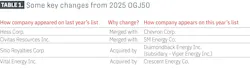
Consolidation continued to reshape the OGJ50 roster in 2025 and into early 2026, with four separate mergers altering the list of qualifying companies.
The year's largest transaction was Chevron's $53-billion all-stock acquisition of Hess Corp., which closed July 18, 2025, after Chevron prevailed in international arbitration over ExxonMobil and China National Offshore Oil Corp. (CNOOC), which had claimed a right of first refusal on Hess's 30% stake in the Stabroek block offshore Guyana. Hess's roughly $2.77 billion of 2024 net income made it the seventh most profitable OGJ50 company that year; its production and reserves now flow through Chevron's results.
Diamondback Energy Inc., through its publicly traded royalty subsidiary Viper Energy Inc., closed its $4.1-billion all-equity acquisition of Sitio Royalties Corp. on Aug. 19, 2025, consolidating two of the Permian basin's largest mineral and royalty aggregators.
Meantime, Crescent Energy Co. closed its $3.1-billion all-stock acquisition of Vital Energy Inc. on Dec. 15, 2025, creating a larger, liquids-weighted independent with an expanded Permian and Eagle Ford footprint. Civitas Resources Inc. agreed to merge with SM Energy Co. in an all-stock merger creating a company with an enterprise value of about $12.8 billion, announced Nov. 3, 2025; the deal closed Jan. 30, 2026, just after this survey's 2025 data year, so Civitas no longer appears as a standalone company on this year's list.
One company, LandBridge Co. LLC, dropped off the survey after Oil & Gas Journal confirmed with the company's investor-relations office that it is no longer required to report oil and gas reserves, since they now account for less than 10% of total revenue.
Taken together, these transactions continue a multiyear trend of scale-driven consolidation, as fewer, larger companies account for a growing share of OGJ50 assets, production, and reserves.
2025 vs. 2024
The top 50 companies' combined total assets grew to $1.44 trillion in 2025 from $1.35 trillion in 2024, an increase of 6.5%. Total revenue was little changed, slipping to $763.7 billion from $767.7 billion, a decline of 0.5%.
Net income fell more sharply, dropping to $74.8 billion in 2025 from $85.0 billion in 2024, a decrease of 12.0%, as lower crude oil prices for much of the year outweighed higher production volumes. Stockholders' equity nonetheless rose to $813.8 billion from $759.4 billion, up 7.2%, while capital and exploration expenditures increased to $112.9 billion from $102.0 billion, a gain of 10.6%.
The growth in assets and equity, even as revenue and net income declined, continues a multiyear pattern of heavy consolidation and M&A activity among OGJ50 companies—a trend that carried through 2025 with deals such as Chevron's acquisition of Hess.
Operationally, the group posted broad double-digit gains. These significant production and reserve gains likewise reflect the year's consolidation wave as much as organic drilling results.
Worldwide liquids production rose to 4.56 billion bbl in 2025 from 4.07 billion bbl in 2024, an increase of 11.9%. Worldwide natural gas production climbed to 21.19 tcf from 18.43 tcf, up 15.0%. Worldwide liquids reserves grew to 44.91 billion bbl from 43.39 billion bbl, a 3.5% increase, while worldwide natural gas reserves rose to 234.81 tcf from 206.95 tcf, up 13.5%.
Domestically, US liquids production increased to 3.51 billion bbl in 2025 from 3.01 billion bbl in 2024, a gain of 16.9%. US natural gas production rose to 17.08 tcf from 14.38 tcf, up 18.8%. US liquids reserves grew to 32.52 billion bbl from 30.96 billion bbl, an increase of 5.1%, and US natural gas reserves climbed to 195.09 tcf from 168.42 tcf, up 15.8%.
Drilling activity accelerated along with the higher capital budgets. US net wells drilled rose to 6,441.2 in 2025 from 5,461.0 in 2024, an increase of 18%.
Earnings leaders
The 2025 OGJ50 net income rankings show broadly lower profitability across the group, in line with the year's weaker crude prices, even as consolidation reshuffled the leaderboard.
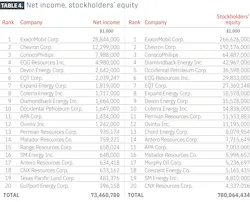
ExxonMobil retained its position as the most profitable US oil and gas company, reporting net income of $28.84 billion for 2025, down 14.4% from $33.68 billion in 2024. The decline reflected weaker crude realizations, lower base volumes from divestments, and higher depreciation, partly offset by record production of 4.7 MMboe/d—the company's highest in more than 40 years—thanks to advantaged growth in the Permian basin and Guyana, including the early startup of the Yellowtail development.
Chevron retained its second-place position with net income of $12.30 billion, down 30.4% from $17.66 billion in 2024, as the July 18 close of its Hess acquisition brought transaction and integration costs alongside lower crude realizations. Chevron's worldwide production stands to benefit going forward from Hess's Stabroek block interest and Bakken shale position.
ConocoPhillips remained in third place with net income of $7.99 billion, down 13.2% from $9.2 billion in 2024. The company delivered record full-year production of 2.37 MMboe/d, up 388,000 boe/d year on year, aided by a full year of Marathon Oil volumes and more than $1 billion of realized acquisition synergies, but lower realized prices outweighed the higher volumes.
EOG Resources Inc. held fourth place with net income of $4.98 billion, down 22.2% from $6.40 billion in 2024. Lower commodity prices ate into earnings, even though production hit a record 1.23 MMboe/d, up 16% from the year before. That growth came largely from EOG's $5.6-billion purchase of Encino Acquisition Partners, which closed Aug. 1 and gave the company a strong new position in the Utica play alongside its existing Delaware basin and Eagle Ford assets.
Devon Energy Corp. followed in fifth with net income of $2.64 billion, down 8.6% from $2.89 billion in 2024. Here too, lower prices outweighed record production of roughly 840,000 boe/d.
EQT Corp. posted the sharpest swing among the top earners, climbing to sixth place with net income of $2.04 billion, up 784% from just $231 million in 2024. The turnaround was driven predominantly by higher sales of natural gas, higher realized natural gas prices, along with increased equity earnings from the Mountain Valley Pipeline joint venture and lower transaction costs.
Expand Energy Corp., the natural gas producer formed from the 2024 merger of Chesapeake Energy and Southwestern Energy, ranked seventh with net income of $1.82 billion, while Coterra Energy Inc. was eighth with $1.72 billion, up 53.2% from $1.12 billion in 2024 on the back of firmer natural gas prices.
Diamondback Energy Inc. rounded out the top nine with $1.66 billion, supported by Permian basin development and continued expansion of its minerals position through Viper Energy. Occidental Petroleum Corp. was tenth with $1.65 billion, down 30.8% from $2.38 billion in 2024, as lower crude prices weighed on earnings despite continued Permian and Rockies development.
Further down the ranking, natural-gas-focused independents CNX Resources Corp. and Gulfport Energy Corp. returned to the top 20, alongside Range Resources Corp., whose net income rose 147.1% to $658 million, and Antero Resources Corp., whose net income rose more than tenfold to $634 million—all benefiting from the firmer gas-price environment.
Hess Corp., the seventh-most-profitable OGJ50 company in 2024 with $2.77 billion in net income, is the most notable company absent from the 2025 top 50, having been absorbed into Chevron's results following the merger's close.
Leaders in capital spending, drilling
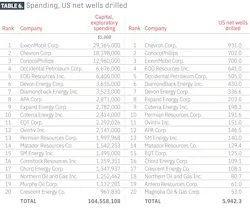
In the OGJ50 survey, capital, exploratory spending figures combine companies' capital expenditures with exploration expenses where a company discloses the latter separately.
ExxonMobil retained its position as the top spender, allocating $29.37 billion in 2025, up from $27.6 billion in 2024. Chevron held second place, increasing spending to $18.40 billion from $16.4 billion, reflecting a full slate of legacy Chevron projects alongside its newly acquired Hess assets. ConocoPhillips remained third, raising spending to $12.96 billion from $12.11 billion as it continued to integrate Marathon Oil's inventory. Occidental Petroleum held fourth place, though its spending eased to $6.68 billion from $7.0 billion, while EOG Resources was fifth with $6.40 billion.
Drilling activity showed more pronounced shifts, tracking the year's wave of consolidation. Chevron moved up to first place in US net wells drilled, with 931 wells in 2025, up from 633 in 2024, as Hess's Bakken shale program added to Chevron's activity following the merger's close. ConocoPhillips climbed to second place with 702 wells, up from 559, reflecting a full year of Marathon Oil's Eagle Ford, Bakken, and Permian basin drilling program. ExxonMobil rose to third place with 700 wells, up from 545, continuing its Permian basin expansion.
EOG Resources, which led the sector in 2024 with 641 net wells drilled, fell to fourth place in 2025 with an unchanged well count of 641. Occidental Petroleum rounded out the top five with 505 wells, up from 412 wells a year ago.
Leaders in liquids reserves, production
ConocoPhillips retained the top position in US liquids reserves in 2025, with 3.97 billion bbl, essentially unchanged from the 3.99 billion bbl it reported in 2024, as a full year of Marathon Oil's reserve base offset normal production depletion. EOG Resources climbed to second place with 3.41 billion bbl, up from 3.23 billion bbl in 2024, while Chevron rebounded sharply to third place with 3.26 billion bbl, up 15.2% from 2.83 billion bbl in 2024, aided by the addition of Hess's Bakken-linked reserve base following the July merger close.
ExxonMobil fell to fourth place with 3.11 billion bbl, down from 3.27 billion bbl in 2024, as strong Permian production outpaced new bookings. Occidental Petroleum held fifth place with 2.81 billion bbl, and Diamondback Energy was sixth with 2.74 billion bbl, roughly flat with the 2.72 billion bbl it reported in 2024 following its Endeavor Energy and Viper Tumbleweed acquisitions the prior year.
Globally, ExxonMobil maintained its commanding lead in worldwide liquids reserves with 12.30 billion bbl, as continued reserve additions in Guyana and the US, including roughly 2.0 billion bbl of new extensions and discoveries in 2025, helped offset production-driven depletion elsewhere. Chevron held second place with 4.88 billion bbl, reflecting the newly consolidated Hess Guyana interest, while ConocoPhillips ranked third with 4.49 billion bbl.
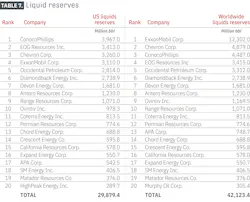
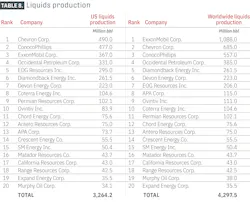
On the production side, Chevron led US liquids output with 490 million bbl in 2025, followed by ConocoPhillips with 477 million bbl and ExxonMobil with 367 million bbl. Worldwide, ExxonMobil remained the clear leader with 1.09 billion bbl of liquids production, followed by Chevron with 685 million bbl and ConocoPhillips with 557 million bbl.
Leaders in natural gas reserves, production
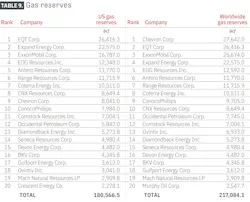
EQT Corp. retained its position as the largest holder of US natural gas reserves, with 26.42 tcf in 2025, up from 24.55 tcf in 2024, supported by continued Marcellus and Utica shale development and a firmer gas-price environment that made additional reserves economic to book. Expand Energy held second place with 22.58 tcf, up from 16.92 tcf in its debut year, reflecting a full year of combined Chesapeake-Southwestern operations. ExxonMobil advanced to third place with 16.79 tcf, roughly unchanged from 16.84 tcf in 2024, continuing its Haynesville and Permian shale-gas push.
EOG Resources and Antero Resources rounded out the top five with 12.35 tcf and 11.77 tcf, respectively, while Range Resources, Coterra Energy, and CNX Resources held steady in the Appalachian mid-tier.
Globally, Chevron took over the top spot in worldwide gas reserves with 27.64 tcf, aided by the addition of Hess's international gas interests, edging out EQT Corp.'s 26.42 tcf. ExxonMobil ranked third worldwide with 25.67 tcf, supported by its LNG-linked growth in Mozambique and the US.
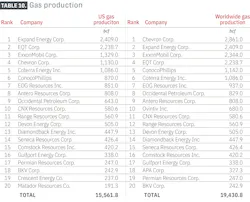
On production, Expand Energy led US natural gas output with 2.41 tcf in 2025, followed closely by EQT Corp. with 2.24 tcf, as the Appalachian basin's two largest producers continued to benefit from firmer gas prices and rising LNG feedgas demand. ExxonMobil ranked third with 1.33 tcf, and Chevron fourth with 1.13 tcf. Worldwide, Chevron led all producers with 2.86 tcf, followed by Expand Energy with 2.41 tcf and ExxonMobil with 2.34 tcf.
Fast-growing companies
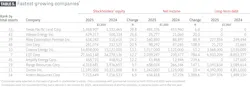
The OGJ50 ranking of fastest-growing companies is based on growth in stockholders' equity. To qualify, companies must have reported positive net income in both 2024 and 2025 with no decline in net income during 2025; subsidiaries, limited partnerships, and newly public companies are excluded.
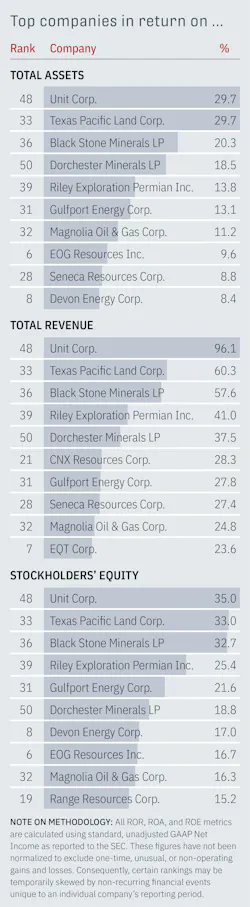
Texas Pacific Land Corp. led the list, growing stockholders' equity 28.8% to $1.46 billion, alongside a 6.0% increase in net income to $481 million; the company carries no long-term debt, consistent with growth funded through internally generated cash flow.
Vitesse Energy Inc. followed with 25.8% equity growth to $629 million, on the back of a 20% rise in net income to $25.3 million; like Texas Pacific Land, Vitesse carries no long-term debt on its balance sheet.
Unit Corp. grew equity 20.9% to $281 million on a 108% increase in net income to $98.3 million, with long-term debt little changed at $21.2 million, pointing to organically funded growth.
Coterra Energy grew stockholders' equity 13.1% to $14.84 billion, with net income up 53.2% to $1.72 billion; long-term debt held roughly steady near $3.57 billion, indicating the gains were primarily organic rather than leveraged.
EQT Corp. posted equity growth of 12.7% to $27.36 billion, alongside the outsized net income increase; notably, long-term debt fell to $6.93 billion from $8.85 billion.
Riley Exploration Permian Inc. also achieved strong net income growth within this group of fastest-growing companies: its earnings surged 81% to $160.8 million, driving a 24.2% increase in equity to $634 million, while long-term debt fell from $249.5 million to $227.9 million.
About the Author
 Conglin Xu
Conglin Xu
Managing Editor-Economics
Conglin Xu, Managing Editor-Economics, covers worldwide oil and gas market developments and macroeconomic factors, conducts analytical economic and financial research, generates estimates and forecasts, and compiles production and reserves statistics for Oil & Gas Journal. She joined OGJ in 2012 as Senior Economics Editor.
Xu holds a PhD in International Economics from the University of California at Santa Cruz. She was a Short-term Consultant at the World Bank and Summer Intern at the International Monetary Fund.
 Laura Bell-Hammer
Laura Bell-Hammer
Statistics Editor
Laura Bell-Hammer is the Statistics Editor for Oil & Gas Journal, where she has led the publication’s global data coverage and analytical reporting for more than three decades. She previously served as OGJ’s Survey Editor and had contributed to Oil & Gas Financial Journal before publication ceased in 2017. Before joining OGJ, she developed her industry foundation at Vintage Petroleum in Tulsa. Laura is a graduate of Oklahoma State University with a Bachelor of Science in Business Administration.